Camptothecin
Camptothecin (CPT) is a cytotoxic quinoline alkaloid of the monoterpene indole class, first isolated from the bark and wood of Camptotheca acuminata, a tree native to southern China.
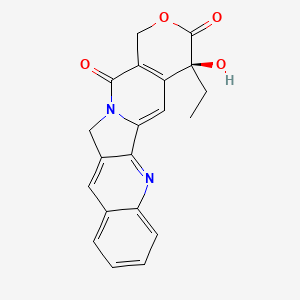
Camptothecin (CPT) is a cytotoxic quinoline alkaloid of the monoterpene indole class, first isolated from the bark and wood of Camptotheca acuminata, a tree native to southern China. It acts on topoisomerase I (Top1), the enzyme that relieves torsional stress by transiently cleaving one DNA strand and allowing the broken strand to rotate around the intact strand before resealing it. Camptothecin binds at the interface of the transient Top1–DNA cleavage complex and blocks the resealing step, so the enzyme remains covalently trapped on nicked DNA. The trapped complex is itself reversible and drug removal releases it; the lethal event comes when an advancing replication fork or transcription complex collides with it, converting a repairable nick into a double-strand break. That requirement makes the drug S-phase specific, and makes exposure duration matter more than peak concentration.
Its chemistry is the practical constraint. The E-ring α-hydroxylactone required for activity hydrolyzes at physiological pH to an inactive carboxylate, an equilibrium that human serum albumin pushes further toward the open form, so the parent compound loses potency in plasma while remaining poorly soluble and toxic. Semisynthetic derivatives address this: irinotecan hydrochloride is a prodrug converted by carboxylesterases to the far more potent SN-38, whose clearance depends on UGT1A1-mediated glucuronidation and whose toxicity therefore tracks UGT1A1 genotype; topotecan is used directly; and exatecan remains investigational as a free drug.
Precise delivery has given the scaffold a second life. Camptothecin analogs are potent at picomolar concentrations, which is what an antibody-drug conjugate needs from a payload, and the most successful current conjugates carry either SN-38 or an exatecan derivative on a cleavable linker — an arrangement that concentrates the drug at the tumor and exploits its membrane permeability to kill neighboring antigen-negative cells. Prodrug design, linker chemistry, and nanoparticle formulation continue to be pursued for the same reason: the molecule kills reliably, and nearly every difficulty with it concerns getting an intact lactone to the right place.
Where the papers sit
15 papers from the last 6 months study camptothecin directly · updated from PubMed 12 Oct 2026
Study type 0 clinical trials · 15 preclinical
Themes one subject · 1 new direction
Those 15 are all about one subject.
-
Targeted Camptothecin Delivery
Controlled-release nanomedicines and prodrugs are moving camptothecin toward tumor-selective, externally or biomarker-activated therapy. pH, ROS, redox, HOCl and enzyme triggers recur alongside light-controlled release and fluorescence or chemiluminescence reporting. Combination designs pair camptothecin with cabazitaxel, niraparib, sonodynamic or photodynamic therapy, and immunotherapy, aiming to improve efficacy and overcome resistance. ADC linker-payloads and improved biosynthesis broaden the path from drug production to precise delivery.
Camptothecin is treated as a biosynthetic production target rather than a therapeutic payload
The Camptotheca acuminata biosynthesis study examines camptothecin production in transgenic plants 42138768May. Whereas the other camptothecin papers use it as a cytotoxic agent to be released, delivered, or compared with, this study treats camptothecin as a natural product whose supply can be increased by engineering metabolism: heterologous CrLAMT activated an alternative methylated-intermediate pathway, raising camptothecin content in leaves and hairy roots. The resulting direction is optimization of camptothecin biosynthesis and yield, not improvement of its pharmacological delivery or antitumor action.
Papers
The 15 papers from the last 6 months that study camptothecin directly, newest first, by theme and by study type. Study types come from PubMed publication types and MeSH headings.
By theme
Targeted Camptothecin Delivery (15)
- Sanger's Reagent-Mediated Prodrug for Light-Controlled Release of Camptothecin With Fluorescent Indication. Chembiochem : a European journal of chemical biology · 28 Aug 2026 PMID 42661320
- Cabazitaxel and camptothecin co-loaded in pH-sensitive transferrin-targeted, PEGylated cholesterol-based poly(amidoamine) dendrimers as a synergistic combination for prostate cancer. Biomedicine & pharmacotherapy = Biomedecine & pharmacotherapie · 22 Jul 2026 PMID 42486016
- Selenide-Bridged Redox-Responsive Nanoparticles: A Synergistic Strategy to Overcome p53 Mutation-Mediated Drug Resistance in Gastric Cancer. ACS nano · 21 Jul 2026 PMID 42478957
- A phospholipid Camptothecin-Niraparib conjugate self-assembled into supramolecular nanotubes for combination cancer therapy. Journal of controlled release : official journal of the Controlled Release Society · 15 Jul 2026 PMID 42456976
- Hyaluronic acid-modified nanoparticles for chemo/sonodynamic therapy: Maximizing antitumor efficacy through the induction of ferroptosis and apoptosis. International journal of biological macromolecules · 5 Jul 2026 PMID 42402299
- Tumor-targeted activatable molecular agent for synergistic chemo-photodynamic therapy. Bioorganic chemistry · 3 Jul 2026 PMID 42398394
- Rational design of active pharmaceutical ingredient-based co-assembled nanoparticles for cancer immunotherapy. Journal of controlled release : official journal of the Controlled Release Society · 21 Jun 2026 PMID 42324030
- Light-programmable, high-drug-loading nanomedicine based on dimeric camptothecin. Biomaterials science · 17 Jun 2026 PMID 42304791
- An HOCl-Activated Acyl Hydrazide Platform for Fluorescence-Guided Release of Hydroxyl-Containing Drugs. Analytical chemistry · 1 Jun 2026 PMID 42224648
- An HOCl-activated chemiluminescent prodrug enabling self-reporting camptothecin release and imaging-guided therapy in peritoneal metastasis. Bioorganic & medicinal chemistry · 29 May 2026 PMID 42214293
- A Tandem-Responsive and Multifunctional Dendritic Dot for Acid and γ-Glutamyl Transpeptidase-Activated Cancer Theranostics. Small (Weinheim an der Bergstrasse, Germany) · 17 May 2026 PMID 42143689
- Enhancing camptothecin biosynthesis in Camptotheca acuminata through CrLAMT transfer from Catharanthus roseus. Biotechnology letters · 15 May 2026 PMID 42138768
- γ-Glutamyl Transferase/Glutathione Cascade-Responsive Unimolecular Nanoprodrug for Precise Cancer Chemotherapy. Biomacromolecules · 2 May 2026 PMID 42068279
- Discovery of Novel N-Linked Camptothecin Linker-Payloads to Access Antibody-Drug Conjugates with High Target-Mediated In Vivo Efficacy. Journal of medicinal chemistry · 30 Apr 2026 PMID 42059187
- Multifunctional niosome-chitosan-gold nanohybrids for pH/ROS-triggered camptothecin release in breast cancer treatment. Bioorganic chemistry · 16 Apr 2026 PMID 41990535
By study type
Preclinical: animal, cell and lab studies (15)
- Sanger's Reagent-Mediated Prodrug for Light-Controlled Release of Camptothecin With Fluorescent Indication. Chembiochem : a European journal of chemical biology · 28 Aug 2026 PMID 42661320
- Cabazitaxel and camptothecin co-loaded in pH-sensitive transferrin-targeted, PEGylated cholesterol-based poly(amidoamine) dendrimers as a synergistic combination for prostate cancer. Biomedicine & pharmacotherapy = Biomedecine & pharmacotherapie · 22 Jul 2026 PMID 42486016
- Selenide-Bridged Redox-Responsive Nanoparticles: A Synergistic Strategy to Overcome p53 Mutation-Mediated Drug Resistance in Gastric Cancer. ACS nano · 21 Jul 2026 PMID 42478957
- A phospholipid Camptothecin-Niraparib conjugate self-assembled into supramolecular nanotubes for combination cancer therapy. Journal of controlled release : official journal of the Controlled Release Society · 15 Jul 2026 PMID 42456976
- Hyaluronic acid-modified nanoparticles for chemo/sonodynamic therapy: Maximizing antitumor efficacy through the induction of ferroptosis and apoptosis. International journal of biological macromolecules · 5 Jul 2026 PMID 42402299
- Tumor-targeted activatable molecular agent for synergistic chemo-photodynamic therapy. Bioorganic chemistry · 3 Jul 2026 PMID 42398394
- Rational design of active pharmaceutical ingredient-based co-assembled nanoparticles for cancer immunotherapy. Journal of controlled release : official journal of the Controlled Release Society · 21 Jun 2026 PMID 42324030
- Light-programmable, high-drug-loading nanomedicine based on dimeric camptothecin. Biomaterials science · 17 Jun 2026 PMID 42304791
- An HOCl-Activated Acyl Hydrazide Platform for Fluorescence-Guided Release of Hydroxyl-Containing Drugs. Analytical chemistry · 1 Jun 2026 PMID 42224648
- An HOCl-activated chemiluminescent prodrug enabling self-reporting camptothecin release and imaging-guided therapy in peritoneal metastasis. Bioorganic & medicinal chemistry · 29 May 2026 PMID 42214293
- A Tandem-Responsive and Multifunctional Dendritic Dot for Acid and γ-Glutamyl Transpeptidase-Activated Cancer Theranostics. Small (Weinheim an der Bergstrasse, Germany) · 17 May 2026 PMID 42143689
- Enhancing camptothecin biosynthesis in Camptotheca acuminata through CrLAMT transfer from Catharanthus roseus. Biotechnology letters · 15 May 2026 PMID 42138768
- γ-Glutamyl Transferase/Glutathione Cascade-Responsive Unimolecular Nanoprodrug for Precise Cancer Chemotherapy. Biomacromolecules · 2 May 2026 PMID 42068279
- Discovery of Novel N-Linked Camptothecin Linker-Payloads to Access Antibody-Drug Conjugates with High Target-Mediated In Vivo Efficacy. Journal of medicinal chemistry · 30 Apr 2026 PMID 42059187
- Multifunctional niosome-chitosan-gold nanohybrids for pH/ROS-triggered camptothecin release in breast cancer treatment. Bioorganic chemistry · 16 Apr 2026 PMID 41990535
Written from 15 PubMed abstracts, each one listed by PMID above. Published: 2026-06-15. Last written: 2026-08-30 by GPT. Corrections: 2026-09-26 by GPT. Drafted by language models from published abstracts; not medical advice.