Alectinib
Alectinib is a targeted anticancer therapy used primarily in Anaplastic Lymphoma Kinase (ALK)–positive non-small-cell lung cancer (NSCLC).
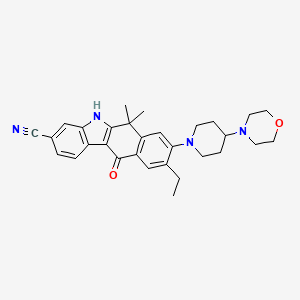
Alectinib is a targeted anticancer therapy used primarily in Anaplastic Lymphoma Kinase (ALK)–positive non-small-cell lung cancer (NSCLC). It is a second-generation ALK inhibitor designed to suppress oncogenic signaling driven by ALK rearrangements, a molecular subtype that defines a clinically important subset of lung cancers. By inhibiting ALK signaling, alectinib helps reduce tumor cell proliferation and disease progression in ALK-positive malignancies.
Clinically, alectinib has become an important treatment option in both advanced and resected early-stage ALK-positive NSCLC. Recent research continues to evaluate its comparative effectiveness, resistance mechanisms, toxicity profile, and potential interactions with immune and cellular pathways such as PD-1/PD-L1 signaling, cancer-associated fibroblasts, and autophagy-related processes.
Where the papers sit
10 papers from the last 6 months study alectinib directly · updated from PubMed 27 Sept 2026
Study type 3 clinical trials · 1 observational · 1 human data · 3 preclinical · 2 unclassified
Themes 3 themes · 1 new direction
-
ALK-Positive Lung Cancer Treatment
Treatment selection is moving toward next-generation ALK inhibitors that extend control after resistance to earlier TKIs. Lorlatinib and brigatinib recur in comparative, economic, and real-world assessments, while gilteritinib is investigated for resistance to second-generation therapy. Toxicity remains consequential, including reversible renal injury requiring dialysis and alectinib-associated hepatic and dermatologic injury. Dose adjustment and sequencing are emerging as ways to balance tumor control, resistance evolution, and treatment burden.
6 papers · 60%
-
Adjuvant ALK Lung Cancer Therapy
Adjuvant alectinib is being positioned as a postsurgical alternative to chemotherapy for resected ALK-positive non-small-cell lung cancer. The central endpoint is disease-free survival across early disease stages. Health-related quality of life and adverse effects, including pneumonitis, neutropenia, and appendicitis, shape the treatment decision. The remaining question is how durable benefit and tolerability compare with chemotherapy in routine practice.
2 papers · 20%
-
NSCLC Treatment Response Modeling
Alectinib efficacy is being related to tumor burden and body mass index rather than treated as uniform across patients. Pooled randomized-trial analyses use progression-free survival and RECIST response to examine these clinical differences. Evolutionary game-theoretic modeling addresses how treatment pressure may shape NSCLC dynamics and resistance. Together, the work supports more individualized prediction, but it does not yet establish a single model or decision rule.
2 papers · 20%
Alectinib is framed as a trigger of liver-to-skin toxicity mediated by systemic biotin depletion
The study of alectinib-induced hepatotoxicity and dermatotoxicity in ALK-positive non-small-cell lung cancer found that alectinib caused excessive autophagic degradation of hepatic biotinidase, producing systemic biotin deficiency that linked hepatocyte apoptosis to skin-barrier dysfunction; biotin supplementation mitigated both toxicities 42107012May. This gives alectinib a role beyond its established use as an antitumor ALK inhibitor or a source of clinically observed adverse events: it becomes the initiating agent in an inter-organ toxicity mechanism, with biotin supplementation proposed as a way to preserve treatment.
Papers
The 10 papers from the last 6 months that study alectinib directly, newest first, by theme and by study type. Study types come from PubMed publication types and MeSH headings.
By theme
ALK-Positive Lung Cancer Treatment (6)
- Severe, reversible alectinib-induced acute kidney injury requiring dialysis in an elderly patient with metastatic non-small cell lung cancer. BMJ case reports · 22 Sept 2026 PMID 42772921
- Varying Cancer Drug Doses to Balance Tumor Control and Resistance Evolution. Cancer research · 2 Sept 2026 PMID 42682083
- Real-World Clinical and Economic Consequences of Next-Generation Anaplastic Lymphoma Kinase-Positive (ALK +) Tyrosine Kinase Inhibitors (TKIs) in Patients with TKI-Naïve ALK + Metastatic Non-Small Cell Lung Cancer in the United States. Advances in therapy · 9 Jul 2026 PMID 42423952
- Liver-originated selective autophagy of BTD by alectinib underlies concurrent hepatotoxicity and Dermatotoxicity. Autophagy · 10 May 2026 PMID 42107012
- Gilteritinib overcomes second‑generation TKIs resistance in ALK‑rearranged non‑small‑cell lung cancer by inhibiting PD‑L1 and CD8 co‑expression. International journal of molecular medicine · 30 Apr 2026 PMID 42059267
- Cost-effectiveness analysis of lorlatinib as first-line treatment for anaplastic lymphoma kinase (ALK)-positive non-small cell lung cancer in Italy. Journal of medical economics · 27 Apr 2026 PMID 42043888
Adjuvant ALK Lung Cancer Therapy (2)
- Adjuvant alectinib versus chemotherapy in resected ALK-positive non-small-cell lung cancer (ALINA): health-related quality-of-life and safety outcomes from a randomised, open-label, phase 3 trial. The Lancet. Oncology · 24 Aug 2026 PMID 42636834
- Disease characteristics and treatment outcomes in patients with resected early-stage ALK-positive non-small cell lung cancer from the randomized ALINA trial. Lung cancer (Amsterdam, Netherlands) · 17 Apr 2026 PMID 41996761
NSCLC Treatment Response Modeling (2)
- Efficacy of alectinib for ALK-positive NSCLC according to tumor burden and body mass index: A pooled analysis of the randomized phase III trials ALEX and J-ALEX. European journal of cancer (Oxford, England : 1990) · 10 Jun 2026 PMID 42269244
- Which evolutionary game-theoretic model best captures NSCLC dynamics? PloS one · 1 Jun 2026 PMID 42224394
By study type
Clinical trials (3)
- Adjuvant alectinib versus chemotherapy in resected ALK-positive non-small-cell lung cancer (ALINA): health-related quality-of-life and safety outcomes from a randomised, open-label, phase 3 trial. The Lancet. Oncology · 24 Aug 2026 PMID 42636834
- Efficacy of alectinib for ALK-positive NSCLC according to tumor burden and body mass index: A pooled analysis of the randomized phase III trials ALEX and J-ALEX. European journal of cancer (Oxford, England : 1990) · 10 Jun 2026 PMID 42269244
- Disease characteristics and treatment outcomes in patients with resected early-stage ALK-positive non-small cell lung cancer from the randomized ALINA trial. Lung cancer (Amsterdam, Netherlands) · 17 Apr 2026 PMID 41996761
Observational studies and case reports (1)
- Severe, reversible alectinib-induced acute kidney injury requiring dialysis in an elderly patient with metastatic non-small cell lung cancer. BMJ case reports · 22 Sept 2026 PMID 42772921
Human data, design not indexed (1)
- Cost-effectiveness analysis of lorlatinib as first-line treatment for anaplastic lymphoma kinase (ALK)-positive non-small cell lung cancer in Italy. Journal of medical economics · 27 Apr 2026 PMID 42043888
Preclinical: animal, cell and lab studies (3)
- Varying Cancer Drug Doses to Balance Tumor Control and Resistance Evolution. Cancer research · 2 Sept 2026 PMID 42682083
- Which evolutionary game-theoretic model best captures NSCLC dynamics? PloS one · 1 Jun 2026 PMID 42224394
- Gilteritinib overcomes second‑generation TKIs resistance in ALK‑rearranged non‑small‑cell lung cancer by inhibiting PD‑L1 and CD8 co‑expression. International journal of molecular medicine · 30 Apr 2026 PMID 42059267
Unclassified: not yet indexed with MeSH (2)
- Real-World Clinical and Economic Consequences of Next-Generation Anaplastic Lymphoma Kinase-Positive (ALK +) Tyrosine Kinase Inhibitors (TKIs) in Patients with TKI-Naïve ALK + Metastatic Non-Small Cell Lung Cancer in the United States. Advances in therapy · 9 Jul 2026 PMID 42423952
- Liver-originated selective autophagy of BTD by alectinib underlies concurrent hepatotoxicity and Dermatotoxicity. Autophagy · 10 May 2026 PMID 42107012
Written from 10 PubMed abstracts, each one listed by PMID above. Published: 2026-06-15. Last written: 2026-09-24 by GPT. Drafted by language models from published abstracts; not medical advice.