Ubidecarenone
Ubidecarenone, commonly known as Coenzyme Q10 (CoQ10), is a lipid-soluble redox cofactor and endogenous antioxidant found in virtually all human cells, with the highest concentrations in metabolically active tissues such as the heart, liver, and skeletal muscle.
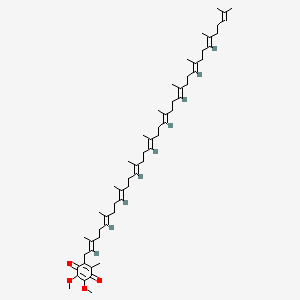
Ubidecarenone, commonly known as Coenzyme Q10 (CoQ10), is a lipid-soluble redox cofactor and endogenous antioxidant found in virtually all human cells, with the highest concentrations in metabolically active tissues such as the heart, liver, and skeletal muscle. Chemically, it belongs to the family of benzoquinone compounds and exists in two principal redox states: the oxidized ubiquinone form and the reduced ubiquinol form. Its core biological function is to serve as a mobile electron carrier within the mitochondrial inner membrane, shuttling electrons between Complexes I and II and Complex III of the electron transport chain, thereby facilitating the production of adenosine triphosphate (ATP) through oxidative phosphorylation. In its reduced state, ubiquinol acts as a potent chain-breaking antioxidant, quenching reactive oxygen species and protecting cellular membranes and lipoproteins from oxidative damage. Beyond energy metabolism, CoQ10 plays roles in membrane stabilization, modulation of mitophagy, and maintenance of mitochondrial proteostasis.
Ubidecarenone is also classified as a nutraceutical and pharmaceutical agent. It is widely used as an oral dietary supplement and has been investigated as a therapeutic candidate for conditions associated with mitochondrial dysfunction, oxidative stress, cardiovascular disease, neurodegeneration, and renal pathology. Its endogenous biosynthesis involves the mevalonate pathway, which is also targeted by statins—drugs known to deplete circulating CoQ10 levels as a side effect—making supplementation clinically relevant in statin-treated populations. Despite its established biological importance, CoQ10's extremely poor aqueous solubility and consequent low oral bioavailability have historically limited its therapeutic application, driving extensive research into novel delivery systems.
Where the papers sit
10 papers from the last 6 months study ubidecarenone directly · updated from PubMed 5 Oct 2026
Study type 0 clinical trials · 2 observational · 1 human data · 7 preclinical
Themes one subject
Those 10 are all about one subject.
-
CoQ10 Therapeutic Research
CoQ10 research links mitochondrial dysfunction, oxidative stress and inflammation across metabolic, reproductive, hepatic, musculoskeletal and aging-related conditions. Supplementation is being paired with myoinositol, melatonin, siRNA and regenerative biomaterials to address insulin resistance, senescence, tissue injury and joint disease. Nanoparticles, nanoemulsions and phospholipid systems recur as strategies to improve stability, tissue bioavailability and therapeutic delivery. Evidence remains divided across clinical supplementation, mechanistic studies and early delivery platforms, leaving optimal dosing and disease-specific benefit unresolved.
Papers
The 10 papers from the last 6 months that study ubidecarenone directly, newest first, by theme and by study type. Study types come from PubMed publication types and MeSH headings.
By theme
CoQ10 Therapeutic Research (10)
- Dietary CoQ10 Ameliorates Age-Related Megakaryocyte Dysfunction via COPS3-Mediated Activation of Autophagy. Aging cell · 29 Sept 2026 PMID 42808563
- Additive and Dose-Dependent Effects of Coenzyme Q10 Combined With Myoinositol on Insulin Resistance and Hyperandrogenism in Women With Polycystic Ovary Syndrome: A Retrospective Controlled Study. The journal of obstetrics and gynaecology research · 29 Sept 2026 PMID 42806611
- Coenzyme Q10 supplementation restores mitochondrial respiration in patients with primary CoQ10 deficiency caused by novel COQ2 and COQ4 variants. Metabolic brain disease · 9 Sept 2026 PMID 42714630
- A dual functional hybrid lipid-polymeric nanoparticle co-loaded coenzyme Q10 and siRNA TNFα for anti-inflammatory skin therapy. International journal of pharmaceutics · 4 Sept 2026 PMID 42697387
- Multi-compartment pharmacokinetics and tissue bioavailability of Coenzyme Q10 from a phospholipid-based self-nanoemulsifying drug delivery system in rats: a distribution pattern consistent with a possible lymphatic contribution. Drug development and industrial pharmacy · 6 Aug 2026 PMID 42559755
- Intra-Articularly Injectable Ion-Coordinated Bionic Lubricants Improve Rheumatoid Arthritis Recession via Pro-Regenerative Reprogramming of Synovial Macrophages. ACS nano · 22 Jul 2026 PMID 42485205
- Ameliorating effects of Coenzyme Q10 and its nanosuspension against cyclophosphamide-induced hepatoxicity in rats. Biochemical and biophysical research communications · 13 Jun 2026 PMID 42288037
- Supplements and Drugs Are Associated With Biological Age in a Cohort of Exceptionally Healthy Individuals. Aging cell · 21 May 2026 PMID 42166733
- Oleoyl-hyaluronate nanoparticles for enhanced stability and bioactivity of encapsulated coenzyme Q10. International journal of pharmaceutics · 9 May 2026 PMID 42105958
- Melatonin and Coenzyme Q10 mitigate Senescence in Human Adipose-Derived Mesenchymal Stem Cells by Restoring Mitophagy and Mitochondrial Proteostasis. PloS one · 29 Apr 2026 PMID 42054487
By study type
Observational studies and case reports (2)
- Additive and Dose-Dependent Effects of Coenzyme Q10 Combined With Myoinositol on Insulin Resistance and Hyperandrogenism in Women With Polycystic Ovary Syndrome: A Retrospective Controlled Study. The journal of obstetrics and gynaecology research · 29 Sept 2026 PMID 42806611
- Supplements and Drugs Are Associated With Biological Age in a Cohort of Exceptionally Healthy Individuals. Aging cell · 21 May 2026 PMID 42166733
Human data, design not indexed (1)
- Coenzyme Q10 supplementation restores mitochondrial respiration in patients with primary CoQ10 deficiency caused by novel COQ2 and COQ4 variants. Metabolic brain disease · 9 Sept 2026 PMID 42714630
Preclinical: animal, cell and lab studies (7)
- Dietary CoQ10 Ameliorates Age-Related Megakaryocyte Dysfunction via COPS3-Mediated Activation of Autophagy. Aging cell · 29 Sept 2026 PMID 42808563
- A dual functional hybrid lipid-polymeric nanoparticle co-loaded coenzyme Q10 and siRNA TNFα for anti-inflammatory skin therapy. International journal of pharmaceutics · 4 Sept 2026 PMID 42697387
- Multi-compartment pharmacokinetics and tissue bioavailability of Coenzyme Q10 from a phospholipid-based self-nanoemulsifying drug delivery system in rats: a distribution pattern consistent with a possible lymphatic contribution. Drug development and industrial pharmacy · 6 Aug 2026 PMID 42559755
- Intra-Articularly Injectable Ion-Coordinated Bionic Lubricants Improve Rheumatoid Arthritis Recession via Pro-Regenerative Reprogramming of Synovial Macrophages. ACS nano · 22 Jul 2026 PMID 42485205
- Ameliorating effects of Coenzyme Q10 and its nanosuspension against cyclophosphamide-induced hepatoxicity in rats. Biochemical and biophysical research communications · 13 Jun 2026 PMID 42288037
- Oleoyl-hyaluronate nanoparticles for enhanced stability and bioactivity of encapsulated coenzyme Q10. International journal of pharmaceutics · 9 May 2026 PMID 42105958
- Melatonin and Coenzyme Q10 mitigate Senescence in Human Adipose-Derived Mesenchymal Stem Cells by Restoring Mitophagy and Mitochondrial Proteostasis. PloS one · 29 Apr 2026 PMID 42054487
Written from 10 PubMed abstracts, each one listed by PMID above. Published: 2026-06-15. Last written: 2026-07-13 by GPT. Drafted by language models from published abstracts; not medical advice.