Sunitinib
Sunitinib is a small-molecule tyrosine kinase inhibitor used as an anticancer therapy, best known for its anti-angiogenic and antiproliferative activity.
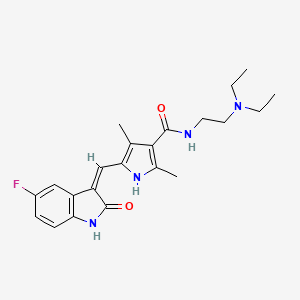
Sunitinib is a small-molecule tyrosine kinase inhibitor used as an anticancer therapy, best known for its anti-angiogenic and antiproliferative activity. It targets multiple receptor tyrosine kinases involved in tumor growth and vascular signaling, including VEGFR-2, and is widely used as a comparator or backbone therapy in renal cell carcinoma and other solid tumors. By inhibiting signaling pathways that support angiogenesis and tumor cell survival, sunitinib can slow disease progression in settings where vascular growth and kinase-driven proliferation are central features.
In biomedical research, sunitinib is frequently used as a reference treatment for advanced renal cell carcinoma and as a benchmark for newer combinations such as axitinib-based regimens, checkpoint inhibitor, and other targeted approaches. Recent studies also continue to examine mechanisms of resistance to sunitinib, including metabolic and cell-death pathways such as cuproptosis and ferroptosis, as well as its potential role in combination strategies with radiotherapy or chemotherapy.
Where the papers sit
11 papers from the last 6 months study sunitinib directly · updated from PubMed 7 Oct 2026
Study type 1 clinical trial · 1 human data · 8 preclinical · 1 unclassified
Themes 3 themes · 1 paradigm shift · 1 new direction
-
Renal Cancer Combination Therapy
Renal cancer treatment is moving toward combinations that pair kinase inhibition with immunotherapy, radiotherapy, or cuproptosis-based delivery. Avelumab plus axitinib and stereotactic radiotherapy plus sunitinib provide clinical combination settings, while hydrogel delivery seeks local immune reprogramming. Resistance recurs through USP15 and c-Myc suppression of cuproptosis and LGALS1-driven fatty-acid metabolism. Whether these mechanisms can guide patient selection or improve survival remains open.
5 papers · 45.5%
-
Novel Anticancer Strategies
Experimental cancer therapy is shifting toward targeted delivery and noncanonical cell-death or physical-ablation strategies. Resveratrol/sunitinib nanoparticles and pH-responsive nanogels aim to improve tumor exposure and sustained release in colorectal and lung models. Sunitinib-derived RIPK1 inhibitors target necroptosis pathways, while photothermal lysosomal conversion offers drug-free ablation. Potency in 3D spheroids and ex vivo systems supports further testing, but clinical relevance remains unresolved.
4 papers · 36.4%
-
Others — Cancer Therapy and Resistance
Hepatocellular carcinoma resistance is linked to PYCR2-driven PPAR signaling, with immune-cell infiltration and apoptotic processes also represented. Meningioma work instead addresses broader barriers to next-generation treatment. No single biological mechanism or disease unifies these findings. The cluster is best read as a mixed set of sunitinib-related oncology studies, not a convergent research direction.
2 papers · 18.2%
Sunitinib response in clear cell renal cell carcinoma is governed in part by cuproptosis, not only by its established kinase-inhibition effects
The injectable pH-responsive hydrogel study in clear cell renal cell carcinoma and the USP15 study of sunitinib-resistant clear cell renal cell carcinoma both found that activating cuproptosis can strengthen or restore sunitinib activity. This challenges the assumption that resistance should be addressed chiefly through the established antiangiogenic/TKI framework: the hydrogel used copper oxide to induce cuproptosis and reprogram the tumor microenvironment, while the USP15 study showed that sunitinib induced cuproptotic features and that USP15-mediated suppression of this death pathway caused resistance. The resulting direction is to treat cuproptosis as a mechanistic determinant and therapeutic partner of sunitinib, rather than merely as an unrelated adjunctive cytotoxic mechanism 42392517Jul 42054210Apr.
Sunitinib is repurposed as a lysosomal photothermal organelle-forming agent for nanoparticle-free tumor ablation
The lysosome-directed photothermal therapy study used sunitinib in ex vivo cancer-cell models, three-dimensional spheroids, patient-derived neuroblastoma tumoroids, and ovarian carcinoma tumor fragments as a lysosomotropic dye-enrichment agent rather than primarily as a kinase inhibitor or systemic anticancer drug. The study found that sunitinib concentrated a non-anticancer photothermal dye in acidic lysosomes, allowing pulsed light to generate intracellular vapor bubbles that mechanically disrupted tumor cells. This gives sunitinib a role outside the delivery, combination, resistance, prognostic, and conventional antitumor categories represented elsewhere in the set 42789725Sep.
Papers
The 11 papers from the last 6 months that study sunitinib directly, newest first, by theme and by study type. Study types come from PubMed publication types and MeSH headings.
By theme
Renal Cancer Combination Therapy (5)
- Injectable pH-responsive gelatin methacryloyl hydrogel for cuproptosis-synergized sunitinib therapy and immune reprogramming in clear cell renal cell carcinoma. Acta biomaterialia · 2 Jul 2026 PMID 42392517
- LGALS1 promotes the malignant progression and sunitinib resistance of clear cell renal cell carcinoma by reprogramming fatty acid metabolism. International immunopharmacology · 20 Jun 2026 PMID 42322858
- Bayesian Evaluation of Treatment Effect of Avelumab Plus Axitinib for Advanced Renal Cell Carcinoma. Cancer medicine · 30 May 2026 PMID 42216439
- USP15 stabilizes c-Myc to drive sunitinib resistance by suppressing cuproptosis in clear cell renal cell carcinoma. Cell reports · 29 Apr 2026 PMID 42054210
- Stereotactic body radiotherapy plus sunitinib vs. sunitinib alone in treatment-naive oligometastatic renal cell carcinoma: A phase 2 clinical trial. Cell reports. Medicine · 21 Apr 2026 PMID 42013852
Novel Anticancer Strategies (4)
- Converting lysosomes into photothermal organelles enables nanoparticle-free tumor ablation via intracellular vapor bubbles. Science advances · 25 Sept 2026 PMID 42789725
- Boswellic Acid-Integrated Chitosan Hybrid Nanogels for pH-Responsive Sustained Sunitinib Release and Lung Tumor Suppression. ACS applied materials & interfaces · 9 Sept 2026 PMID 42713680
- Anti-carcinoembryonic antigen conjugated resveratrol/sunitinib-loaded polymeric nanoparticles for therapeutic enhancement in colorectal cancer. International journal of biological macromolecules · 14 Jul 2026 PMID 42448198
- Design, synthesis and anti-necroptosis evaluation of RIPK1 inhibitors derived from sunitinib. European journal of medicinal chemistry · 15 May 2026 PMID 42140113
Others — Cancer Therapy and Resistance (2)
- PYCR2 contributes to sunitinib resistance in hepatocellular carcinoma by activating the PPAR signaling pathway. Biochemical and biophysical research communications · 19 May 2026 PMID 42155340
- Next-Generation Therapies for Meningioma: Overcoming Barriers and Expanding Treatment Options. Cancer investigation · 22 Apr 2026 PMID 42017452
By study type
Clinical trials (1)
- Stereotactic body radiotherapy plus sunitinib vs. sunitinib alone in treatment-naive oligometastatic renal cell carcinoma: A phase 2 clinical trial. Cell reports. Medicine · 21 Apr 2026 PMID 42013852
Human data, design not indexed (1)
- Bayesian Evaluation of Treatment Effect of Avelumab Plus Axitinib for Advanced Renal Cell Carcinoma. Cancer medicine · 30 May 2026 PMID 42216439
Preclinical: animal, cell and lab studies (8)
- Converting lysosomes into photothermal organelles enables nanoparticle-free tumor ablation via intracellular vapor bubbles. Science advances · 25 Sept 2026 PMID 42789725
- Boswellic Acid-Integrated Chitosan Hybrid Nanogels for pH-Responsive Sustained Sunitinib Release and Lung Tumor Suppression. ACS applied materials & interfaces · 9 Sept 2026 PMID 42713680
- Anti-carcinoembryonic antigen conjugated resveratrol/sunitinib-loaded polymeric nanoparticles for therapeutic enhancement in colorectal cancer. International journal of biological macromolecules · 14 Jul 2026 PMID 42448198
- Injectable pH-responsive gelatin methacryloyl hydrogel for cuproptosis-synergized sunitinib therapy and immune reprogramming in clear cell renal cell carcinoma. Acta biomaterialia · 2 Jul 2026 PMID 42392517
- LGALS1 promotes the malignant progression and sunitinib resistance of clear cell renal cell carcinoma by reprogramming fatty acid metabolism. International immunopharmacology · 20 Jun 2026 PMID 42322858
- PYCR2 contributes to sunitinib resistance in hepatocellular carcinoma by activating the PPAR signaling pathway. Biochemical and biophysical research communications · 19 May 2026 PMID 42155340
- Design, synthesis and anti-necroptosis evaluation of RIPK1 inhibitors derived from sunitinib. European journal of medicinal chemistry · 15 May 2026 PMID 42140113
- USP15 stabilizes c-Myc to drive sunitinib resistance by suppressing cuproptosis in clear cell renal cell carcinoma. Cell reports · 29 Apr 2026 PMID 42054210
Unclassified: not yet indexed with MeSH (1)
- Next-Generation Therapies for Meningioma: Overcoming Barriers and Expanding Treatment Options. Cancer investigation · 22 Apr 2026 PMID 42017452
Written from 11 PubMed abstracts, each one listed by PMID above. Published: 2026-06-16. Last written: 2026-08-27 by GPT. Drafted by language models from published abstracts; not medical advice.