quercetin
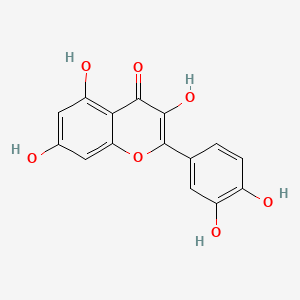
Overview
Quercetin is a naturally occurring flavonol — a plant polyphenol built on a 3-hydroxyflavone (2-phenylchromen-4-one) backbone bearing five hydroxyl groups, giving the systematic name 3,3',4',5,7-pentahydroxyflavone. It occurs widely in fruits, vegetables, and medicinal plants, most often as glycosides that are hydrolyzed to the free aglycone during digestion, and it is among the most extensively studied dietary polyphenols. Its catechol B-ring and 3-hydroxyl group make it an efficient hydrogen and electron donor, which underlies its direct scavenging of reactive oxygen species and its capacity to chelate transition metals. Alongside this direct antioxidant chemistry, quercetin activates nuclear factor erythroid 2-related factor 2 (NRF2) signaling, raising the expression of endogenous antioxidant enzymes such as superoxide dismutase, catalase, and glutathione peroxidase 4 and supporting cellular glutathione pools. It frequently appears in plant extracts and traditional medicines together with structurally related flavonoids including kaempferol, apigenin, luteolin, and hesperidin, and network pharmacology analyses of such extracts repeatedly nominate it as a principal active constituent.
Biologically, quercetin is best characterized as a multi-target agent rather than a selective ligand. Its anti-inflammatory activity involves suppression of the TLR4/P2X7–NLRP3 inflammasome axis, with reduced caspase-1 activation, gasdermin D–mediated pyroptosis, and release of interleukin-1β and interleukin-18, together with lower tumor necrosis factor-α and interleukin-6 output and inhibition of cyclooxygenase-2. Docking and pathway studies also place it at the PI3K/Akt axis and at hypoxia-inducible factor 1-alpha– and TP53-linked signaling, which is consistent with reported effects on proliferation, apoptosis, and ferroptosis in tumor and stromal cells. These properties have prompted investigation across osteoporosis and bone remodeling, inflammatory bowel disease and intestinal barrier injury, atopic dermatitis and wound healing, cancer, and antimicrobial applications, sometimes as an adjunct to conventional agents. Translation is constrained by quercetin's poor aqueous solubility, chemical instability in the gastrointestinal tract, low oral bioavailability, and rapid phase II metabolism and clearance — limitations that motivate much of the current work on nanocarriers, nanomicelles, lipid-based particles, and hydrogel delivery systems designed to improve its stability, absorption, and site-specific release.
Recent Publications Summary (latest 30 papers)
Recent studies have continued to examine quercetin as a bioactive target in diverse experimental and translational settings, most often in combination with delivery systems or other agents designed to overcome its poor solubility and bioavailability. In nanotechnology-based work, quercetin was incorporated into pH-responsive CMC/CeO2/CQDs nanocarriers for lung cancer cell evaluation, gold nanoparticle conjugates for antimicrobial theranostics, quercetin nanomicelles combined with doxycycline for Mycoplasma gallisepticum infection in broilers, butter-based nanostructured lipid carriers for wound-related applications, a dual-fibril gel for intestinal barrier protection, magnetic ionic liquid nanomicelles for sustained anticancer delivery, self-assembled quercetin-mecobalamin nanoparticles for ischemic stroke, and quercetin-loaded herbosomes for Alzheimer’s disease-oriented formulation development 42467848Jul42456709Jul42406229Jul42410212Jul42347739Jun42052870Apr42028836Apr42191751May. Across these studies, quercetin-containing systems generally showed improved encapsulation, controlled or pH-dependent release, enhanced stability, or improved biological performance relative to free quercetin, although the specific outcomes varied by model and formulation 42467848Jul42456709Jul42406229Jul42410212Jul42347739Jun42052870Apr42028836Apr42191751May.
Several publications focused on quercetin’s antioxidant and anti-inflammatory activities in disease models. In osteoporosis-related work, quercetin was identified as a principal active component from Cyathulae Radix and was reported to restore viability and osteogenic differentiation in H2O2-damaged MC3T3-E1 pre-osteoblasts, consistent with dual pro-osteogenic and antioxidant effects 42474720Jul. In wound-healing-related assays, quercetin loading into butter-based nanocarriers did not further increase proliferation or repopulation beyond the carrier effect, but it did improve protection against H2O2-induced intracellular reactive oxygen species 42410212Jul. Quercetin was also studied in diabetic rat liver injury, where co-treatment with melatonin attenuated hepatic damage by mitigating oxidative stress and inflammation 42021540Apr. In broiler thymus, quercetin was investigated for protection against lipopolysaccharide-induced necroptosis through Nrf2/PERK signaling, and in Drosophila exposed to hydroquinone, quercetin improved lifespan, fertility, fecundity, and gut toxicity while showing strong computational binding to DNMT2 and Piwi 42046449Apr42154051May. Additional anti-inflammatory studies linked quercetin to modulation of TNF, IL-6, PTGS2/COX-2, and related pathways in plant-extract and multi-flavonoid systems 42383440Jul42128884May42132650May42168772May.
Quercetin was also evaluated in neurological and inflammatory disease contexts. In aged mice with postoperative cognitive dysfunction, quercetin improved cognitive impairment and locomotor capacity by relieving microglia-mediated neuroinflammation, with the study proposing a mechanism involving miR-379-5p RNA modification 42209865May. In ischemic stroke, quercetin-mecobalamin nanoparticles reduced infarct size, neuroinflammation, and functional deficits in a mouse MCAO model, with suppression of microglial M1 polarization and downregulation of Panx1 42028836Apr. In spinal cord injury, a quercetin-containing supramolecular hydrogel scavenged reactive oxygen species, preserved mitochondrial structure, inhibited apoptosis, promoted macrophage polarization toward M2, and improved locomotor recovery while increasing autophagy/mitophagy markers 42128418May. Quercetin was also examined in a quercetin-based herbosomal system for Alzheimer’s disease, and in a separate bioinformatics study of hippocampal glycosylation-related biomarkers for Alzheimer’s disease drug repurposing, although the latter abstract did not report a quercetin-specific intervention outcome 42191751May42178007May.
Other recent studies placed quercetin within broader multi-component or multi-target frameworks. Network pharmacology and docking analyses identified quercetin among key flavonoids in Dolichos lablab flower extract, with strong predicted binding to PTGS2/COX-2 and in vitro anti-inflammatory activity in LPS-stimulated RAW 264.7 macrophages 42383440Jul. Quercetin was also one of the flavonoids examined in Lithocarpus litseifolius leaf extract for hyperuricemia, where the overall extract and flavonoid mixture reduced uric acid, improved renal dysfunction, and modulated the TLR2/PI3K/NF-κB pathway and gut microbiota, though the strongest effects were attributed to phlorizin and trilobatin 42132650May. In a study of Fagonia cretica, quercetin was among the major flavonoids identified by LC-ESI-MS/MS and was highlighted in docking analyses supporting the extract’s antioxidant, antibacterial, and antidiabetic properties 42168772May. Quercetin also appeared as a comparator or reference compound in bacterial neuraminidase inhibition studies and in bibliometric or phytochemical surveys of hepatocellular carcinoma-related natural products, underscoring its continued use as a benchmark flavonoid in mechanistic and screening studies 42179005May42061133Apr.
What Changes, What Holds
1. Delivery systems continue to be the main way quercetin is being advanced, but they do not yet change its core role
REINFORCES The new formulations mainly extend the baseline account of quercetin as a poorly soluble, low-bioavailability flavonol whose practical development depends on carriers that improve stability, release, and tissue delivery. The studies add breadth across cancer, infection, wound, stroke, and neurodegeneration models, but the central message is unchanged: the compound is still being used as a multi-target payload rather than a stand-alone selective drug. 42467848Jul42456709Jul
2. Recent disease-model work sharpens quercetin’s antioxidant and anti-inflammatory profile without overturning it
REINFORCES These studies fit the established view that quercetin supports redox control and dampens inflammatory injury, including osteogenic rescue under oxidative stress and protection against ROS-linked damage. The mixed wound-healing result is important because it suggests the carrier can contribute as much as the flavonol itself, so benefit may depend on formulation context rather than quercetin alone. The paragraph strengthens the baseline mechanism, but it does not add a new biological role. 42474720Jul42410212Jul
3. Neurologic applications now look like a major extension of quercetin’s multi-target profile, not a replacement for its known mechanisms
NEW DIRECTION The baseline already allows effects on proliferation, apoptosis, and inflammation, but it does not specifically cover postoperative cognitive dysfunction, ischemic stroke, or spinal cord injury. These reports broaden quercetin into neuroprotection, microglial control, and mitochondrial/autophagy-linked recovery, while still relying on the same general antioxidant and anti-inflammatory logic. The evidence is preclinical and formulation-dependent, so the practical question is whether these CNS benefits survive beyond model systems. 42209865May42028836Apr
4. Quercetin remains a recurring benchmark flavonoid in multi-component pharmacology rather than a newly defined standalone indication
REINFORCES The new extract and docking studies mainly confirm the baseline picture of quercetin as one of several principal constituents repeatedly nominated in network pharmacology and phytochemical work. What changes is the range of contexts in which it is being embedded—hyperuricemia, antibacterial screening, antidiabetic extract profiling, and comparator assays—but none of that displaces the established account. The most useful takeaway is that quercetin continues to function as a reference molecule for pathway-level screening, not as evidence of a new therapeutic class. 42383440Jul42132650May
Overview update candidates: neurologic applications in postoperative cognitive dysfunction; ischemic stroke; and spinal cord injury as a broader preclinical extension of quercetin’s multi-target profile.
quercetin
Background Contexts
In the literature, the biological baseline, pathological conditions, or disease models commonly surrounding quercetin are described as follows:
- overt diabetes (Disease) — 3 papers: PMIDs 42318610, 41990533, 41935525
- 2-phenylchromane flavonoid (Chemical) — 2 papers: PMIDs 42114831, 42080542
- diabetes (Disease) — 2 papers: PMIDs 42021540, 41732673
- liver cancer (Disease) — 2 papers: PMIDs 42145839, 42061133
- oxidative stress (Biological Process) — 2 papers: PMIDs 41732673, 41506100
- acute kidney injury (Disease) — 1 paper: PMIDs 41506100
- advanced lung cancer (Disease) — 1 paper: PMIDs 42467848
- Alzheimer's disease (Disease) — 1 paper: PMIDs 42178007
- Astragalus (Organism) — 1 paper: PMIDs 41933745
- atopic dermatitis (Disease) — 1 paper: PMIDs 42225173
- Bacterial keratitis (Disease) — 1 paper: PMIDs 41558272
- bioactive natural compounds (Other) — 1 paper: PMIDs 42061133
Methodologies & Technologies Used
Researchers utilize the following experimental methods, imaging platforms, computational models, or biological reagents to study quercetin:
- Network Pharmacology (Technology) — 3 papers: PMIDs 42046449, 41990533, 41967781
- 2,2-diphenyl-1-picrylhydrazyl (Technology) — 2 papers: PMIDs 42168772, 42068787
- ABTS•+ (Technology) — 2 papers: PMIDs 42470532, 42114195
- ethyl cellulose (Chemical) — 2 papers: PMIDs 41831974, 41576605
- fluorescence recovery after photobleaching (Technology) — 2 papers: PMIDs 42470532, 42114195
- GeneCards (Technology) — 2 papers: PMIDs 42474720, 42145839
- high performance thin layer chromatography (Technology) — 2 papers: PMIDs 42216852, 41990533
- lysophosphatidylcholine (Chemical) — 2 papers: PMIDs 42443636, 41967781
- molecular docking (Technology) — 2 papers: PMIDs 42178007, 41967781
- molecular docking studies (Technology) — 2 papers: PMIDs 42168772, 42154051
- quantitative reverse transcription-PCR (Technology) — 2 papers: PMIDs 42178007, 41933745
- Reverse Transcription Quantitative Real-time PCR (Technology) — 2 papers: PMIDs 42209865, 42145839
Molecular Interventions & Targets
The primary molecular pathways, regulatory genes, enzymes, or therapeutic agents actively targeted and manipulated in relation to quercetin include:
- kaempferol (Chemical) — 5 papers: PMIDs 42383440, 42225173, 42033182, 41967781, etc.
- isorhamnetin (Chemical) — 4 papers: PMIDs 42383440, 42128980, 42033182, 41967781
- luteolin (Chemical) — 4 papers: PMIDs 42383440, 42168772, 42128980, 42068787
- apigenin (Chemical) — 3 papers: PMIDs 42383440, 42068787, 42033182
- ferulic acid (Chemical) — 3 papers: PMIDs 42168772, 42068787, 41875753
- (+)-catechin (Chemical) — 2 papers: PMIDs 42168772, 41875753
- curcumin (Chemical) — 2 papers: PMIDs 42061133, 41831974
- Cyclooxygenase 2 (COX-2) (Protein) — 2 papers: PMIDs 42383440, 42128884
- Heat shock protein 90-alpha (Hsp90α) (Protein) — 2 papers: PMIDs 42145839, 41967781
- HK2 (Protein) — 2 papers: PMIDs 41935525, 41921767
- Interleukin-6 (IL-6) (Protein) — 2 papers: PMIDs 42474720, 42128884
- phlorizin (Chemical) — 2 papers: PMIDs 42225173, 42132650
Observed Outcomes & Phenotypes
The phenotypic changes, physiological endpoints, or clinical metrics observed and measured in connection with quercetin include:
- glutathione (Chemical) — 4 papers: PMIDs 42474720, 42470532, 42021540, 41946426
- oxidative stress (Biological Process) — 4 papers: PMIDs 42485438, 42225353, 42061133, 42025668
- antioxidant capacity (Clinical Metric) — 3 papers: PMIDs 42168772, 42114195, 42080542
- binding affinities (Clinical Metric) — 3 papers: PMIDs 42168772, 42114831, 41875753
- human gut flora (Biological Process) — 3 papers: PMIDs 42347739, 42132650, 41974237
- kaempferol (Chemical) — 3 papers: PMIDs 42114831, 41990533, 41933745
- proinflammatory cytokine (Biological Process) — 3 papers: PMIDs 42383440, 42025668, 41990977
- reactive oxygen species (Chemical) — 3 papers: PMIDs 42410212, 42128418, 42052870
- Staphylococcus aureus (Organism) — 3 papers: PMIDs 42225353, 42168772, 41875753
- angiogenesis (Biological Process) — 2 papers: PMIDs 42225353, 41248680
- apigenin (Chemical) — 2 papers: PMIDs 42470532, 42383440
- binding energies (Clinical Metric) — 2 papers: PMIDs 42145839, 41875753
General Takeaways & Clinical Potentials
The high-level concepts, clinical translations, and overarching conclusions proposed in the research surrounding quercetin are summarized below:
- functional food (Other) — 2 papers: PMIDs 42216852, 41794487
- therapeutic potential (Other) — 2 papers: PMIDs 42114831, 42052870
- active ingredients (Other) — 1 paper: PMIDs 42061133
- age-related diseases (Disease) — 1 paper: PMIDs 42154051
- anti-HCC effects (Other) — 1 paper: PMIDs 42145839
- anti-inflammatory agent (Other) — 1 paper: PMIDs 42318610
- anti-inflammatory and antioxidant activities (Other) — 1 paper: PMIDs 42025668
- anti-osteoporotic effects (Other) — 1 paper: PMIDs 42474720
- antibacterial and bactericidal activity (Biological Process) — 1 paper: PMIDs 42318610
- application potential in corn (Other) — 1 paper: PMIDs 42034448
- Autologous Hematopoietic Stem and Progenitor Cell (Cellular Component) — 1 paper: PMIDs 42485438
- azoxystrobin (Chemical) — 1 paper: PMIDs 41797183