Niraparib
Niraparib is an orally bioavailable poly(ADP-ribose) polymerase inhibitor used in oncology, particularly in the context of ovarian cancer maintenance therapy after platinum-based chemotherapy.
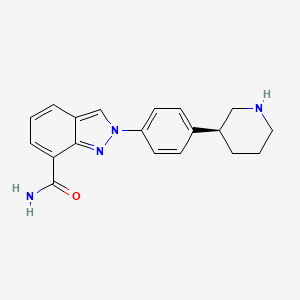
Niraparib is an orally bioavailable poly(ADP-ribose) polymerase inhibitor used in oncology, particularly in the context of ovarian cancer maintenance therapy after platinum-based chemotherapy. It targets PARP enzymes, especially poly(ADP-ribose) polymerase 1 (PARP1) and PARP2, thereby interfering with DNA repair and promoting selective cytotoxicity in tumor cells with impaired DNA damage response pathways. This mechanism is especially relevant in cancers associated with homologous recombination defects, including tumors with BRCA1 and BRCA2 alterations.
As a therapeutic agent, niraparib is part of the broader class of poly(adenosine diphosphate ribose) polymerase inhibitors and is studied both for its antitumor activity and for the mechanisms that limit its effectiveness. Recent research has also examined its pharmacologic properties, formulation quality, and adverse-effect profile, reflecting its established role in clinical oncology and ongoing efforts to optimize its use.
Where the papers sit
10 papers from the last 6 months study niraparib directly · updated from PubMed 6 Oct 2026
Study type 0 clinical trials · 2 observational · 7 preclinical · 1 unclassified
Themes 3 themes · 2 new directions
-
Ovarian Cancer PARP Therapy
Niraparib use in ovarian cancer is moving toward risk-adapted maintenance and combination strategies while defining toxicity and resistance. Severe anemia and second primary malignancies, including myelodysplastic syndrome and acute myeloid leukemia, remain important clinical concerns. Resistance recurs through drug-specific PARP inhibitor mechanisms, while arginine restriction targeting DNMT3B-ASS1 auxotrophy and mTORC1-suppressed autophagy offers a combination approach. HER2-directed ADC activity in endometrial cancer broadens the preclinical scope but remains separate from established ovarian practice.
5 papers · 50%
-
Drug Synthesis and Combination Therapy
Niraparib development is advancing through scalable enzymatic synthesis and exploratory treatment combinations. An evolved transaminase enables manufacturing-scale production, emphasizing process efficiency and supply. Separately, a niraparib-based Schiff base is being tested with electroporation and low-dose X-rays for enhanced anticancer activity. The evidence remains early and divided between pharmaceutical manufacture and radiation-linked therapeutic optimization.
2 papers · 20%
-
Others — Niraparib Translational Development
Work ranges from a camptothecin–niraparib phospholipid nanotube to analytical control of the R-isomer and multi-omics of synthetic-lethality signatures in lung adenocarcinoma. The shared focus is positioning niraparib within drug design, quality testing, and biomarker discovery. No single therapeutic direction or disease context unites these efforts. The set is therefore exploratory development rather than a coherent biological program.
3 papers · 30%
Niraparib becomes a covalently integrated component of a dual-drug nanomedicine
The camptothecin–niraparib conjugate model treats niraparib not as a standalone PARP inhibitor administered alongside another therapy, but as one covalently linked half of a redox-responsive phospholipid molecule that self-assembles into nanotubes and synchronously releases both drugs. This changes niraparib’s role from an independently delivered DNA-repair inhibitor to an integrated co-drug in a supramolecular delivery system designed to solve mismatched pharmacokinetics and co-delivery limitations 42456976Jul.
Niraparib is repurposed as a chemical scaffold for metal-based cytotoxic agents
The SKOV-3 ovarian-cancer model uses a niraparib-derived Schiff base as a ligand for palladium(II) and iron(II) complexes, evaluating these coordination compounds with electroporation and low-dose radiation rather than using niraparib for its established PARP-inhibitory activity. This gives niraparib a new role as a structural precursor for metal-based anticancer agents, with the resulting complexes showing greater cytotoxicity than carboplatin in the reported cell model 42229349Jun.
Papers
The 10 papers from the last 6 months that study niraparib directly, newest first, by theme and by study type. Study types come from PubMed publication types and MeSH headings.
By theme
Ovarian Cancer PARP Therapy (5)
- A mouse PDX clinical trial reveals broad efficacy of niraparib and vc-seco-DUBA anti-HER2 ADC SYD985 in HER2/neu expressing endometrial cancer. Biomedicine & pharmacotherapy = Biomedecine & pharmacotherapie · 4 Aug 2026 PMID 42551191
- Arginine restriction exploits DNMT3B-ASS1-driven arginine auxotrophy and mTORC1-suppressed autophagy to overcome niraparib resistance in ovarian cancer. Cancer letters · 23 May 2026 PMID 42176791
- Real-World Risk of Myelodysplastic Syndrome/Acute Myeloid Leukemia and Other Second Primary Malignancies in Patients with Epithelial Ovarian Cancer Treated with Niraparib Maintenance Therapy: Results from a Postauthorization Safety Study. Advances in therapy · 20 May 2026 PMID 42159951
- Risk Factors for Niraparib-induced Severe Anemia in Japanese Patients With Ovarian Cancer: A Multicenter Study. Anticancer research · 28 Apr 2026 PMID 42049354
- Identification of novel drug-specific PARP inhibitor resistance mechanisms in ovarian cancer-implications for clinical practice. British journal of cancer · 17 Apr 2026 PMID 41998207
Drug Synthesis and Combination Therapy (2)
- Realization of a Manufacturing-Scale Synthesis of Niraparib Using an Evolved Transaminase. Chembiochem : a European journal of chemical biology · 27 Sept 2026 PMID 42801751
- Combined effects of electroporation and 100 mGy X-ray on the anticancer activity of newly synthesized niraparib-based Schiff base, Pd(II) and Fe(II) complexes in SKOV-3 cancer cells. Bioorganic chemistry · 2 Jun 2026 PMID 42229349
Others — Niraparib Translational Development (3)
- Integrative multi-omics reveals a prognostic and therapeutic landscape of synthetic lethality-associated signatures in lung adenocarcinoma. iScience · 14 Aug 2026 PMID 42597961
- A phospholipid Camptothecin-Niraparib conjugate self-assembled into supramolecular nanotubes for combination cancer therapy. Journal of controlled release : official journal of the Controlled Release Society · 15 Jul 2026 PMID 42456976
- A Novel, Robust, and Isocratic HPLC-UV Method for the Comprehensive Determination of Enantiomeric Impurity (R-Isomer) in Niraparib Drug Substance. Chirality · 17 Jun 2026 PMID 42304726
By study type
Observational studies and case reports (2)
- Real-World Risk of Myelodysplastic Syndrome/Acute Myeloid Leukemia and Other Second Primary Malignancies in Patients with Epithelial Ovarian Cancer Treated with Niraparib Maintenance Therapy: Results from a Postauthorization Safety Study. Advances in therapy · 20 May 2026 PMID 42159951
- Risk Factors for Niraparib-induced Severe Anemia in Japanese Patients With Ovarian Cancer: A Multicenter Study. Anticancer research · 28 Apr 2026 PMID 42049354
Preclinical: animal, cell and lab studies (7)
- Realization of a Manufacturing-Scale Synthesis of Niraparib Using an Evolved Transaminase. Chembiochem : a European journal of chemical biology · 27 Sept 2026 PMID 42801751
- A mouse PDX clinical trial reveals broad efficacy of niraparib and vc-seco-DUBA anti-HER2 ADC SYD985 in HER2/neu expressing endometrial cancer. Biomedicine & pharmacotherapy = Biomedecine & pharmacotherapie · 4 Aug 2026 PMID 42551191
- A phospholipid Camptothecin-Niraparib conjugate self-assembled into supramolecular nanotubes for combination cancer therapy. Journal of controlled release : official journal of the Controlled Release Society · 15 Jul 2026 PMID 42456976
- A Novel, Robust, and Isocratic HPLC-UV Method for the Comprehensive Determination of Enantiomeric Impurity (R-Isomer) in Niraparib Drug Substance. Chirality · 17 Jun 2026 PMID 42304726
- Combined effects of electroporation and 100 mGy X-ray on the anticancer activity of newly synthesized niraparib-based Schiff base, Pd(II) and Fe(II) complexes in SKOV-3 cancer cells. Bioorganic chemistry · 2 Jun 2026 PMID 42229349
- Arginine restriction exploits DNMT3B-ASS1-driven arginine auxotrophy and mTORC1-suppressed autophagy to overcome niraparib resistance in ovarian cancer. Cancer letters · 23 May 2026 PMID 42176791
- Identification of novel drug-specific PARP inhibitor resistance mechanisms in ovarian cancer-implications for clinical practice. British journal of cancer · 17 Apr 2026 PMID 41998207
Unclassified: not yet indexed with MeSH (1)
- Integrative multi-omics reveals a prognostic and therapeutic landscape of synthetic lethality-associated signatures in lung adenocarcinoma. iScience · 14 Aug 2026 PMID 42597961
Written from 10 PubMed abstracts, each one listed by PMID above. Published: 2026-07-02. Last written: 2026-07-29 by GPT. Drafted by language models from published abstracts; not medical advice.