dexamethasone
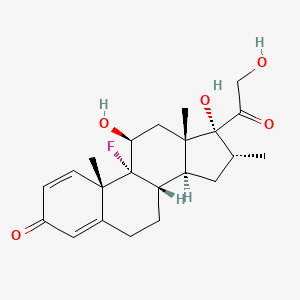
Overview
Dexamethasone is a synthetic glucocorticoid drug used clinically for its anti-inflammatory, immunosuppressive, and antineoplastic effects. Structurally derived from cortisol, it binds the glucocorticoid receptor with high affinity, driving receptor translocation to the nucleus and altering transcription of genes governing inflammation, immune activation, and metabolism. Its anti-inflammatory potency substantially exceeds that of hydrocortisone, and its long biological half-life and negligible mineralocorticoid activity make it the corticosteroid of choice where sustained glucocorticoid effect without sodium retention is desired. Downstream, dexamethasone suppresses production of proinflammatory cytokines such as interleukin-6, inhibits NF-κB-driven transcription, and modulates oxidative stress responses in which reactive oxygen species and the Nrf2 antioxidant axis are central — the same axis targeted by anti-inflammatory agents such as luteolin in models of ocular injury.
In practice, dexamethasone is a backbone agent in hematologic oncology, where it is combined with proteasome inhibitors such as bortezomib and carfilzomib, immunomodulatory drugs such as lenalidomide, cereblon E3 ligase modulators, and cytotoxics including cyclophosphamide and doxorubicin in regimens for multiple myeloma and related plasma cell disorders. It is also standard supportive care: premedication before taxane chemotherapy to prevent hypersensitivity reactions, antiemetic and antiedema therapy in neuro-oncology, and topical or intraocular therapy — often as dexamethasone sodium phosphate or sustained-release implants — for ocular inflammation in both human and veterinary surgery. Because systemic corticosteroid exposure carries dose-dependent harms, including perioperative hyperglycaemia, immune suppression, and skeletal muscle atrophy through FOXO-mediated induction of atrogin-1 and MuRF-1, much current work focuses on dose minimization and on localized delivery through hydrogels, polymeric nanoparticles, and microneedle systems. Its well-characterized potency also makes it the conventional reference comparator against which new anti-inflammatory agents and delivery platforms are benchmarked.
Recent Publications Summary (latest 30 papers)
Dexamethasone continues to serve as a cornerstone glucocorticoid component of multi-agent regimens for multiple myeloma treatment across both newly diagnosed and relapsed/refractory disease populations. The XVRd regimen (selinexor, bortezomib, lenalidomide, and dexamethasone) achieved a 93.3% overall response rate in 30 newly diagnosed high-risk myeloma patients 42544613Aug, while comparative effectiveness studies demonstrated improved progression-free survival with daratumumab-based quadruplet therapy (DVRd) versus triplet VRd regimens in transplant-eligible patients 42444515Jul. Additional combination regimens incorporating dexamethasone with ixazomib and cyclophosphamide 42315418Jun, mezigdomide with carfilzomib 42289183Jun, and melflufen 42270486Jun reported response rates ranging from 28% to 75% in heavily pretreated populations. Immunological monitoring revealed that VRd specifically expanded circulating monocytic myeloid-derived suppressor cells post-induction, with expansion patterns correlating to treatment response depth 42374568Jun. safety surveillance across multiple myeloma trials documented elevated infection risks with daratumumab-containing dexamethasone-based regimens, with highest incidence occurring within the first six months of treatment initiation 42085642May, and comprehensive pharmacovigilance analysis identified neurological disorder signals associated with VRd and infection signals with DRd 42171749May.
Dexamethasone's potent anti-inflammatory properties have motivated development of advanced drug delivery systems designed to enhance therapeutic efficacy while reducing systemic exposure and adverse effects. photobiomodulation combined with dexamethasone demonstrated superior reduction of tumor necrosis factor-alpha and interleukin-6 in lipopolysaccharide/interferon-gamma-stimulated macrophages at lower dexamethasone concentrations compared to either modality alone 42543442Aug. Reverse-engineered triglyceride-ceramide lipid nanoparticle encapsulating dexamethasone exhibited selective reduction of pro-inflammatory cytokines through multimodal protein corona-mediated cytokine sequestration 42522898Jul. Comparative studies showed that cerium-luteolin nanoparticles matched dexamethasone's efficacy in treating experimentally induced ocular alkali burns while avoiding observable adverse effects 42301120Jun, and natural phenylpropanoids and triterpenes from Lavandula coronopifolia altered macrophage morphology and downregulated nitric oxide synthase and interleukin-6 expression in patterns similar to dexamethasone 42178365May. Multiple formulation platforms—including thermosensitive hydrogels with liposomes for sustained middle ear delivery 41966427Apr, salivary enzyme-responsive nanoparticles for buccal application 42233472Jun, engineered non-spherical microparticles for oral inflammatory bowel disease treatment 42217660May, and intracochlear PLGA implants 42070660May—demonstrated improved drug retention, controlled release kinetics, and therapeutic efficacy. hyaluronic acid-based nanoparticles co-delivered dexamethasone with melphalan at fixed 1:1 stoichiometric ratios for enhanced multiple myeloma targeting and reduced systemic toxicity 41943381Apr.
Perioperative administration of dexamethasone revealed important metabolic consequences warranting clinical awareness. Intraoperative dexamethasone at 8 mg significantly elevated maximum perioperative blood glucose levels in patients with diabetes mellitus (median 12.5 mM versus 10.3 mM in placebo, p<0.001), although this hyperglycemia did not translate to increased surgical-site infection rates 42303515Jun. Reduced-dose dexamethasone premedication strategies were evaluated for efficacy in preventing taxane-induced hypersensitivity reactions during weekly paclitaxel chemotherapy while minimizing steroid-related toxicity 42371187Jun. The reliability of overnight dexamethasone suppression testing in post-bariatric surgery patients was investigated, as altered gastrointestinal anatomy may compromise drug absorption and affect diagnostic accuracy 42176158May. Intravitreal dexamethasone implants for non-infectious posterior-segment uveitis demonstrated therapeutic benefits in real-world 12-month outcome data 42188201May.
Dexamethasone's glucocorticoid activity induces significant catabolic effects on skeletal muscle, prompting investigation of therapeutic countermeasures. Oral administration of Limosilactobacillus fermentum ANC4 mitigated dexamethasone-induced muscle atrophy in mice by downregulating glucocorticoid receptor signaling and E3 ubiquitin ligases (MuRF-1 and Atrogin-1) while upregulating myogenic markers including MyoD, myogenin, and myosin heavy chain 42049697Apr. Dexamethasone-loaded polymeric nanoparticles promoted angiogenesis and pro-regenerative macrophage polarization in a rabbit critical-size calvarial bone defect model, with potential applications for bone regeneration during dental implant treatment procedures 42009190Apr. Computational approaches identified dexamethasone as a potential modulator of macrophage polarization genes dysregulated in spinal cord injury models 42081466May. pH-responsive bovine serum albumin nanoparticles were engineered to co-deliver dexamethasone with chemotherapeutic agents and antiemetics, improving cancer therapy tolerability by reducing chemotherapy-induced nausea and vomiting 42070610May, while controlled-release formulations in hydrogel matrices maintained dexamethasone bioactivity for sustained anti-inflammatory effects 42301751Jun.
What Changes, What Holds
1. Dexamethasone's myeloma role now sits inside quadruplets, and the added benefit comes with a countable infection cost — REINFORCES — Backbone status in plasma cell disorder regimens is what the baseline already asserts, and adding selinexor or daratumumab to the bortezomib/lenalidomide/dexamethasone spine is another combination, not a new class of claim 42544613Aug. The consequential wrinkle is that infection risk clusters in the first six months of daratumumab-containing therapy 42085642May — a timing signal that turns the Overview's generic "immune suppression" caution into something schedulable. Whether dexamethasone or the antibody drives that window is unresolved.
2. Cheaper co-modalities and plant-derived agents reach dexamethasone's anti-inflammatory endpoint without its dose — NEW DIRECTION — Losing a head-to-head comparison is the departure here: the Overview positions dexamethasone as the reference comparator that new agents are benchmarked against, and cerium-luteolin nanoparticles matched it in alkali burn while avoiding observable adverse effects 42301120Jun. photobiomodulation pushes in the same direction by achieving greater cytokine suppression at lower dexamethasone concentrations 42543442Aug. The delivery platforms remain confirmatory. What is untested is whether equivalence at a single preclinical endpoint survives broader inflammatory readouts.
3. Perioperative hyperglycaemia from an 8 mg dose is real but does not produce the infections it was feared to cause — REINFORCES — Uncoupling the glucose spike from surgical-site infection sharpens rather than unsettles the baseline's dose-dependent harm framing: the metabolic effect is confirmed, the assumed downstream consequence is not 42303515Jun. This weakens the strongest argument for withholding a single intraoperative dose in diabetes, and sits alongside continued reduced-dose taxane premedication work 42371187Jun that pursues minimization for other reasons. Infection was the endpoint that mattered; longer-horizon glycaemic harms stay unmeasured.
4. Reversing steroid muscle atrophy may be achievable upstream of the ligases, through the gut — NEW DIRECTION — Countermeasures to the FOXO/atrogin-1/MuRF-1 catabolic axis are absent from the Overview, which describes the atrophy mechanism without any means of blunting it; an oral probiotic downregulating glucocorticoid receptor signalling itself while restoring myogenic markers is a route the baseline does not contemplate 42049697Apr. Pro-regenerative macrophage polarization and angiogenesis in bone defects points the same way — dexamethasone as a tissue-building agent 42009190Apr, not merely a suppressive one. Both are single preclinical models in different species.
Overview update candidates: the early-window infection signal in daratumumab-based regimens; hyperglycaemia without excess surgical-site infection; dexamethasone's pro-regenerative role in bone.
dexamethasone
Background Contexts
In the literature, the biological baseline, pathological conditions, or disease models commonly surrounding dexamethasone are described as follows:
- multiple myeloma (Disease) — 10 papers: PMIDs 42544613, 42444515, 42374568, 42315418, etc.
- relapsed/refractory multiple myeloma (Disease) — 3 papers: PMIDs 42270486, 41770089, 41719502
- CD20 (Protein) — 2 papers: PMIDs 42477805, 42411504
- glucocorticoid-induced osteoporosis (Disease) — 2 papers: PMIDs 42360339, 41962468
- lenalidomide (Therapy) — 2 papers: PMIDs 42289183, 42212933
- Metabolic disorders (Disease) — 2 papers: PMIDs 42529834, 42480512
- tuberculous meningitis (Disease) — 2 papers: PMIDs 41711419, 41408415
- ulcerative colitis (Disease) — 2 papers: PMIDs 41791486, 40987980
- 21 Hydroxylase Deficiency (Disease) — 1 paper: PMIDs 42529834
- acute lung injury (Disease) — 1 paper: PMIDs 41921707
- acute respiratory distress syndrome (Disease) — 1 paper: PMIDs 42300751
- Adiponectin (APN) (Protein) — 1 paper: PMIDs 42480512
Methodologies & Technologies Used
Researchers utilize the following experimental methods, imaging platforms, computational models, or biological reagents to study dexamethasone:
- Rat (Organism) — 4 papers: PMIDs 42546823, 42480512, 42372888, 42360339
- C2C12 skeletal muscle myotubes (Cell Line) — 3 papers: PMIDs 42480512, 41996735, 41790122
- cyclophosphamide (Therapy) — 3 papers: PMIDs 42477805, 42212672, 42082264
- lipopolysaccharide (Other) — 3 papers: PMIDs 42546823, 42543442, 42522898
- HEK293T (Cell Line) — 2 papers: PMIDs 42480512, 42178365
- proinflammatory cytokine (Biological Process) — 2 papers: PMIDs 42300751, 41996735
- rabbit (Clinical Metric) — 2 papers: PMIDs 42009190, 41690448
- rituximab (Therapy) — 2 papers: PMIDs 42477805, 42082264
- 1,2-distearoyl-sn-glycero-3-phosphocholine (Chemical) — 1 paper: PMIDs 41966427
- 1-acyl-sn-glycero-3-phosphoserine (Other) — 1 paper: PMIDs 42185524
- 1.4 or 1.9 mg/kg (Other) — 1 paper: PMIDs 41719502
- 12-gene panel (Other) — 1 paper: PMIDs 41996735
Molecular Interventions & Targets
The primary molecular pathways, regulatory genes, enzymes, or therapeutic agents actively targeted and manipulated in relation to dexamethasone include:
- lenalidomide (Therapy) — 9 papers: PMIDs 42544613, 42444515, 42374568, 42171749, etc.
- bortezomib (Therapy) — 8 papers: PMIDs 42544613, 42444515, 42374568, 42171749, etc.
- daratumumab (Therapy) — 5 papers: PMIDs 42444515, 42315418, 42171749, 42085642, etc.
- belantamab mafodotin (Therapy) — 3 papers: PMIDs 41770089, 41719502, 41346230
- Acyl-CoA synthetase long-chain family member 4 (ACSL4) (Protein) — 2 papers: PMIDs 42439361, 41791486
- B cell maturation antigen (BCMA) (Protein) — 2 papers: PMIDs 42212933, 41719502
- carfilzomib (Therapy) — 2 papers: PMIDs 42289183, 41719502
- Forkhead box O3 (FOXO3) (Protein) — 2 papers: PMIDs 42000627, 41790122
- selinexor (Therapy) — 2 papers: PMIDs 42544613, 41564431
- (+/-)-sulforaphane (Chemical) — 1 paper: PMIDs 42289208
- (2R)-3-(3,4-dihydroxyphenyl)-1-methoxy-1-oxopropan-2-yl (2E)-3-(3,4-dihydroxyphenyl)prop-2-enoate (Chemical) — 1 paper: PMIDs 42178365
- 1,2,3-triazole-linked (±)-Agrimonolide derivatives (Therapy) — 1 paper: PMIDs 40987980
Observed Outcomes & Phenotypes
The phenotypic changes, physiological endpoints, or clinical metrics observed and measured in connection with dexamethasone include:
- proinflammatory cytokine (Biological Process) — 6 papers: PMIDs 42301751, 42300751, 42207030, 42185524, etc.
- progression-free survival (Clinical Metric) — 5 papers: PMIDs 42544613, 42315418, 42289183, 42270486, etc.
- overall survival (Clinical Metric) — 4 papers: PMIDs 42544613, 42315418, 42270486, 42212933
- biocompatibility (Other) — 3 papers: PMIDs 42372888, 42233472, 41759379
- death (Clinical Metric) — 3 papers: PMIDs 42444515, 42289183, 42082264
- E3 ubiquitin-protein ligase TRIM63 (Protein) — 3 papers: PMIDs 42480512, 42190600, 41996735
- grip strength (Clinical Metric) — 3 papers: PMIDs 42480512, 42049697, 42000627
- infection (Disease) — 3 papers: PMIDs 42289183, 42212933, 42085642
- inflammatory cell infiltration (Other) — 3 papers: PMIDs 42372888, 42301120, 42300751
- Overall Response Rate (Clinical Metric) — 3 papers: PMIDs 42544613, 42315418, 41719502
- very good partial response (Clinical Metric) — 3 papers: PMIDs 42544613, 42374568, 41719502
- Adverse Events (Other) — 2 papers: PMIDs 42284069, 41719502
General Takeaways & Clinical Potentials
The high-level concepts, clinical translations, and overarching conclusions proposed in the research surrounding dexamethasone are summarized below:
- bortezomib (Therapy) — 2 papers: PMIDs 42501235, 42444515
- daratumumab (Therapy) — 2 papers: PMIDs 42501235, 42444515
- lenalidomide (Therapy) — 2 papers: PMIDs 42541591, 42444515
- muscle atrophy (Biological Process) — 2 papers: PMIDs 42190600, 41790122
- potent anti-inflammatory efficacy (Clinical Metric) — 2 papers: PMIDs 42546823, 42134601
- progression-free survival (Clinical Metric) — 2 papers: PMIDs 41564431, 41346230
- 15-PGDH/PGE2 pathway (Pathway) — 1 paper: PMIDs 42000627
- 2-step-up dosing regimen (Therapy) — 1 paper: PMIDs 42411504
- 21 Hydroxylase Deficiency (Disease) — 1 paper: PMIDs 42529834
- 3-step-up dosing regimen (Therapy) — 1 paper: PMIDs 42411504
- AdipoR1-targeting (Protein) — 1 paper: PMIDs 42480512
- Age bias (Other) — 1 paper: PMIDs 42397615