kaempferol
Overview
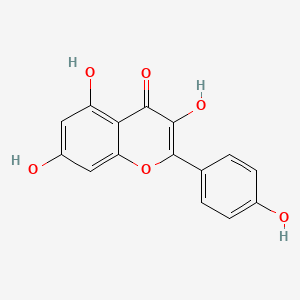
Kaempferol is a naturally occurring flavonol belonging to the 2-phenylchromane flavonoid class, widely distributed across fruits, vegetables, and medicinal plants. It is found in dietary sources such as kale, broccoli, tea, and a range of botanical extracts, and has been isolated from species including Carissa macrocarpa, Moringa oleifera, and Anoectochilus roxburghii. Structurally, kaempferol frequently occurs in plant tissues as flavonoid glycosides, where it is conjugated with various sugar moieties, and can be released as a free aglycone through enzymatic or fermentative processing. Its pharmacological profile is broad, encompassing anti-inflammatory, antioxidant, antifibrotic, anticancer, and antimicrobial activities, making it a subject of sustained interest across multiple therapeutic domains.
The mechanism of action of kaempferol is multifactorial. It modulates the expression of proinflammatory cytokines including Interleukin-1β (IL-1β) and IL18, suppresses oxidative stress through upregulation of enzymes such as Superoxide Dismutase (SOD), and attenuates extracellular matrix degradation in degenerative and fibrotic conditions. Kaempferol has also been shown to interact with key signaling nodes including TP53, Cyclooxygenase 2 (COX-2), TLR4/P2X7-NLRP3 signaling pathway components, and caspase cascades. Despite this promising pharmacological breadth, its clinical translation has historically been constrained by poor aqueous solubility and limited bioavailability, driving active research into advanced delivery systems.
Recent Publications Summary
Recent studies have continued to examine kaempferol as a bioactive flavonoid with anti-inflammatory, antioxidant, and disease-modulating properties across multiple experimental systems. In intervertebral disc degeneration, network pharmacology, multi-omics, molecular docking, transcriptomics, and experimental validation were used to identify potential therapeutic targets of kaempferol, building on prior evidence that it can attenuate pro-inflammatory cytokine expression and extracellular matrix degradation in degenerated discs 42283840Jun. In hepatocellular carcinoma, transcriptomic analysis, single-cell RNA sequencing, Mendelian randomization, and cell-based assays were used to investigate how kaempferol inhibits glycolysis; the study reported effects on proliferation, invasion, migration, glucose uptake, lactate production, and the AKT-mTOR signaling pathway, with additional analysis of glycolytic enzymes and CA9 knockdown 42322592Jun.
Several publications focused on kaempferol as a formulation component or delivery payload to improve therapeutic performance. Kaempferol-loaded solid lipid nanoparticle were developed for adjuvant-induced arthritic rats and showed enhanced antioxidant and anti-inflammatory activity compared with pure kaempferol, including improved DPPH scavenging and modulation of inflammatory markers, MMP-13, and oxidative stress-related parameters 42184086May. A liposome-based co-delivery system with edaravone was designed to cross the blood-brain barrier for amyotrophic lateral sclerosis therapy; in SOD1G93A mice, the formulation slowed weight loss and improved motor performance, while suppressing ferroptosis through upregulation of GPX4 and SLC7A11 42171198May. In systemic sclerosis, kaempferol-loaded liposome-exosome composite nanoparticles reduced dermal thickening, collagen deposition, and myofibroblast activation in a bleomycin-induced mouse model, while activating the Nrf2/ARE antioxidant pathway and downregulating TGF-β/Smad signaling 42107749May. In lung cancer, kaempferol was incorporated into a pH/photothermal dual-responsive nanocarrier for targeted NSCLC therapy, where it promoted mitochondrial apoptosis via p-Akt inhibition, Bax/Bcl-2 regulation, and caspase cascade activation, and also downregulated VEGF and altered tumor microenvironment redox homeostasis 42207955May.
Other recent work examined kaempferol in complex natural-product or topical systems. In a medicinal formula studied for jellyfish venom-induced cardiac injury, kaempferol was identified as the pivotal bioactive component and was reported to antagonize cardiomyocyte cytotoxicity by inhibiting MAPK signaling 41903811Mar. In oral ulcer repair, kaempferol-loaded self-healing hydrogel sealants promoted wound closure, epithelial regeneration, collagen deposition, and neovascularization, while scavenging reactive oxygen species and showing antibacterial activity against Escherichia coli and Staphylococcus aureus 41995139Apr. In atopic dermatitis, kaempferol was included in antioxidant-enriched cream formulations, but no clinically relevant benefit over vehicle was observed despite differences in skin penetration and formulation behavior 42225173Jun. In a study of Moringa oleifera leaf fermentation, kaempferol was among the flavonoid aglycones that accumulated significantly during Monascus anka fermentation, alongside increased antioxidant capacity 41780433Mar. In glucose and lipid metabolism disorder, kaempferol was identified as one of the key ingredients of Anoectochilus roxburghii contributing to metabolic effects 41538970Jan.
What Changes, What Holds
1. Kaempferol’s disease scope now extends beyond inflammation and oxidation to metabolic and disc-specific mechanisms
NEW DIRECTION Network pharmacology and validation in disc degeneration reinforce the established anti-inflammatory, antioxidant, and matrix-protective profile 42283840Jun. More importantly, the hepatocellular carcinoma work adds a distinct metabolic angle: kaempferol is now linked to suppression of glycolysis, AKT-mTOR signaling, and invasive behavior 42322592Jun. That does not overturn the baseline, but it broadens kaempferol from a general cytoprotective flavonol into a compound with context-dependent effects on tumor metabolism.
2. Formulation advances are making kaempferol more usable, but they do not change its core pharmacology
REINFORCES The new delivery systems mainly address the baseline problem of poor bioavailability rather than redefining what kaempferol does. Across nanoparticle, liposome, and nanocarrier platforms, the recurring theme is improved anti-inflammatory, antioxidant, antifibrotic, or pro-apoptotic performance relative to free compound 42184086May42107749May. The ALS and lung cancer systems also show that formulation can redirect tissue exposure and mechanism, but these are delivery gains layered onto established activities, not a new biological role.
3. Kaempferol is emerging as a practical component of local repair and complex botanical formulations, with one negative topical result tempering enthusiasm
NEW DIRECTION The oral-ulcer hydrogel and cardiac-injury formula suggest a more applied role for kaempferol in wound repair and cardioprotection, extending the baseline beyond systemic anti-inflammatory and antioxidant effects into local biomaterial and multi-component use 41995139Apr41903811Mar. At the same time, the atopic dermatitis cream failed to outperform vehicle, which cautions against assuming that better skin penetration automatically translates into benefit 42225173Jun. Fermentation-driven aglycone accumulation and metabolic-ingredient findings support enrichment and formulation relevance, not a new mechanism.
Overview update candidates: kaempferol’s role in glycolysis suppression in hepatocellular carcinoma; formulation-enabled delivery improvements; local wound-repair applications with mixed topical efficacy.
kaempferol
Background Contexts
In the literature, the biological baseline, pathological conditions, or disease models commonly surrounding kaempferol are described as follows:
- rheumatoid arthritis (Disease) — 3 papers: PMIDs 42264056, 42184086, 42033182
- 2-phenylchromane flavonoid (Chemical) — 1 paper: PMIDs 42114831
- amyotrophic lateral sclerosis (Disease) — 1 paper: PMIDs 42171198
- atopic dermatitis (Disease) — 1 paper: PMIDs 42225173
- biofilm-forming capacity (Other) — 1 paper: PMIDs 42025853
- blood–brain barrier (Biological Process) — 1 paper: PMIDs 42171198
- cardiovascular disease (Disease) — 1 paper: PMIDs 41538970
- Carissa macrocarpa (Organism) — 1 paper: PMIDs 42114831
- degenerative disc disease (Disease) — 1 paper: PMIDs 42283840
- functional food (Other) — 1 paper: PMIDs 42025050
- glucose and lipid metabolism (Biological Process) — 1 paper: PMIDs 41538970
- Jellyfish stings (Other) — 1 paper: PMIDs 41903811
Methodologies & Technologies Used
Researchers utilize the following experimental methods, imaging platforms, computational models, or biological reagents to study kaempferol:
- Collagen-induced arthritis (Disease) — 2 papers: PMIDs 42264056, 42033182
- single-cell RNA-seq (Technology) — 2 papers: PMIDs 42329418, 42322592
- (+)-catechin (Chemical) — 1 paper: PMIDs 42025853
- (E)-chlorogenic acid (Chemical) — 1 paper: PMIDs 42025853
- 2,2-diphenyl-1-picrylhydrazyl (Technology) — 1 paper: PMIDs 42184086
- 2,3,5,6-tetrachloro-4-(methylsulfonyl)pyridine (Technology) — 1 paper: PMIDs 42283840
- acridine orange/ethidium bromide (Technology) — 1 paper: PMIDs 42033182
- adult female zebrafish (Organism) — 1 paper: PMIDs 42285688
- anti-CCP (Clinical Metric) — 1 paper: PMIDs 42033182
- arthritis scores (Clinical Metric) — 1 paper: PMIDs 42033182
- Autodock Vina (Technology) — 1 paper: PMIDs 42283840
- bleomycin-induced mouse model of localized scleroderma (Organism) — 1 paper: PMIDs 42107749
Molecular Interventions & Targets
The primary molecular pathways, regulatory genes, enzymes, or therapeutic agents actively targeted and manipulated in relation to kaempferol include:
- quercetin (Chemical) — 3 papers: PMIDs 42225173, 42033182, 41780433
- CASP1 (Protein) — 2 papers: PMIDs 42283840, 42033182
- 6-gene mitochondrial-macrophage signature (Gene) — 1 paper: PMIDs 42329418
- AKT/mTOR pathway (Pathway) — 1 paper: PMIDs 42322592
- AMPKα (Pathway) — 1 paper: PMIDs 42285688
- Anoectochilus roxburghii (Therapy) — 1 paper: PMIDs 41538970
- apigenin (Chemical) — 1 paper: PMIDs 42033182
- ATG3 (Gene) — 1 paper: PMIDs 42329418
- Carbonic anhydrase 9 (Protein) — 1 paper: PMIDs 42322592
- cGAS-STING/NF-κB signaling pathway (Pathway) — 1 paper: PMIDs 42285688
- cytochrome b-245 beta chain (Gene) — 1 paper: PMIDs 42329418
- edaravone (Therapy) — 1 paper: PMIDs 42171198
Observed Outcomes & Phenotypes
The phenotypic changes, physiological endpoints, or clinical metrics observed and measured in connection with kaempferol include:
- proinflammatory cytokine (Biological Process) — 3 papers: PMIDs 42285688, 42264056, 42184086
- collagen deposition (Clinical Metric) — 2 papers: PMIDs 42107749, 41995139
- IL17A (Protein) — 2 papers: PMIDs 42285688, 42184086
- MMP13 (Protein) — 2 papers: PMIDs 42283840, 42184086
- -6.47 mV (Clinical Metric) — 1 paper: PMIDs 42184086
- ABTS and DPPH radical scavenging capacities (Chemical) — 1 paper: PMIDs 41780433
- Acyl-CoA synthetase long chain family member 4 (Protein) — 1 paper: PMIDs 42171198
- aggrecan (Protein) — 1 paper: PMIDs 42283840
- Akt1 (Protein) — 1 paper: PMIDs 42322592
- anti-inflammatory cytokines (Biological Process) — 1 paper: PMIDs 42184086
- anti-virulence (Other) — 1 paper: PMIDs 42025853
- antibacterial and bactericidal activity (Biological Process) — 1 paper: PMIDs 42025853
General Takeaways & Clinical Potentials
The high-level concepts, clinical translations, and overarching conclusions proposed in the research surrounding kaempferol are summarized below:
- AI-based, explainable 6-gene signature (Other) — 1 paper: PMIDs 42329418
- Anoectochilus roxburghii (Therapy) — 1 paper: PMIDs 41538970
- anti-arthritic efficacy (Other) — 1 paper: PMIDs 42184086
- anti-psoriatic effects (Biological Process) — 1 paper: PMIDs 42285688
- cardioprotective effect (Other) — 1 paper: PMIDs 41903811
- F127-AG platform (Therapy) — 1 paper: PMIDs 41995139
- formulation design (Other) — 1 paper: PMIDs 42225173
- host-directed therapeutics (Therapy) — 1 paper: PMIDs 42329418
- jellyfish envenomation (Other) — 1 paper: PMIDs 41903811
- joint inflammation (Clinical Metric) — 1 paper: PMIDs 42033182
- kaempferol-loaded liposome-exosome composite nanoparticle (Other) — 1 paper: PMIDs 42107749
- M. anka-secreted enzymes (Other) — 1 paper: PMIDs 41780433