celecoxib
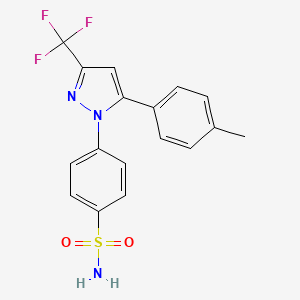
Overview
Celecoxib is a selective cyclooxygenase-2 (COX-2) inhibitor belonging to the nonsteroidal anti-inflammatory drug (NSAID) class, distinguished by its preferential blockade of the inducible COX-2 isoform over the constitutively expressed COX-1. By inhibiting COX-2, celecoxib suppresses the enzymatic conversion of arachidonic acid to prostaglandin H2, thereby reducing downstream synthesis of prostaglandin E2 (PGE2) and other pro-inflammatory eicosanoids. This mechanism underlies its well-established clinical use in managing pain, osteoarthritis, rheumatoid arthritis, and ankylosing spondylitis. Compared to non-selective NSAIDs such as (RS)-ketoprofen or sulindac, celecoxib's COX-2 selectivity is associated with a reduced risk of gastrointestinal ulceration, making it a widely used reference compound in anti-inflammatory research. In preclinical and translational settings, its inhibition of the COX-2/PGE2 axis also positions it as a candidate for modulating neuroinflammation, cancer-related inflammation, and chemotherapy-induced adverse effects.
Beyond its canonical anti-inflammatory role, celecoxib has attracted growing interest as an oncological adjunct and a neurological therapeutic. Its ability to suppress proinflammatory cytokine signaling — including pathways involving TNF-α and interleukin-6 (IL-6) — and to downregulate Cyclooxygenase 2 (COX-2) (PTGS2/COX-2) expression at the transcriptional level has prompted investigation into its utility across a remarkably broad spectrum of diseases. The drug's well-characterized pharmacology and decades of clinical safety data make it a frequent positive control and benchmark comparator in studies evaluating novel anti-inflammatory and antitumor agents.
Recent Publications Summary
Recent studies have continued to evaluate celecoxib as a COX-2–targeted therapy in both preclinical and clinical settings. In a randomized, single-blind, placebo-controlled crossover trial in 12 healthy volunteers, 8-day pretreatment with celecoxib did not alter tramadol exposure after a single oral dose, but it reduced formation of O-desmethyltramadol, consistent with celecoxib’s reported weak CYP2D6 inhibition in vivo 42272128Jun. In another pharmacology-focused study, celecoxib was incorporated into a spatiotemporally programmed nanovesicle with gemcitabine to suppress tumor prostaglandin E2 signaling before inducing immunogenic cell death, thereby boosting dendritic cell maturation and antitumor immune priming in triple-negative breast cancer models 42236688Jun.
Several publications used celecoxib as a comparator or reference standard in anti-inflammatory and anticancer screening. Extracts and selenium nanoparticle preparations from Convolvulus oxyphyllus significantly down-regulated IL6 and COX2 expression, with effects described as comparable to celecoxib 42128884May. Likewise, a series of methoxylated 3,4-diarylpyrazoles showed anti-inflammatory activity in TPA-induced topical edema, and the most active analog surpassed celecoxib in inhibition while also reducing myeloperoxidase and proinflammatory cytokines including TNF-α, IL-1β, and IL-6 41894851Mar. In a separate medicinal chemistry study, newly synthesized pyrimidine derivatives were benchmarked against celecoxib and Diclofenac; the most potent compound showed slightly higher COX-2 potency and selectivity than celecoxib, while other analogues were comparable to it 41806609Mar. Celecoxib was also used as a reference in a study of thiadiazole derivatives, where docking scores comparable to celecoxib guided selection of compounds for in vivo analgesic and anti-inflammatory testing 41638094Feb. In vitro anticancer screening of NSAID-containing dendrons and dendrimers found that a sulindac-celecoxib Janus dendrimer was selectively active against MCF-7 cells 42167254May.
Other recent work focused on celecoxib’s therapeutic potential in disease models. In rats with paclitaxel-induced peripheral neuropathy, celecoxib attenuated thermal and mechanical hypersensitivity, improved histologic injury in dorsal root ganglia, sciatic nerve, and plantar skin, and downregulated COX-2, prostaglandin E2, and MHC expression; in vitro, it reduced DRG neuronal apoptosis and promoted survival, with effects comparable to COX-2 gene silencing 42048120Apr. Celecoxib was also studied as part of PrimeC, a fixed-dose oral combination with ciprofloxacin being evaluated in amyotrophic lateral sclerosis for mechanisms including neuroinflammation and iron homeostasis 41837970Mar. In oncology, a post hoc analysis examined long-term oncological outcomes and quality of life after combining celecoxib with low-dose-rate brachytherapy in prostate cancer, reflecting ongoing interest in celecoxib as an adjunct to (chemo)radiotherapy 41570179Jan.
What Changes, What Holds
1. Celecoxib can alter tramadol metabolism without changing parent-drug exposure, and it may be useful as a weak CYP2D6 probe rather than only a COX-2 inhibitor
NEW DIRECTION Celecoxib’s established anti-inflammatory role stands, but this adds a clinically relevant pharmacokinetic interaction signal: it reduced O-desmethyltramadol formation while leaving tramadol exposure unchanged 42272128Jun. That does not overturn the Overview, yet it broadens celecoxib’s understood effects beyond prostaglandin suppression and suggests weak in vivo CYP2D6 inhibition may matter in coadministration studies and possibly in practice.
2. Celecoxib remains a benchmark comparator, but some newer anti-inflammatory chemotypes now match or exceed it
REINFORCES The new screening papers mostly use celecoxib the way the Overview says it is used: as a reference standard for anti-inflammatory and anticancer work 42128884May41806609Mar. What changes is not celecoxib’s own mechanism, but the competitive landscape around it: several candidates were described as comparable to, or better than, celecoxib in COX-2 or cytokine-related readouts. That sharpens its role as a benchmark rather than adding a new biological function.
3. Celecoxib’s COX-2/PGE2 axis remains therapeutically relevant in neuropathy and oncology adjunct settings
REINFORCES The recent disease-model and combination-therapy studies extend, rather than challenge, the Overview’s account of celecoxib as a modulator of inflammation-linked pathology 42048120Apr41570179Jan. Its benefit in paclitaxel neuropathy fits the established COX-2/PGE2 framework, and the prostate-cancer analysis continues the long-standing interest in using celecoxib alongside radiotherapy. PrimeC and the dendrimer work add context, but they do not displace the baseline mechanism or use case.
Overview update candidates: celecoxib may weakly inhibit CYP2D6 in vivo and can reduce tramadol metabolite formation; its role as a comparator/reference standard is further entrenched; its COX-2/PGE2-linked utility extends to neuropathy and adjunct oncology settings.
celecoxib
Background Contexts
In the literature, the biological baseline, pathological conditions, or disease models commonly surrounding celecoxib are described as follows:
- nonsteroidal anti-inflammatory drugs (Therapy) — 2 papers: PMIDs 42167254, 42093605
- amyotrophic lateral sclerosis (Disease) — 1 paper: PMIDs 41837970
- Cancers (Clinical Metric) — 1 paper: PMIDs 41894851
- Ceiba insignis (Organism) — 1 paper: PMIDs 42087791
- Ceiba speciosa (Organism) — 1 paper: PMIDs 42087791
- cytochrome P4502D26 (Protein) — 1 paper: PMIDs 42272128
- damage-associated molecular pattern (Biological Process) — 1 paper: PMIDs 42236688
- high-risk prostate cancer (Disease) — 1 paper: PMIDs 41570179
- immunogenic cell death (Biological Process) — 1 paper: PMIDs 42236688
- inflammatory response (Biological Process) — 1 paper: PMIDs 41894851
- Neurodegenerative Disorders (Disease) — 1 paper: PMIDs 41894851
- O-desmethyltramadol (Therapy) — 1 paper: PMIDs 42272128
Methodologies & Technologies Used
Researchers utilize the following experimental methods, imaging platforms, computational models, or biological reagents to study celecoxib:
- pharmacokinetic characteristics (Clinical Metric) — 2 papers: PMIDs 42272128, 41806609
- 1-acyl-sn-glycero-3-phosphoserine (Other) — 1 paper: PMIDs 42087791
- 12-O-tetradecanoylphorbol-13-acetate (Chemical) — 1 paper: PMIDs 41894851
- 2-phenylchromane flavonoid (Chemical) — 1 paper: PMIDs 42087791
- Acetic acid-induced writhing test (Other) — 1 paper: PMIDs 41638094
- alpha-linolenic acid (Chemical) — 1 paper: PMIDs 42087791
- apigenin-O-deoxyhexosyl hexoside (Chemical) — 1 paper: PMIDs 42087791
- Behavioral assays (Technology) — 1 paper: PMIDs 42048120
- breast cancer cells (Cell Line) — 1 paper: PMIDs 42167254
- Carrageenan-induced paw edema model (Other) — 1 paper: PMIDs 41638094
- cold pressor pain models (Technology) — 1 paper: PMIDs 42272128
- compounds 19, 39, 70, and 73 (Chemical) — 1 paper: PMIDs 42093605
Molecular Interventions & Targets
The primary molecular pathways, regulatory genes, enzymes, or therapeutic agents actively targeted and manipulated in relation to celecoxib include:
- Prostaglandin-endoperoxide synthase 2 (Protein) — 4 papers: PMIDs 42128884, 42048120, 41806609, 41638094
- 4D (Therapy) — 1 paper: PMIDs 41638094
- 4F (Therapy) — 1 paper: PMIDs 41638094
- Arachidonate 5-lipoxygenase (Protein) — 1 paper: PMIDs 41806609
- ciprofloxacin (Therapy) — 1 paper: PMIDs 41837970
- Convolvulus oxyphyllus (Organism) — 1 paper: PMIDs 42128884
- cyclooxygenase (Protein) — 1 paper: PMIDs 42093605
- Cyclooxygenases (Protein) — 1 paper: PMIDs 41894851
- daidzein-8-C-glucoside (Chemical) — 1 paper: PMIDs 42128884
- Diclofenac (Therapy) — 1 paper: PMIDs 41806609
- Dungeons & Dragons (4th edition) (Chemical) — 1 paper: PMIDs 41638094
- dysregulated microRNAs (Gene) — 1 paper: PMIDs 41837970
Observed Outcomes & Phenotypes
The phenotypic changes, physiological endpoints, or clinical metrics observed and measured in connection with celecoxib include:
- proinflammatory cytokine (Biological Process) — 2 papers: PMIDs 42087791, 41894851
- 2-phenylchromane flavonoid (Chemical) — 1 paper: PMIDs 42128884
- 5-LOX center (Cellular Component) — 1 paper: PMIDs 42087791
- 69% and 73% (Clinical Metric) — 1 paper: PMIDs 42128884
- 7 July 2005 London bombings (Chemical) — 1 paper: PMIDs 41806609
- anticancer activity (Biological Process) — 1 paper: PMIDs 42167254
- Arachidonate 5-lipoxygenase (Protein) — 1 paper: PMIDs 42087791
- COX-2 binding interactions (Other) — 1 paper: PMIDs 41638094
- CSF/plasma AUC ratio (Clinical Metric) — 1 paper: PMIDs 42272128
- cytokine (Biological Process) — 1 paper: PMIDs 41894851
- dendritic cell (Cellular Component) — 1 paper: PMIDs 42236688
- Dihydrosterculic acid (Chemical) — 1 paper: PMIDs 42087791
General Takeaways & Clinical Potentials
The high-level concepts, clinical translations, and overarching conclusions proposed in the research surrounding celecoxib are summarized below:
- (chemo)radiotherapy (Biological Process) — 1 paper: PMIDs 42236688
- Analgesic and anti-inflammatory drug candidates (Other) — 1 paper: PMIDs 41638094
- bioactivation (Biological Process) — 1 paper: PMIDs 42272128
- CIPN management (Other) — 1 paper: PMIDs 42048120
- Combination therapy research (Other) — 1 paper: PMIDs 42048120
- Comprehensive preclinical and clinical studies (Other) — 1 paper: PMIDs 41638094
- differences in pharmacological effects (Clinical Metric) — 1 paper: PMIDs 42272128
- immunosignal conflict (Other) — 1 paper: PMIDs 42236688
- inflammatory disorders (Disease) — 1 paper: PMIDs 42087791
- natural anti-inflammatory agents (Other) — 1 paper: PMIDs 42128884
- Neuroprotective mechanism (Other) — 1 paper: PMIDs 42048120
- new generation of NSAIDs (Other) — 1 paper: PMIDs 42093605