ubidecarenone
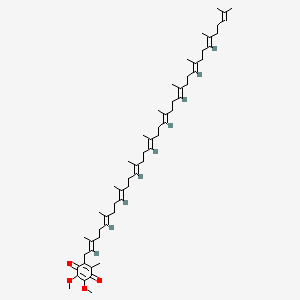
Overview
Ubidecarenone, commonly known as Coenzyme Q10 (CoQ10), is a lipid-soluble redox cofactor and endogenous antioxidant found in virtually all human cells, with the highest concentrations in metabolically active tissues such as the heart, liver, and skeletal muscle. Chemically, it belongs to the family of benzoquinone compounds and exists in two principal redox states: the oxidized ubiquinone form and the reduced ubiquinol form. Its core biological function is to serve as a mobile electron carrier within the mitochondrial inner membrane, shuttling electrons between Complexes I and II and Complex III of the electron transport chain, thereby facilitating the production of adenosine triphosphate (ATP) through oxidative phosphorylation. In its reduced state, ubiquinol acts as a potent chain-breaking antioxidant, quenching reactive oxygen species and protecting cellular membranes and lipoproteins from oxidative damage. Beyond energy metabolism, CoQ10 plays roles in membrane stabilization, modulation of mitophagy, and maintenance of mitochondrial proteostasis.
Ubidecarenone is also classified as a nutraceutical and pharmaceutical agent. It is widely used as an oral dietary supplement and has been investigated as a therapeutic candidate for conditions associated with mitochondrial dysfunction, oxidative stress, cardiovascular disease, neurodegeneration, and renal pathology. Its endogenous biosynthesis involves the mevalonate pathway, which is also targeted by statins—drugs known to deplete circulating CoQ10 levels as a side effect—making supplementation clinically relevant in statin-treated populations. Despite its established biological importance, CoQ10's extremely poor aqueous solubility and consequent low oral bioavailability have historically limited its therapeutic application, driving extensive research into novel delivery systems.
Recent Publications Focus
Recent studies have continued to examine ubidecarenone, also known as coenzyme Q10, primarily in the context of delivery systems designed to overcome its poor water solubility, low bioaccessibility, and limited mitochondrial targeting. In a cross-sectional cohort of exceptionally healthy individuals, reported coenzyme Q10 use was associated with a lower biological age signal in a longitudinal subset, although the multivariate-corrected results were not significant 42166733May. Other work focused on formulation strategies, including oleoyl-hyaluronate nanoparticles, oil phase-driven nanoemulsions, and ultra-small lipid nanoparticle, all aimed at improving stability, encapsulation, release behavior, and absorption of ubidecarenone 42105958May41895943Mar41765038Mar.
Across these formulation studies, ubidecarenone-loaded systems generally showed high encapsulation efficiency and improved physicochemical performance. Oleoyl-hyaluronate nanoparticles achieved up to 96% encapsulation efficiency, retained chemical stability over extended storage, and enhanced cellular antioxidant and anti-inflammatory activity, including protection against reactive oxygen species and modulation of HMOX1 and IL-6 expression; when incorporated into a water-in-oil emulsion, skin absorption increased 3.8-fold versus unencapsulated coenzyme Q10 and commercial liposomal formulations 42105958May. Similarly, nanoemulsions prepared with different edible oils showed high encapsulation efficiency and improved thermal, pH, and storage stability, while flaxseed- and sunflowerseed-oil systems increased in vitro bioaccessibility and ex vivo intestinal uptake relative to soybean oil formulations 41895943Mar. Ultra-small lipid nanoparticle also improved antioxidant activity and enabled adjustable release kinetics, with the best performance reported for a nanostructured lipid carrier containing olive oil 41765038Mar.
Several studies evaluated ubidecarenone in mitochondria-focused therapeutic settings. In human adipose-derived mesenchymal stem cells, coenzyme Q10 was tested alongside melatonin and was reported to reduce stress-induced mitochondrial ROS, lipid peroxidation, and cellular senescence-associated β-galactosidase activity while restoring mitophagy markers such as Parkin, NDP52, BNIP3, BNIP3L/Nix, and LC3B 42054487Apr. In a mouse model of early acetaminophen-induced liver injury, mitochondria-targeted CoQ10 nanocarriers were assessed across different particle sizes and lipid compositions; the 50-nm CoQ10-MITO-Porter produced the strongest hepatoprotective effect, with reduced serum alanine aminotransferase and hepatic necrosis, whereas larger particles and a liposome-mimicking formulation were less effective 41638489Feb. A review on atherosclerosis also highlighted mitochondria-targeted delivery systems, noting that TPP+-modified liposomes can deliver coenzyme Q10 to the mitochondrion and may have clinical potential in mitochondrial dysfunction-driven disease 41668545Feb.
Beyond delivery and mitochondrial protection, ubidecarenone was also mentioned in broader disease-focused literature. A review of steroid-resistant nephrotic syndrome noted that COQ2 and PDSS2 mutations may respond to coenzyme Q10 supplementation, underscoring its relevance in precision treatment for specific genetic subtypes 41898355Mar. One additional publication described an optimized oral nano-system formulation approach intended to unlock the bactericidal potential of coenzyme Q10, but the abstract provided only the study rationale and did not report results 41910360Mar.
What Changes, What Holds
1. CoQ10’s main recent advance is formulation science, not a new biological role -- METHOD -- Recent work mostly extends ubidecarenone’s established problem of poor aqueous solubility by testing delivery systems meant to improve stability, absorption, and mitochondrial access. The healthy-cohort signal suggesting lower biological age is intriguing but remains observational and not robust after multivariable correction, so it does not yet alter the baseline account of CoQ10 as a supplement with uncertain systemic outcome benefits 42166733May42105958May41895943Mar41765038Mar.
2. Encapsulation strategies can materially improve CoQ10 performance, but they do not yet change its core therapeutic status -- REINFORCES -- These studies sharpen the baseline by showing that better carriers can preserve chemical stability and improve antioxidant behavior, anti-inflammatory readouts, skin absorption, bioaccessibility, and intestinal uptake. That strengthens the existing view that poor bioavailability is the main barrier to clinical use, while leaving open whether these formulation gains translate into meaningful patient outcomes 42105958May41895943Mar41765038Mar.
3. Mitochondria-targeted delivery is emerging as the most consequential new use case for CoQ10 -- NEW DIRECTION -- Work in stem cells and liver injury models pushes ubidecarenone beyond generic antioxidant supplementation toward targeted mitochondrial rescue, including effects on mitophagy, senescence, and organ protection. That does not contradict the Overview’s mitochondrial role; it adds a more specific therapeutic framing that the baseline does not yet cover, though the evidence remains preclinical and needs clinical validation 42054487Apr41638489Feb41668545Feb.
4. Genetic CoQ10 deficiency remains a precision-treatment niche, and a speculative antimicrobial angle is still unproven -- REINFORCES -- The nephrotic syndrome review supports the established idea that CoQ10 is clinically relevant in selected mevalonate-pathway or biosynthetic defects, especially COQ2 and PDSS2 mutations, which fits the baseline’s emphasis on endogenous biosynthesis and supplementation. The separate nano-system paper only states a rationale for bactericidal use, so it adds no settled change to the article 41898355Mar41910360Mar.
Overview update candidates: mitochondria-targeted delivery as a therapeutic strategy; precision supplementation for COQ2/PDSS2-related disease.
ubidecarenone
Background Contexts
In the literature, the biological baseline, pathological conditions, or disease models commonly surrounding ubidecarenone are described as follows:
- mitochondrion (Cellular Component) — 2 papers: PMIDs 41668545, 41638489
- adipose tissue (Clinical Metric) — 1 paper: PMIDs 41931022
- APAP-induced liver injury (Disease) — 1 paper: PMIDs 41638489
- astaxanthin (Chemical) — 1 paper: PMIDs 41914515
- atherosclerosis (Disease) — 1 paper: PMIDs 41668545
- blood plasma (Biological Process) — 1 paper: PMIDs 41931022
- C57BL/6J mice (Organism) — 1 paper: PMIDs 41931022
- cerebellar damage (Disease) — 1 paper: PMIDs 42036720
- COQ2 (Gene) — 1 paper: PMIDs 41931022
- COQ8A (Gene) — 1 paper: PMIDs 41931022
- health enthusiasts (Other) — 1 paper: PMIDs 42166733
- heart tissue (Organism) — 1 paper: PMIDs 41931022
Methodologies & Technologies Used
Researchers utilize the following experimental methods, imaging platforms, computational models, or biological reagents to study ubidecarenone:
- 3-week intervention (Other) — 1 paper: PMIDs 41914515
- Adeno-associated virus (Technology) — 1 paper: PMIDs 41898355
- antioxidant (Other) — 1 paper: PMIDs 42054487
- bacterial lipopolysaccharide (Other) — 1 paper: PMIDs 41962635
- CoQ10-loaded nanocarriers (Technology) — 1 paper: PMIDs 41638489
- CoQ10-MITO-Porter (Technology) — 1 paper: PMIDs 41638489
- corn oil (Chemical) — 1 paper: PMIDs 41914515
- CRISPR-Cas (Technology) — 1 paper: PMIDs 41898355
- flavonoid-enriched solid lipid nanoparticles (Technology) — 1 paper: PMIDs 41765038
- free soybean oil (Chemical) — 1 paper: PMIDs 41895943
- high-pressure homogenization (Technology) — 1 paper: PMIDs 41895943
- Histidine kinase YIL147C (Technology) — 1 paper: PMIDs 41765038
Molecular Interventions & Targets
The primary molecular pathways, regulatory genes, enzymes, or therapeutic agents actively targeted and manipulated in relation to ubidecarenone include:
- 9-CpG clock (Biological Process) — 1 paper: PMIDs 42166733
- adenosine triphosphate (Chemical) — 1 paper: PMIDs 41931022
- Age Residual (Clinical Metric) — 1 paper: PMIDs 42166733
- Anti-Inflammatory Drugs Remodel the Tumor Immune Environment to Enhance Immune Checkpoint Blockade Efficacy (Therapy) — 1 paper: PMIDs 41668545
- BPM31510 (Chemical) — 1 paper: PMIDs 41931022
- calcium alpha-ketoglutarate (Chemical) — 1 paper: PMIDs 42166733
- compound fish oil capsules (Therapy) — 1 paper: PMIDs 41914515
- COQ2 (Gene) — 1 paper: PMIDs 41898355
- histamine antagonist (Chemical) — 1 paper: PMIDs 42166733
- human adipose-derived mesenchymal stem cells (Cell Line) — 1 paper: PMIDs 42054487
- magnesium L-threonate (Chemical) — 1 paper: PMIDs 42084749
- Magnesium-Acetyl-Taurate (Chemical) — 1 paper: PMIDs 42084749
Observed Outcomes & Phenotypes
The phenotypic changes, physiological endpoints, or clinical metrics observed and measured in connection with ubidecarenone include:
- heme oxygenase 1 (Gene) — 2 papers: PMIDs 42105958, 42084749
- proinflammatory cytokine (Biological Process) — 2 papers: PMIDs 42105958, 41962635
- anterior interventricular branch of left coronary artery (Cellular Component) — 1 paper: PMIDs 41914515
- antioxidant ability (Other) — 1 paper: PMIDs 41765038
- behavioral impairments (Other) — 1 paper: PMIDs 41962635
- Blood Pressure (Clinical Metric) — 1 paper: PMIDs 41914515
- BNIP3L/Nix (Protein) — 1 paper: PMIDs 42054487
- Brain derived neurotrophic factor (Protein) — 1 paper: PMIDs 42084749
- CALCOCO2 (Protein) — 1 paper: PMIDs 42054487
- CAT (Protein) — 1 paper: PMIDs 42084749
- Collagen types IV and VII (Protein) — 1 paper: PMIDs 42105958
- Cyclic-AMP response element binding protein B Dmel_CG6103 (Protein) — 1 paper: PMIDs 42084749
General Takeaways & Clinical Potentials
The high-level concepts, clinical translations, and overarching conclusions proposed in the research surrounding ubidecarenone are summarized below:
- adjustable release kinetics (Other) — 1 paper: PMIDs 41765038
- Aging and Neurodegenerative Diseases (Disease) — 1 paper: PMIDs 42084749
- Cognitive decline (Disease) — 1 paper: PMIDs 42084749
- cognitive functions (Other) — 1 paper: PMIDs 42084749
- compound fish oil capsules (Therapy) — 1 paper: PMIDs 41914515
- drug repositioning (Other) — 1 paper: PMIDs 41910360
- EDV and PDV levels (Clinical Metric) — 1 paper: PMIDs 41914515
- energy homeostasis (Biological Process) — 1 paper: PMIDs 41931022
- future controlled trials (Other) — 1 paper: PMIDs 42166733
- healthy user and recruitment bias (Other) — 1 paper: PMIDs 42166733
- liver necrosis (Disease) — 1 paper: PMIDs 41638489
- mitochondria-targeted nanomedicines (Therapy) — 1 paper: PMIDs 41638489