sorafenib
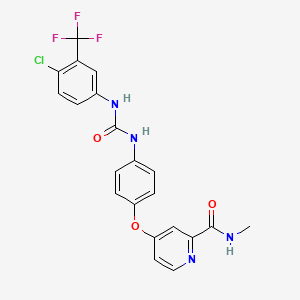
Overview
Sorafenib is an orally administered small-molecule multikinase inhibitor used as systemic anticancer therapy, marketed as Nexavar and originally developed as BAY 43-9006. It is approved for advanced hepatocellular carcinoma (HCC), advanced renal cell carcinoma (RCC), and radioiodine-refractory differentiated thyroid carcinoma. Sorafenib inhibits both tumour-cell and vascular targets: it blocks RAF kinases upstream of the MAPK signalling pathway, suppressing RAF-MEK-ERK signal transduction, and inhibits receptor tyrosine kinases that drive angiogenesis, including vascular endothelial growth factor receptor 2 (VEGFR2) and the platelet-derived growth factor receptors, along with KIT and FLT3. The combined effect is reduced tumour proliferation and reduced neovascularisation. Beyond apoptosis, sorafenib is a recognised inducer of ferroptosis, acting through inhibition of cystine uptake and depletion of glutathione, which limits glutathione peroxidase 4 (GPX4) activity and permits lethal accumulation of lipid reactive oxygen species.
For more than a decade sorafenib was the reference first-line systemic treatment for unresectable HCC, and it remains the comparator against which newer regimens are measured; immune checkpoint inhibitor–based combinations such as atezolizumab with bevacizumab, and the multikinase inhibitor lenvatinib, have since displaced it from first-line use in many settings, leaving sorafenib an important option in later lines and where immunotherapy is contraindicated. Its clinical benefit is constrained by intrinsic and acquired resistance. Described mechanisms include lysosomal sequestration of the drug, which lowers concentrations at intracellular targets; cytoprotective autophagy and altered Bcl-2/Beclin-1 balance; and suppression of ferroptosis through antioxidant programmes such as nuclear factor erythroid 2-related factor 2 (NRF2) signalling, alongside adrenergic and hypoxia-inducible factor 1-alpha (HIF-1α)–linked adaptations in the tumour microenvironment. Poor aqueous solubility also restricts exposure, motivating targeted delivery strategies such as nanoparticle and dendrimer conjugates. These liabilities make sorafenib a common backbone for combination and repurposing research, including pairings with chemotherapeutics, autophagy or lysosome-modulating agents, and immunotherapy.
Recent Publications Summary (latest 30 papers)
Recent studies have examined sorafenib's role as a first-line and subsequent-line therapy for hepatocellular carcinoma (HCC) in the context of advancing immunotherapy options. Real-world data from UK and French cohorts demonstrated that atezolizumab plus bevacizumab now achieves superior overall survival compared to sorafenib monotherapy for unresectable HCC 42477572Jul42276189Jun, and multiple trials have evaluated second-line treatments following immunotherapy failure, with lenvatinib showing a progression-free survival advantage over sorafenib in this setting 41944032Apr. The CheckMate 9DW trial indicated that nivolumab combined with ipilimumab also outperformed sorafenib and lenvatinib as first-line therapy 41981891Apr, reflecting a broad shift toward immunotherapy-based combinations. pembrolizumab monotherapy demonstrated durable antitumor activity in both sorafenib-treated and treatment-naive advanced HCC patients, providing an alternative option for those with limited tolerance 41770235Mar. Economic analyses comparing emerging agents such as finotonlimab plus bevacizumab with sorafenib have begun to inform clinical decision-making in resource-constrained settings 42133639May.
To address sorafenib's clinical limitations—poor aqueous solubility, gastrointestinal intolerance, and lack of cellular specificity—multiple delivery and formulation strategies have been developed. IGFIIR aptamer-functionalized liposomes loaded with sorafenib achieved enhanced hepatic stellate cell targeting and superior antifibrotic efficacy compared to free sorafenib in liver fibrosis models 42579473Aug, while PSMA-targeted dendrimer conjugates improved cellular uptake and MAPK suppression in prostate cancer 42342430Jun. Combination approaches have also shown promise: clomipramine potentiated sorafenib efficacy in HCC by reducing lysosomal sequestration and modulating autophagy pathways 42377685Jun, and Atorvastatin combined with sorafenib induced synergistic ferroptosis and apoptosis in colorectal cancer cell lines 42204072May. A biomimetic phase-separating hydrogel enabling co-delivery of sorafenib with oncolytic herpes simplex virus 2 successfully reversed epigenetic resistance and suppressed glioblastoma recurrence in mouse models 42097225May.
Mechanistic studies have identified and validated resistance pathways and therapeutic targets to enhance sorafenib sensitivity. Aurora-A kinase was shown to drive sorafenib resistance by scaffolding stress granule assembly through phase separation; disrupting this RNA-binding function restored drug sensitivity 42008675Apr. Stress-induced catecholamine signaling through β2-adrenergic receptors attenuated sorafenib efficacy in renal cell carcinoma by inhibiting ferroptosis 42359705Jun, while NAT10 inhibition sensitized HCC cells to sorafenib by destabilizing Nrf2 mRNA and elevating oxidative stress 41692399Feb. Carbonic anhydrase IX/XII inhibitors enhanced sorafenib sensitivity in breast and pancreatic cancer cells under both normoxic and hypoxic conditions 42059120Apr. In parallel, ferroptosis-based delivery systems—including exosomal nanoplatforms co-delivering sorafenib with endogenous miRNAs in triple-negative breast cancer 42030227Apr and mesoporous Fe-hematoporphyrin complexes for photodynamic therapy in colorectal cancer 42011059Apr—have demonstrated synergistic cytotoxic mechanisms that overcome the immunosuppressive tumor microenvironment.
Comparative drug development and mechanistic studies have identified novel compounds with improved efficacy or safety profiles relative to sorafenib. The pyruvate carboxylase inhibitor CIB-Q22 achieved comparable antitumor activity against HCC with improved in vivo stability and safety compared to sorafenib 42286802Jun, while bis(diphenylphosphine oxide)ethanes displayed 9–25-fold greater cytotoxicity against cervical cancer cells 42035247Apr, and VEGFR-2/HDAC dual-acting quinazolines showed 5–8-fold superior potency in breast and colorectal cancer models 41903478Mar. Plant-derived benzophenones (Anemarrhenones) and guaianolide-eudesmanolide dimers achieved HCC cell inhibition comparable to or exceeding sorafenib through novel targets including ALDH3A1 and NEURL1B respectively 41724003Feb41861701Mar, while VEGFR-2-selective piperazine-bridged indolin-2-one derivatives demonstrated improved selectivity and apoptosis induction in breast cancer 41785707Mar. Studies identified 3D chromatin architecture-related genes that influence response to sorafenib therapy in lung adenocarcinoma 42240917Jun. Notably, sorafenib has also been repurposed against non-oncologic pathogens: the clinical kinase inhibitor exhibited broad-spectrum efficacy against multidrug-resistant Streptococcus pneumoniae by inhibiting the bacterial serine/threonine kinase StkP, offering a potential therapeutic avenue for pneumococcal infections 42300766Jun. Together, these studies highlight ongoing efforts to optimize sorafenib's therapeutic window, overcome resistance mechanisms, and develop next-generation analogs with enhanced potency, selectivity, and safety across multiple malignancy types and diverse clinical settings.
What Changes, What Holds
1. Sorafenib is being displaced rather than extended as the default comparator in advanced HCC
NEW DIRECTION atezolizumab plus bevacizumab and nivolumab plus ipilimumab now look superior to sorafenib in first-line unresectable HCC, and lenvatinib also outperforms sorafenib in some post-immunotherapy settings 42477572Jul41981891Apr41944032Apr. That does not overturn sorafenib’s established activity, but it does narrow its practical role to later-line use, limited-access settings, or patients who cannot receive immunotherapy. pembrolizumab activity in both treated and untreated patients reinforces the shift in the treatment landscape rather than sorafenib itself 41770235Mar.
2. Sorafenib is still useful, but its best role is increasingly as a payload to be delivered or combined more intelligently
REINFORCES The new formulation and combination studies mostly sharpen the baseline problem of poor solubility, off-target exposure, and resistance, while offering ways around it rather than changing sorafenib’s core biology 42579473Aug42377685Jun. Targeted liposomes, dendrimer conjugates, and co-delivery systems suggest that efficacy can be improved by better localization and by blocking lysosomal sequestration or pairing with ferroptosis-promoting agents. These findings strengthen the rationale for delivery engineering and combination therapy that the Overview already described.
3. Multiple resistance pathways now look actionable, but none replace the established resistance model
REINFORCES Aurora-A–linked stress granule assembly, β2-adrenergic suppression of ferroptosis, and NAT10-driven Nrf2 stabilization all fit within the Overview’s account of adaptive resistance through autophagy, antioxidant signalling, and tumour microenvironmental stress responses 42008675Apr42359705Jun41692399Feb. The added value is therapeutic: each pathway now offers a concrete handle for sensitizing tumours to sorafenib. Carbonic anhydrase inhibition and ferroptosis-based delivery platforms extend that logic, but they do not displace the established mechanisms already described.
4. Sorafenib is increasingly a benchmark that newer agents and repurposed uses are measured against, not necessarily a leading option
NEW DIRECTION Comparisons with CIB-Q22, benzophenone and quinazoline analogs, and other novel compounds suggest that sorafenib is often being matched or surpassed on potency, stability, or selectivity rather than serving as the best-in-class reference 42286802Jun42035247Apr41903478Mar. The lung adenocarcinoma chromatin-architecture finding is an added predictor of response, but the more consequential departure is the antibacterial repurposing against Streptococcus pneumoniae, because the Overview covers no non-oncologic role at all 42300766Jun42240917Jun. That new use is early and mechanistically distinct, so it remains tentative.
Overview update candidates: sorafenib’s diminished first-line role in HCC; delivery engineering and combination strategies to overcome poor solubility/resistance; actionable resistance mediators; repurposing against multidrug-resistant Streptococcus pneumoniae.
sorafenib
Background Contexts
In the literature, the biological baseline, pathological conditions, or disease models commonly surrounding sorafenib are described as follows:
- liver cancer (Disease) — 13 papers: PMIDs 42286802, 42276189, 42178458, 42111772, etc.
- hepatocellular carcinoma (Disease) — 6 papers: PMIDs 42505057, 42476653, 42262196, 41944032, etc.
- ferroptosis (Biological Process) — 3 papers: PMIDs 42359705, 41946426, 41650740
- triple-negative breast cancer (Disease) — 3 papers: PMIDs 42030227, 41946426, 41650740
- advanced hepatocellular carcinoma (Disease) — 2 papers: PMIDs 42133639, 41770235
- Cancers (Clinical Metric) — 2 papers: PMIDs 41903478, 41795436
- liver tumours (Disease) — 2 papers: PMIDs 42377685, 42170959
- reactive oxygen species (Chemical) — 2 papers: PMIDs 42011059, 41687749
- rectum adenocarcinoma (Disease) — 2 papers: PMIDs 42464330, 42011059
- unresectable hepatocellular carcinoma (Disease) — 2 papers: PMIDs 42477572, 42030777
- (+)-matrine (Chemical) — 1 paper: PMIDs 41533014
- acute myeloid leukemia (Disease) — 1 paper: PMIDs 42504815
Methodologies & Technologies Used
Researchers utilize the following experimental methods, imaging platforms, computational models, or biological reagents to study sorafenib:
- human hepatocellular carcinoma (HCC) cell lines (Cell Line) — 5 papers: PMIDs 41997003, 41936795, 41861701, 41795436, etc.
- HCT 116 (Cell Line) — 4 papers: PMIDs 42560559, 42054875, 41903478, 41880789
- Hep-G2 (Cell Line) — 4 papers: PMIDs 42476653, 42381467, 42054875, 41880789
- MCF-10A (Cell Line) — 4 papers: PMIDs 42381467, 42054875, 41936795, 41785707
- Huh-7 (Cell Line) — 3 papers: PMIDs 42476653, 41861701, 41638593
- lenvatinib (Therapy) — 3 papers: PMIDs 42461363, 42342601, 42111772
- MCF-7 breast cancer cells (Cell Line) — 3 papers: PMIDs 42187623, 41795436, 41785707
- molecular docking (Technology) — 3 papers: PMIDs 42381467, 42054875, 41880789
- A-549 (Cell Line) — 2 papers: PMIDs 42035247, 41936795
- HT-29 (Cell Line) — 2 papers: PMIDs 42560559, 42204072
- Immunofluorescence (Technology) — 2 papers: PMIDs 41999263, 41292064
- MCF-7 (Disease) — 2 papers: PMIDs 42381467, 42054875
Molecular Interventions & Targets
The primary molecular pathways, regulatory genes, enzymes, or therapeutic agents actively targeted and manipulated in relation to sorafenib include:
- bevacizumab (Therapy) — 6 papers: PMIDs 42505057, 42477572, 42276189, 42133639, etc.
- atezolizumab (Therapy) — 4 papers: PMIDs 42477572, 42276189, 42262196, 42030777
- lenvatinib (Therapy) — 4 papers: PMIDs 42262196, 41999263, 41981891, 41944032
- Vascular endothelial growth factor receptor 2 (VEGFR2) (Protein) — 3 papers: PMIDs 41936795, 41903478, 41785707
- BCL2 apoptosis regulator (Protein) — 2 papers: PMIDs 42377685, 41638593
- finotonlimab (Therapy) — 2 papers: PMIDs 42505057, 42133639
- Glutathione Peroxidase 4 (GPX4) (Protein) — 2 papers: PMIDs 42030227, 41946426
- hepatocellular carcinoma (Disease) — 2 papers: PMIDs 41533014, 41292064
- nivolumab (Therapy) — 2 papers: PMIDs 42111772, 41981891
- regorafenib (Therapy) — 2 papers: PMIDs 41999263, 41944032
- Vascular endothelial growth factor receptor 2 (Protein) — 2 papers: PMIDs 42381467, 42054875
- 1,2-dihexadecanoyl-sn-glycerol-3-phosphate (Therapy) — 1 paper: PMIDs 42111772
Observed Outcomes & Phenotypes
The phenotypic changes, physiological endpoints, or clinical metrics observed and measured in connection with sorafenib include:
- apoptotic process (Biological Process) — 10 papers: PMIDs 42476653, 42381467, 42286802, 42187623, etc.
- Caspase-3 (CASP3) (Protein) — 5 papers: PMIDs 42030227, 41936795, 41903478, 41880789, etc.
- progression-free survival (Clinical Metric) — 5 papers: PMIDs 42505057, 42477572, 42461363, 42262196, etc.
- ferroptosis (Biological Process) — 4 papers: PMIDs 42476653, 42286802, 42011059, 41844497
- IC50 (Clinical Metric) — 4 papers: PMIDs 42476653, 42381467, 41638593, 41533014
- objective response rate (Clinical Metric) — 4 papers: PMIDs 42477572, 42461363, 42342601, 42262196
- overall survival (Clinical Metric) — 4 papers: PMIDs 42505057, 42477572, 42342601, 42262196
- reactive oxygen species (Chemical) — 4 papers: PMIDs 42560559, 42011059, 41692399, 41564609
- Bax (Protein) — 3 papers: PMIDs 41936795, 41903478, 41880789
- BCL2 apoptosis regulator (Protein) — 3 papers: PMIDs 41936795, 41903478, 41880789
- G2/M phase (Biological Process) — 3 papers: PMIDs 42476653, 42054875, 41936795
- lipid peroxidation (Biological Process) — 3 papers: PMIDs 42101633, 42030227, 42011059
General Takeaways & Clinical Potentials
The high-level concepts, clinical translations, and overarching conclusions proposed in the research surrounding sorafenib are summarized below:
- hepatocellular carcinoma (Disease) — 3 papers: PMIDs 42262196, 41533014, 41292064
- ferroptosis (Biological Process) — 2 papers: PMIDs 42560559, 42030227
- Targeted therapies (Therapy) — 2 papers: PMIDs 42342601, 41292064
- Advanced thyroid cancer (Disease) — 1 paper: PMIDs 42342601
- allogeneic hematopoietic cell transplantation (Therapy) — 1 paper: PMIDs 42504815
- anti-HCC activity (Biological Process) — 1 paper: PMIDs 41638593
- Anti-Hepatocellular Carcinoma Therapy (Therapy) — 1 paper: PMIDs 42476653
- anti-malarial drug resistance (Other) — 1 paper: PMIDs 41692399
- antiangiogenic therapy (Therapy) — 1 paper: PMIDs 42342601
- antifibrotic effect (Biological Process) — 1 paper: PMIDs 42579473
- apoptotic process (Biological Process) — 1 paper: PMIDs 42030227
- atezolizumab (Therapy) — 1 paper: PMIDs 42262196