olaparib
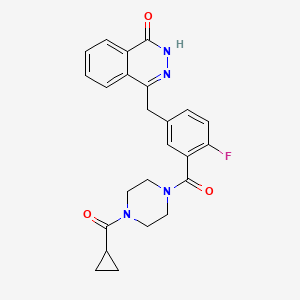
Overview
Olaparib is a small-molecule inhibitor of poly(ADP-ribose) polymerase (PARP), marketed as Lynparza and developed under the codes AZD2281 and KU59436. It is an orally administered targeted anticancer drug, used both as maintenance therapy after platinum-based chemotherapy and in combination regimens across ovarian, breast, prostate and pancreatic Cancers.
The drug binds the catalytic site of PARP1 and the related enzyme PARP2, blocking the poly(ADP-ribosyl)ation that recruits repair factors to single-strand breaks, and — more consequentially — traps the enzyme on the DNA it has bound. A trapped PARP is a worse lesion than an absent one: the stalled complex collapses the oncoming replication fork into a double-strand break that only homologous recombination can repair. Tumors deficient in that pathway, most characteristically those with germline or somatic pathogenic variants in BRCA1 or BRCA2 and more broadly those scored as homologous recombination deficiency (HRD)-positive, cannot compensate, so the drug is selectively lethal to them while sparing repair-proficient tissue. This synthetic-lethal relationship underlies both its indications and the use of BRCA testing as a companion diagnostic.
The same dependence on the DNA damage response explains its use alongside DNA-damaging and antiangiogenic agents — the platinum drugs cisplatin and carboplatin, taxanes such as paclitaxel, temozolomide, radiotherapy and bevacizumab — and its pairing in prostate cancer with abiraterone plus prednisone or prednisolone, a regimen established in trials, unlike combination with enzalutamide. It is also combined with immune checkpoint blockade such as the anti-PD-L1 antibody durvalumab. Resistance arises through reversion mutations that restore homologous recombination, loss of the trapping-sensitive target, drug efflux via P-glycoprotein, restored fork protection, and adaptive responses including autophagy; response has been inconsistent in tumors that appear PARP-inhibitor-sensitive on other grounds, such as Ewing sarcoma. Common toxicities — myelosuppression, fatigue and gastrointestinal effects — reflect action on proliferating tissue, and prolonged exposure carries a small risk of myelodysplastic syndrome or acute myeloid leukemia.
New Publications Today (1)
- PMID 42601174 — DNA hypomethylation identifying clinical benefit subgroup of small-cell lung cancer: multi-omics analysis of a phase II trial with durvalumab plus olaparib as maintenance therapy.
Recent Publications Summary
Recent publications demonstrate olaparib's role in combination therapy across multiple cancer types. In extensive-stage small-cell lung cancer, a phase II trial investigated durvalumab plus olaparib as maintenance therapy, with multi-omics analyses characterizing molecular subtypes associated with clinical outcomes, including DNA hypomethylation patterns identifying clinical benefit subgroups 42601174Aug. The phase III DUO-E/GOG-3041/ENGOT-EN10 trial reported progression-free survival benefit with carboplatin/paclitaxel plus durvalumab followed by durvalumab with or without olaparib maintenance in patients with advanced or recurrent endometrial cancer 41943281Apr41690202Feb. Cost-effectiveness analyses in advanced ovarian cancer demonstrated that olaparib plus bevacizumab significantly prolonged progression-free and overall survival compared to bevacizumab monotherapy as first-line maintenance for patients with homologous recombination deficiency-positive status at high risk of disease progression 42484750Jul. In metastatic castration-resistant prostate cancer, a phase II trial of olaparib combined with the anti-PD-L1 antibody durvalumab showed activity in an HRR-unselected population 41881502Mar, while another phase II study evaluated olaparib plus abiraterone in metastatic hormone-sensitive prostate cancer with homologous recombination repair gene mutations 42115448May.
Mechanistic studies revealed synergistic effects between olaparib and complementary therapeutic modalities. A histone deacetylase inhibitor, Chidamide, demonstrated synergistic antitumor effects with olaparib in lung cancer through cooperative downregulation of MYBL2 and BRCA1 expression, leading to G2M cell cycle arrest and enhanced apoptosis 42068974May. In triple-negative breast cancer, a novel type II SYK inhibitor synergized with olaparib by increasing DNA damage through inhibition of SYK-mediated CtIP phosphorylation, overcoming homologous recombination-mediated therapeutic resistance 42304805Jun. USP1 inhibitors potentiated olaparib efficacy in triple-negative breast cancer via enhanced suppression of tumor survival pathways and significantly improved tumor growth inhibition in xenograft models 42054575Apr. Additionally, small molecules disrupting G4-STAT1 interaction showed pronounced synergistic effects with olaparib in suppressing cancer cell viability 42087785May, and RU486 combined with olaparib enhanced apoptosis in endometriosis by simultaneously targeting hormonal signaling and DNA repair pathways 41707660Feb.
Genomic profiling and molecular biomarkers emerged as key predictors of olaparib response. Pathogenic variants in DNA repair genes including BRCA2, RAD51, and MLH1 identified actionable targets for olaparib sensitivity in a newly characterized HPV-negative cervical cancer model, where olaparib sensitivity was further augmented upon combination with platinum-based chemotherapeutics 42527451Jul. SLC44A4 downregulation in nasopharyngeal carcinoma was associated with increased sensitivity to multiple DNA-damaging agents including olaparib, doxorubicin, cisplatin, and temozolomide 42361082Jun. Clinical and molecular determinants distinguishing long-term from short-term responders to maintenance olaparib in epithelial ovarian carcinoma were characterized across primary and recurrent disease settings 41264162Nov. Companion diagnostic testing for germline BRCA1/2 pathogenic variants, essential for adjuvant olaparib use in high-risk HER2-negative early breast cancer, showed variable real-world uptake in Japanese clinical practice 42176176May.
Resistance mechanisms and safety considerations shaped clinical implementation strategies. autophagy was identified as a mechanism impairing olaparib sensitivity in Ewing sarcoma cells, explaining clinical resistance observed despite preclinical efficacy 42215796May. P-glycoprotein/ABCB1-mediated drug efflux influenced resistance to both olaparib and niraparib in ovarian cancer maintenance settings 41998207Apr. RNF146 overexpression enhanced olaparib sensitivity in triple-negative breast cancer by downregulating XRCC5, a key non-homologous end-joining protein 41932112Apr. Hematologic toxicity, particularly anemia, emerged as a dose-limiting adverse event in Japanese patients with ovarian cancer receiving olaparib, with identified clinical risk factors informing dose optimization strategies 42104280May. Comparative real-world adverse event reporting in prostate cancer patients receiving olaparib, enzalutamide, or lutetium Lu-177 vipivotide tetraxetan characterized time-dependent safety profiles 42446704Jul.
Novel drug formulations and chemical strategies extended olaparib's therapeutic reach. An olaparib-cyanine dye conjugate demonstrated proof-of-concept for improved potency in glioblastoma by facilitating blood-brain barrier crossing and enabling PARP1 inhibition in central nervous system malignancies 42035252Apr. A PARP1-specific platinum(II)-based targeted drug conjugate (Ola-604) exhibited higher tumor growth inhibitory efficacy than cisplatin, olaparib monotherapy, and their physical mixture in ovarian cancer xenograft models while demonstrating lower toxicity 41996568Apr. Fragment-based drug design coupled with artificial intelligence and machine learning approaches identified novel PARP-1 inhibitors against triple-negative breast cancer with favorable binding characteristics and pharmacokinetic properties 41724073Feb. Dual PARP-1/EGFR inhibitors represented a rational approach to improving anti-cancer efficacy through simultaneous inhibition of both pathways, with lead compounds demonstrating potent cytotoxic effects and mechanistic validation in cell-cycle arrest and apoptosis 42207930May. Physiologically based pharmacokinetic modeling enabled formulation bridging of olaparib between adult and pediatric formulations, supporting regulatory pathways without requiring all clinical bioequivalence studies 41979227Apr.
What Changes, What Holds
1. durvalumab-olaparib combinations show clinical benefit in small-cell lung cancer and endometrial cancer
REINFORCES Multiple cancer types benefit from anti-PD-L1 plus olaparib maintenance strategies 42601174Aug41943281Apr, extending the established paradigm where olaparib combines with DNA-damaging agents and immunotherapy across tumor types. Molecular stratification by DNA hypomethylation patterns in small-cell lung cancer refines patient selection within this combination class without altering the fundamental mechanism the Overview already covers.
2. Synergistic mechanisms with HDAC inhibitors, kinase inhibitors and DNA repair modulators enable rational combination design
NEW DIRECTION Mechanistic synergy between olaparib and agents like Chidamide 42068974May, SYK inhibitors 42304805Jun, and USP1 inhibitors 42054575Apr identifies cooperation pathways the Overview does not address. These establish how targeted co-inhibition of repair factors and cell-cycle checkpoints amplifies olaparib efficacy, moving beyond empirical combination screening to rational, mechanism-driven drug pairing.
3. Response heterogeneity and SLC44A4 emerge as biomarker complements to BRCA-HRD testing
NEW DIRECTION SLC44A4 downregulation predicts olaparib sensitivity in nasopharyngeal carcinoma 42361082Jun, a biomarker the Overview does not name. Long-term versus short-term responders in ovarian cancer maintenance 41264162Nov reveal durable versus transient benefit despite matching BRCA-HRD criteria, showing that current companion diagnostics cannot predict maintenance response durability and calling for expanded stratification.
4. autophagy in Ewing sarcoma and RNF146 overexpression clarify resistance and sensitivity mechanisms underlying known response variability
REINFORCES autophagy's role in Ewing sarcoma resistance 42215796May explains the response inconsistency the Overview notes but attributes only speculatively. P-glycoprotein efflux 41998207Apr and RNF146-driven XRCC5 suppression 41932112Apr add mechanistic detail to the existing resistance catalog. Japanese cohort data on anemia as a dose-limiting toxicity 42104280May sharpen understanding without changing the myelosuppression profile already established.
5. Blood-brain barrier-penetrating conjugates and dual PARP-EGFR inhibitors extend olaparib into glioblastoma and compound development beyond monotherapy
NEW DIRECTION Olaparib-cyanine conjugates enable CNS penetration for glioblastoma 42035252Apr, a tissue type entirely absent from the Overview. PARP1-platinum conjugates and AI-guided inhibitor discovery 41724073Feb represent chemical optimization strategies the baseline does not address, as do dual PARP-EGFR inhibitors 42207930May and pediatric formulation work 41979227Apr, collectively expanding the drug's applicability.
Overview update candidates: none.
olaparib
Background Contexts
In the literature, the biological baseline, pathological conditions, or disease models commonly surrounding olaparib are described as follows:
- ovarian cancer (Disease) — 4 papers: PMIDs 42104280, 42035252, 41998207, 41996568
- PARP inhibitor (Therapy) — 4 papers: PMIDs 42601174, 42240069, 42092176, 41690451
- Poly(ADP-ribose) polymerase 1 (PARP1) (Protein) — 4 papers: PMIDs 42601174, 42092176, 41881502, 41264162
- DNA repair (Biological Process) — 3 papers: PMIDs 42527451, 42068974, 42035252
- triple-negative (Other) — 3 papers: PMIDs 42304805, 42240069, 41932112
- endometrial cancer (Disease) — 2 papers: PMIDs 41943281, 41690202
- prostate adenocarcinoma (Disease) — 2 papers: PMIDs 42446704, 42342430
- triple-negative breast cancer (Disease) — 2 papers: PMIDs 42054575, 41724073
- (chemo)radiotherapy (Biological Process) — 1 paper: PMIDs 42359758
- acquired resistance (Biological Process) — 1 paper: PMIDs 42092176
- advanced OC (Disease) — 1 paper: PMIDs 42484750
- antitumor activity (Clinical Metric) — 1 paper: PMIDs 42601174
Methodologies & Technologies Used
Researchers utilize the following experimental methods, imaging platforms, computational models, or biological reagents to study olaparib:
- MDA-MB-231 (Cell Line) — 2 papers: PMIDs 42418250, 42207930
- triple-negative breast adenocarcinoma (Cell Line) — 2 papers: PMIDs 42304805, 42001586
- 1,2,3-Triazole (Chemical) — 1 paper: PMIDs 42001586
- 1,3-dihydro-2H-imidazo[4,5-c]pyridin-2-one (Chemical) — 1 paper: PMIDs 42054575
- 4T1 cells (Cell Line) — 1 paper: PMIDs 41932112
- acetonitrile (Chemical) — 1 paper: PMIDs 42490602
- AI/machine learning (Technology) — 1 paper: PMIDs 42304805
- athymic mice (Organism) — 1 paper: PMIDs 42257398
- autophagy pathways (Biological Process) — 1 paper: PMIDs 42215796
- Base-case analysis (Technology) — 1 paper: PMIDs 42484750
- Bayesian confidence propagation neural network (Other) — 1 paper: PMIDs 42446704
- benzimidazole (Chemical) — 1 paper: PMIDs 42304805
Molecular Interventions & Targets
The primary molecular pathways, regulatory genes, enzymes, or therapeutic agents actively targeted and manipulated in relation to olaparib include:
- Poly(ADP-ribose) polymerase 1 (PARP1) (Protein) — 9 papers: PMIDs 42257398, 42207930, 42092176, 42035252, etc.
- durvalumab (Therapy) — 4 papers: PMIDs 42601174, 41943281, 41881502, 41690202
- cisplatin/fluorouracil (Therapy) — 2 papers: PMIDs 42361082, 42359758
- doxorubicin (Therapy) — 2 papers: PMIDs 42361082, 42207930
- PARP inhibitor (Therapy) — 2 papers: PMIDs 42527451, 42304805
- poly(ADP) ribose polymerase inhibitors (Therapy) — 2 papers: PMIDs 42215796, 42054575
- [211At]LT-674 (Therapy) — 1 paper: PMIDs 42257398
- [211At]talazoparib (Therapy) — 1 paper: PMIDs 42257398
- abemaciclib (Therapy) — 1 paper: PMIDs 42490602
- abiraterone (Therapy) — 1 paper: PMIDs 42115448
- adult and pediatric formulations (Other) — 1 paper: PMIDs 41979227
- ALK-mutant neuroblastoma (Disease) — 1 paper: PMIDs 42359758
Observed Outcomes & Phenotypes
The phenotypic changes, physiological endpoints, or clinical metrics observed and measured in connection with olaparib include:
- apoptotic process (Biological Process) — 7 papers: PMIDs 42418250, 42207930, 42068974, 42001586, etc.
- DNA repair (Biological Process) — 3 papers: PMIDs 42601174, 42361082, 41996568
- tumor growth inhibition (Clinical Metric) — 3 papers: PMIDs 42257398, 42207930, 42054575
- anemia (Clinical Metric) — 2 papers: PMIDs 42446704, 42104280
- DNA damage (Biological Process) — 2 papers: PMIDs 42304805, 42054575
- icELISA IC50 (Clinical Metric) — 2 papers: PMIDs 42304805, 42001586
- synthetic lethality (Biological Process) — 2 papers: PMIDs 42068974, 41661672
- 90 Days (Other) — 1 paper: PMIDs 42446704
- Accuracy (Clinical Metric) — 1 paper: PMIDs 42490602
- adaptive drug resistance (Biological Process) — 1 paper: PMIDs 41998207
- Alive and progression-free at 12 months rate (Clinical Metric) — 1 paper: PMIDs 42601174
- Antigen presentation machinery (Biological Process) — 1 paper: PMIDs 42601174
General Takeaways & Clinical Potentials
The high-level concepts, clinical translations, and overarching conclusions proposed in the research surrounding olaparib are summarized below:
- [211At]talazoparib (Therapy) — 1 paper: PMIDs 42257398
- abemaciclib (Therapy) — 1 paper: PMIDs 42490602
- anti-malarial drug resistance (Other) — 1 paper: PMIDs 41690451
- Antitumor Effects (Clinical Metric) — 1 paper: PMIDs 42068974
- bioequivalence (Clinical Metric) — 1 paper: PMIDs 41979227
- BRCA (Organism) — 1 paper: PMIDs 42092176
- chronic stress-related biomarkers (Other) — 1 paper: PMIDs 42361082
- cost effectiveness (Other) — 1 paper: PMIDs 42484750
- cross-drug comparisons (Other) — 1 paper: PMIDs 42446704
- DNA hypomethylation (Biological Process) — 1 paper: PMIDs 42601174
- Durvalumab plus olaparib (Therapy) — 1 paper: PMIDs 42601174
- G4 stabilizers (Other) — 1 paper: PMIDs 42087785