Ibrutinib
Ibrutinib is a first-in-class, orally administered small-molecule inhibitor of Bruton's tyrosine kinase (BTK), the signaling enzyme that relays B-cell receptor (BCR) engagement to downstream survival pathways.
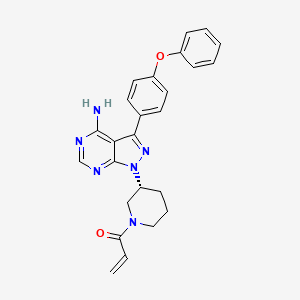
Ibrutinib is a first-in-class, orally administered small-molecule inhibitor of Bruton's tyrosine kinase (BTK), the signaling enzyme that relays B-cell receptor (BCR) engagement to downstream survival pathways. It forms an irreversible covalent bond with cysteine-481 in the ATP-binding site — with hydrogen bonding at Glu475 and Met477 — permanently silencing the kinase in each molecule it meets, so activity outlasts the drug's short plasma half-life and permits once-daily dosing. Blocking BTK cuts the survival and proliferation signals malignant B cells depend on, including flux through the PI3K/Akt signaling pathway, and also disrupts the adhesion and chemokine responses that keep those cells in protective tissue niches; the transient lymphocytosis seen on starting treatment is malignant cells being displaced into the blood rather than disease progression. Approved in 2013, it established BTK inhibition as a pillar of hematologic oncology.
Its indications span B-cell neoplasms including chronic lymphocytic leukemia (CLL), mantle cell lymphoma (MCL), Waldenström macroglobulinemia (WM) and marginal zone lymphoma (MZL). The covalent chemistry that makes it potent is also the source of its characteristic toxicity: cysteine-481 is not unique to BTK, and off-target inhibition of related kinases including EGFR, ITK and TEC family members contributes to rash, diarrhea and bleeding, while the mechanism of atrial fibrillation remains incompletely understood; these toxicities limit long-term use. Next-generation covalent inhibitors such as acalabrutinib and zanubrutinib were designed for greater selectivity and carry less of that burden, which is the principal reason they have displaced ibrutinib in several settings.
Resistance most often arises by mutation of cysteine-481 itself, removing the anchor the covalent bond requires, or by activating mutations in PLCG2 downstream of the kinase — a failure mode that prompted non-covalent BTK inhibitors binding elsewhere, and BTK-directed degraders that remove the protein rather than inhibit it. Combination strategies, mechanisms of resistance and novel BTK-targeting compounds remain active areas of investigation.
Where the papers sit
13 papers from the last 6 months study ibrutinib directly · updated from PubMed 12 Oct 2026
Study type 4 clinical trials · 2 observational · 1 human data · 4 preclinical · 2 unclassified
Themes one subject · 1 paradigm shift · 1 new direction
Those 13 are all about one subject.
-
BTK Inhibition Across Cancers
BTK inhibition is being assessed across CLL, mantle cell lymphoma, diffuse large B-cell lymphoma and selected solid-tumour settings. Clinical studies emphasize first-line combinations such as ibrutinib with venetoclax, trastuzumab or autologous transplantation, alongside adherence and cardiovascular toxicity. Translational work repeatedly examines BCR phenotype, cytokine and microenvironmental resistance, including IL-16 and immunosuppressive T-cell states. Ocular toxicity, brain delivery and screening studies broaden the safety and treatment-development questions without establishing one dominant direction.
Ibrutinib resistance can be imposed by the tumor microenvironment rather than arising solely from tumor-intrinsic genetic escape
The DLBCL decellularized human bone-derived 3D scaffold model and the chronic-ibrutinib-exposed marginal zone lymphoma model (PMIDs 42455448, 42213644) found that ibrutinib sensitivity observed in conventional tumor-cell assays does not reliably predict treatment response in a microenvironmental context. ECM adhesion reduced drug-induced apoptosis in DLBCL cells, while a non-genetic, cytokine-secretory state centered on IL-16 induced cross-resistance across several B-cell lymphoma models and was associated with elevated IL-16 in mutation-negative refractory CLL. The resulting change is to treat extracellular matrix interactions and cytokine-mediated cell-state reprogramming as causal mechanisms of resistance, not merely as secondary correlates or explanations requiring BTK or PLCG2 mutations.
Ibrutinib is developed as an intranasal, brain-targeted liposomal treatment for glioblastoma
The glioblastoma study treats ibrutinib not as conventional systemic BTK-inhibitor therapy for a B-cell malignancy but as the payload of a pH-sensitive liposomal formulation designed for direct nose-to-brain delivery. By addressing poor solubility, limited bioavailability, and blood–brain barrier permeability through an intranasal delivery system, it assigns ibrutinib a drug-delivery role outside the systemic targeted-treatment and combination-therapy uses represented by the other papers 42184887May.
Papers
The 13 papers from the last 6 months that study ibrutinib directly, newest first, by theme and by study type. Study types come from PubMed publication types and MeSH headings.
By theme
BTK Inhibition Across Cancers (13)
- Uveitis as a class effect of Bruton tyrosine kinase inhibitors: ibrutinib and zanubrutinib ocular toxicity. BMJ case reports · 29 Sept 2026 PMID 42810753
- High-throughput primary B cell cytokines assay for drug screening in multiple sclerosis. Biomedicine & pharmacotherapy = Biomedecine & pharmacotherapie · 4 Sept 2026 PMID 42697043
- Long-Term Clinical Outcomes, Adherence, Persistence, and Adverse Event Management in Patients With Chronic Lymphocytic Leukemia Treated With Ibrutinib. European journal of haematology · 14 Aug 2026 PMID 42598870
- A Phase I/II Study of Ibrutinib Plus Trastuzumab in HER2-Positive Metastatic Breast Cancer. Cancer medicine · 27 Jul 2026 PMID 42504645
- First-line ibrutinib plus venetoclax for nonblastoid mantle cell lymphoma in patients ≥65 years old or with TP53 mutations. Blood · 16 Jul 2026 PMID 42462092
- DLBCL-microenvironment interactions: cytokine profiling and ECM-mediated ibrutinib resistance in a 3D bone-based model. Medical oncology (Northwood, London, England) · 15 Jul 2026 PMID 42455448
- The Impact of the BCR Phenotype of Large B-cell Lymphoma on Ibrutinib Sensitivity. Anticancer research · 29 Jun 2026 PMID 42373252
- Ibrutinib for early-stage CLL: genetic risk factors and treatment outcome in the GCLLSG CLL12 trial. Blood · 20 Jun 2026 PMID 42322115
- IL-16 production is a mechanism of resistance to BTK inhibitors and R-CHOP in lymphomas. Blood · 29 May 2026 PMID 42213644
- QbD-based intranasal pH-sensitive Ibrutinib liposomes for glioblastoma management: in vitro, ex vivo, and in vivo pharmacokinetics and brain distribution assessment. European journal of pharmaceutics and biopharmaceutics : official journal of Arbeitsgemeinschaft fur Pharmazeutische Verfahrenstechnik e.V · 25 May 2026 PMID 42184887
- Addition of autologous stem-cell transplantation to an ibrutinib-containing first-line treatment in patients aged 18-65 years with mantle cell lymphoma (TRIANGLE): 4·5-year follow-up of a three-arm, randomised, open-label, phase 3 superiority trial of the European MCL Network. Lancet (London, England) · 14 May 2026 PMID 42134356
- Comparative Risk of Adverse Cardiovascular Outcomes With Zanubrutinib Versus Ibrutinib in B-Cell Malignancies: A Large Real-World Propensity-Matched Analysis. The American journal of cardiology · 5 May 2026 PMID 42086088
- Single-Cell RNA-seq Analysis Reveals Distinct Tumor and Immunosuppressive T-Cell Phenotypes in Patients with CLL Treated with Ibrutinib. Clinical cancer research : an official journal of the American Association for Cancer Research · 22 Apr 2026 PMID 42018044
By study type
Clinical trials (4)
- A Phase I/II Study of Ibrutinib Plus Trastuzumab in HER2-Positive Metastatic Breast Cancer. Cancer medicine · 27 Jul 2026 PMID 42504645
- First-line ibrutinib plus venetoclax for nonblastoid mantle cell lymphoma in patients ≥65 years old or with TP53 mutations. Blood · 16 Jul 2026 PMID 42462092
- Ibrutinib for early-stage CLL: genetic risk factors and treatment outcome in the GCLLSG CLL12 trial. Blood · 20 Jun 2026 PMID 42322115
- Addition of autologous stem-cell transplantation to an ibrutinib-containing first-line treatment in patients aged 18-65 years with mantle cell lymphoma (TRIANGLE): 4·5-year follow-up of a three-arm, randomised, open-label, phase 3 superiority trial of the European MCL Network. Lancet (London, England) · 14 May 2026 PMID 42134356
Observational studies and case reports (2)
- Uveitis as a class effect of Bruton tyrosine kinase inhibitors: ibrutinib and zanubrutinib ocular toxicity. BMJ case reports · 29 Sept 2026 PMID 42810753
- Comparative Risk of Adverse Cardiovascular Outcomes With Zanubrutinib Versus Ibrutinib in B-Cell Malignancies: A Large Real-World Propensity-Matched Analysis. The American journal of cardiology · 5 May 2026 PMID 42086088
Human data, design not indexed (1)
- Single-Cell RNA-seq Analysis Reveals Distinct Tumor and Immunosuppressive T-Cell Phenotypes in Patients with CLL Treated with Ibrutinib. Clinical cancer research : an official journal of the American Association for Cancer Research · 22 Apr 2026 PMID 42018044
Preclinical: animal, cell and lab studies (4)
- High-throughput primary B cell cytokines assay for drug screening in multiple sclerosis. Biomedicine & pharmacotherapy = Biomedecine & pharmacotherapie · 4 Sept 2026 PMID 42697043
- DLBCL-microenvironment interactions: cytokine profiling and ECM-mediated ibrutinib resistance in a 3D bone-based model. Medical oncology (Northwood, London, England) · 15 Jul 2026 PMID 42455448
- The Impact of the BCR Phenotype of Large B-cell Lymphoma on Ibrutinib Sensitivity. Anticancer research · 29 Jun 2026 PMID 42373252
- QbD-based intranasal pH-sensitive Ibrutinib liposomes for glioblastoma management: in vitro, ex vivo, and in vivo pharmacokinetics and brain distribution assessment. European journal of pharmaceutics and biopharmaceutics : official journal of Arbeitsgemeinschaft fur Pharmazeutische Verfahrenstechnik e.V · 25 May 2026 PMID 42184887
Unclassified: not yet indexed with MeSH (2)
- Long-Term Clinical Outcomes, Adherence, Persistence, and Adverse Event Management in Patients With Chronic Lymphocytic Leukemia Treated With Ibrutinib. European journal of haematology · 14 Aug 2026 PMID 42598870
- IL-16 production is a mechanism of resistance to BTK inhibitors and R-CHOP in lymphomas. Blood · 29 May 2026 PMID 42213644
Written from 13 PubMed abstracts, each one listed by PMID above. Published: 2026-06-15. Last written: 2026-08-26 by GPT. Corrections: 2026-09-26 by GPT. Drafted by language models from published abstracts; not medical advice.