apigenin
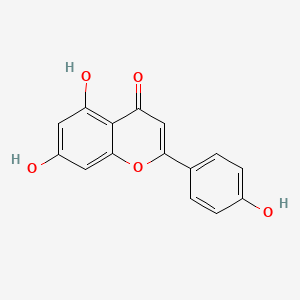
Overview
Apigenin is a naturally occurring plant flavone, a subclass of flavonoids widely distributed in edible and medicinal plants. In biomedical research, it is commonly studied for its antioxidant, anti-inflammatory, and cytoprotective properties, as well as for its ability to participate in multi-component phytochemical systems and nanomedicine formulations. Across the recent studies provided here, apigenin appears as a bioactive constituent of herbal extracts and formulations, and also as a building block in carrier-free nanoparticle assemblies.
Biologically, apigenin is being investigated in relation to inflammatory signaling, oxidative stress, cardiovascular protection, and tissue injury responses. The recent literature contexts specifically connect it with pathways and targets such as NLRP3, Caspase-1, Gasdermin D (GSDMD), FOXO1/PDK4 signaling, and broader polyphenol-based therapeutic platforms that also involve tannic acid, Cu2+ ions, cannabidiol, kaempferol, quercetin, salidroside, naringenin, and related phytochemicals.
Recent Publications Summary
Apigenin has been examined across this recent literature primarily as a plant-derived flavone with anti-inflammatory and anticancer activity, and secondarily as a bioactive constituent used to characterize or standardize botanical extracts. In a dietary-glycoside study, apiin (apigenin-7-O-apiosylglucoside) was shown to resist host digestion and undergo microbial deglycosylation in the distal intestine to release apigenin as the bioactive aglycone; apiin administration was associated with reduced severity of DSS-induced colitis, lower TNF-α, IL-1β and IL-6, and restored intestinal barrier integrity, with multi-omics analyses linking these effects to reshaped gut microbiota, increased butyrate production, GPR41/GPR43 and PPARγ signaling, and attenuated NF-κB-driven inflammation 42448689Jul. This positions apigenin as the downstream effector of a microbiota-dependent biotransformation rather than as a directly absorbed dietary compound.
Anti-inflammatory and anticancer effects have been probed through combined network pharmacology, docking and in vitro or in vivo validation. In Dolichos lablab flower extract, apigenin (5.72% of the purified n-butanol fraction) and quercetin (4.06%) were the predominant constituents among 44 identified compounds, with apigenin predicted to act on core targets including TNF, IL6 and PTGS2 and showing strong docking affinity for TNF (ΔG = −10.9 kcal/mol); the extract suppressed pro-inflammatory cytokines in LPS-stimulated RAW 264.7 macrophages 42383440Jul. An in silico screen of Scutellaria barbata identified apigenin, 4′-hydroxywogonin and hispidulin as favorable drug-like flavonoids acting on the hub targets AKT1, IL6 and TNF within PI3K-Akt, MAPK and TNF signaling, with apigenin binding at −7.7 kcal/mol and hispidulin at −8.1 kcal/mol, nominating apigenin as an AKT1 inhibitor candidate in breast cancer 42348584Jun. In vivo, apigenin and chrysin were tested individually and in combination at 50 mg/kg orally for 8 weeks in a diethylnitrosamine/2-acetylaminofluorene rat model of hepatocellular carcinoma, with biochemical and histopathological endpoints assessed against DEN-induced activation of tumor-promoting signaling 42346026Jun.
Apigenin has also been incorporated into delivery systems and evaluated alongside other flavonoids in neuroprotection research. A biomimetic, macrophage-membrane-coated nanoparticle combined polysaccharide for immunomodulation, apigenin for cardiovascular protection and cannabidiol for neuroprotection into a single multi-target formulation, characterized physicochemically and tested for efficacy in a middle cerebral artery occlusion model of ischemic stroke 42003696Apr. In a phytochemical study of five Encephalartos species, apigenin was isolated from the ethyl acetate fraction of E. ferox together with naringenin and the biflavonoids amentoflavone, bilobetin and ginkgetin; the biflavonoids, rather than apigenin itself, carried the reported acetylcholinesterase inhibition (IC50 0.762–2.146 µg/mL versus rivastigmine at 3.357 µg/mL), and a validated HPLC-DAD method was developed for their simultaneous quantification 42443245Jul.
A further group of studies uses apigenin chiefly as an analytical marker of extract composition. Metabolomic profiling of Achillea arabica ethanolic extract by UHPLC-QTOF-MS² listed apigenin among the key constituents alongside chlorogenic acid, isorhamnetin, kaempferol-3-O-glucoside, naringenin and anthocyanin glycosides, underpinning the extract's antioxidant (DPPH IC50 135.99 µg/mL; ABTS IC50 422.02 µg/mL), antidiabetic and anti-inflammatory activities 42126671May, while response-surface optimization of ultrasound-assisted extraction from dandelion (Taraxacum officinale) maximized recovery of total phenolics (40.77 mg GAE/g) and flavonoids (22.68 mg RE/g) with HPLC profiling of individual bioactives 42068787May. Apigenin appears in a similar constituent-level role in work on multi-component traditional formulations: Yangxinshi Tablet improved cardiac function and mitochondrial energy metabolism in post-myocardial-infarction heart failure through inhibition of FOXO1/PDK4 signaling, with its components profiled by molecular docking and validated in cell-based assays, and the "Tianyu" formulation reduced NLRP3/caspase-1/GSDMD-mediated pyroptosis and IL-1β, IL-18 and TNF-α release in rheumatoid arthritis fibroblast-like synoviocytes and a collagen-induced arthritis rat model 42033182Apr. Collectively, these reports converge on inflammatory signaling — TNF, IL-6, NF-κB and PI3K-Akt — as the recurring axis through which apigenin is proposed to act, though most mechanistic support to date is computational or extract-level rather than derived from apigenin administered alone.
What Changes, What Holds
1. Apigenin now appears to act downstream of gut microbial deglycosylation rather than only as a directly absorbed flavone
NEW DIRECTION Apiin’s conversion to apigenin in the distal intestine adds a microbiota-dependent route to apigenin exposure and helps explain why the aglycone can mediate anti-colitic effects in a way that depends on host microbes, barrier repair, and short-chain fatty acid signaling 42448689Jul. This does not displace the established anti-inflammatory profile of apigenin, but it does narrow how its dietary bioavailability should be understood.
2. Recent screening work strengthens apigenin’s anti-inflammatory and anticancer candidacy but does not yet move it beyond a lead compound
REINFORCES The new extract-level, docking, and validation studies keep apigenin aligned with the baseline view of a flavone acting on inflammatory signaling and cancer-related targets, especially TNF, IL6, PTGS2 and AKT1 42383440Jul42348584Jun. What changes is mainly confidence in target plausibility and botanical relevance, not the underlying claim that apigenin is a bioactive anti-inflammatory phytochemical.
3. Apigenin is being pushed into combination delivery and comparative phytochemistry, not a new biological role
REINFORCES The nanoparticle formulation extends the existing nanomedicine context by packaging apigenin with other agents for multi-target use, while the Encephalartos study mainly treats it as one constituent among several flavonoids 42003696Apr42443245Jul. Neither result overturns the baseline; both reinforce apigenin’s utility as a component in complex formulations and analytical profiling rather than as a newly defined mechanism-specific drug.
4. Apigenin is increasingly used as a compositional marker in extracts whose activity is still attributed to mixed phytochemistry
METHOD Metabolomic and HPLC-oriented studies place apigenin among the compounds used to characterize botanical preparations with antioxidant, antidiabetic, anti-inflammatory, or cardiometabolic effects 42126671May42068787May42033182Apr. That shifts the emphasis toward standardization and mixture analysis, while leaving the baseline mechanistic story intact and still largely inferential rather than apigenin-alone driven.
Overview update candidates: microbiota-dependent release of apigenin from apiin; apigenin as a compositional marker in extract standardization and multi-component formulations.
apigenin
Background Contexts
In the literature, the biological baseline, pathological conditions, or disease models commonly surrounding apigenin are described as follows:
- Achillea arabica Kotschy (Organism) — 1 paper: PMIDs 42126671
- Carrier-free self-assembled nanomedicines (Other) — 1 paper: PMIDs 42133860
- colon cancer liver metastasis (Disease) — 1 paper: PMIDs 42365116
- Dandelion (Taraxacum mongolicum Hand.-Mazz.) (Organism) — 1 paper: PMIDs 42068787
- enzyme-responsive system (Other) — 1 paper: PMIDs 42365116
- heart failure (Disease) — 1 paper: PMIDs 42062031
- ischemic stroke (Disease) — 1 paper: PMIDs 42003696
- liver tumours (Disease) — 1 paper: PMIDs 42346026
- locally advanced or metastatic breast cancer (Disease) — 1 paper: PMIDs 42348584
- myocardial infarction (Disease) — 1 paper: PMIDs 42062031
- rheumatoid arthritis (Disease) — 1 paper: PMIDs 42033182
- Scutellaria barbata D. Don (Organism) — 1 paper: PMIDs 42348584
Methodologies & Technologies Used
Researchers utilize the following experimental methods, imaging platforms, computational models, or biological reagents to study apigenin:
- Immunofluorescence (Technology) — 2 papers: PMIDs 42062031, 42033182
- western blot (Technology) — 2 papers: PMIDs 42062031, 42033182
- 2,2-diphenyl-1-picrylhydrazyl (Technology) — 1 paper: PMIDs 42068787
- 2-acetylaminofluorene (Chemical) — 1 paper: PMIDs 42346026
- A. arabica ethanolic extract (Other) — 1 paper: PMIDs 42126671
- acridine orange/ethidium bromide (Technology) — 1 paper: PMIDs 42033182
- anti-CCP (Clinical Metric) — 1 paper: PMIDs 42033182
- arthritis scores (Clinical Metric) — 1 paper: PMIDs 42033182
- Box-Behnken design (BBD) (Technology) — 1 paper: PMIDs 42068787
- Cell Counting Kit-8 (CCK-8) (Technology) — 1 paper: PMIDs 42033182
- chromatin immunoprecipitation (Technology) — 1 paper: PMIDs 42062031
- cognitively unimpaired (Other) — 1 paper: PMIDs 42365116
Molecular Interventions & Targets
The primary molecular pathways, regulatory genes, enzymes, or therapeutic agents actively targeted and manipulated in relation to apigenin include:
- (E)-chlorogenic acid (Chemical) — 2 papers: PMIDs 42126671, 42068787
- isorhamnetin (Chemical) — 2 papers: PMIDs 42126671, 42033182
- quercetin (Chemical) — 2 papers: PMIDs 42068787, 42033182
- 4'-Hydroxywogonin (Chemical) — 1 paper: PMIDs 42348584
- active ingredients (Other) — 1 paper: PMIDs 42068787
- antioxidant (Other) — 1 paper: PMIDs 42068787
- apigenin-copper (Chemical) — 1 paper: PMIDs 42365116
- astragaloside IV (Chemical) — 1 paper: PMIDs 42062031
- Astragaloside VII (Chemical) — 1 paper: PMIDs 42062031
- AT-Cu NPs (Other) — 1 paper: PMIDs 42133860
- caftaric acid (Chemical) — 1 paper: PMIDs 42068787
- cannabidiol (Chemical) — 1 paper: PMIDs 42003696
Observed Outcomes & Phenotypes
The phenotypic changes, physiological endpoints, or clinical metrics observed and measured in connection with apigenin include:
- 1OSE-cosmosiin complex (Protein) — 1 paper: PMIDs 42126671
- 2,2'-azino-bis(3-ethylbenzothiazoline-6-sulfonic acid) (Other) — 1 paper: PMIDs 42068787
- ABTS+• radicals (Other) — 1 paper: PMIDs 42126671
- adenosine triphosphate (Chemical) — 1 paper: PMIDs 42062031
- Annexin V (Protein) — 1 paper: PMIDs 42346026
- Area Under the Receiver Operating Characteristic Curve (Clinical Metric) — 1 paper: PMIDs 42365116
- biocompatibility (Other) — 1 paper: PMIDs 42003696
- BIRC5 (Protein) — 1 paper: PMIDs 42346026
- cancer cell killing (Biological Process) — 1 paper: PMIDs 42133860
- cardiac function (Clinical Metric) — 1 paper: PMIDs 42062031
- caspase-3 (Protein) — 1 paper: PMIDs 42346026
- Cellular Apoptosis (Biological Process) — 1 paper: PMIDs 42365116
General Takeaways & Clinical Potentials
The high-level concepts, clinical translations, and overarching conclusions proposed in the research surrounding apigenin are summarized below:
- A. arabica (Organism) — 1 paper: PMIDs 42126671
- Antitumor Effects (Clinical Metric) — 1 paper: PMIDs 42346026
- biochemical and histopathological findings (Other) — 1 paper: PMIDs 42346026
- biocompatible, carrier-free nanotherapeutic strategy (Other) — 1 paper: PMIDs 42133860
- Cerebral Stroke (Disease) — 1 paper: PMIDs 42003696
- combination cancer treatment (Other) — 1 paper: PMIDs 42133860
- food and pharmaceutical industry (Other) — 1 paper: PMIDs 42068787
- hypoxic-microenvironment-responsive therapeutic strategy (Therapy) — 1 paper: PMIDs 42365116
- joint inflammation (Clinical Metric) — 1 paper: PMIDs 42033182
- oncogenic signaling pathways (Biological Process) — 1 paper: PMIDs 42348584
- optimized ultrasound-assisted extraction method (Other) — 1 paper: PMIDs 42068787
- pyroptosis (Biological Process) — 1 paper: PMIDs 42033182