acarbose
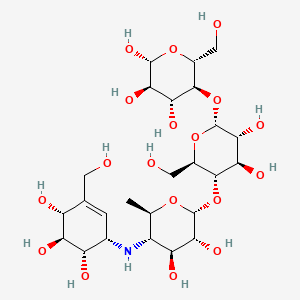
Overview
Acarbose is an orally administered antidiabetic drug used primarily to reduce postprandial hyperglycemia. It acts as an inhibitor of intestinal carbohydrate-digesting enzymes, especially α-glucosidase, and is also commonly used as a reference inhibitor in studies of α-amylase and related carbohydrate-hydrolyzing targets. By slowing the breakdown of complex carbohydrates into absorbable monosaccharides, acarbose reduces the rate at which glucose enters the bloodstream after meals.
In biomedical research, acarbose is frequently used as a benchmark compound for evaluating new α-glucosidase inhibitors, antidiabetic natural products, and synthetic small molecules. In the recent studies summarized here, it served both as a comparator drug and as a target-related reference in assays examining enzyme inhibition, docking, and postprandial glucose control. The surrounding research context also links acarbose to broader metabolic and functional-food investigations involving Acid α-glucosidase (AAG), Amylase alpha 1C (AMY1C), obesity, and hyperinsulinemic T2D patients.
Recent Publications Summary
Acarbose functions almost exclusively as the benchmark reference compound across this body of work, providing the potency yardstick against which novel synthetic scaffolds, food-derived peptides, plant extracts, and nanomaterials are judged for α-glucosidase and α-amylase inhibition.
Several medicinal-chemistry campaigns reported compounds substantially outperforming acarbose in vitro. N-propylcarbazole-1,3-thiazole hybrids yielded compound 5k with an IC50 of 6.25 ± 0.17 μM against acarbose's 118.09 ± 8.39 μM, with Lineweaver-Burk analysis indicating uncompetitive inhibition 42033845Apr. Thiazole-hydrazine hybrids built on an isoindole-1,3-dione core produced TR6 (KI 0.452 ± 0.093 μM), roughly 15-fold more potent than acarbose (KI 6.748 ± 0.167 μM), with halogenation by chlorine or bromine identified as the key potency-enhancing substitution 41855632Mar. Chromenone-linked spiro[indene-2,3'-pyrrolizine]-1,3-diones gave a 3-bromo analog (3m, IC50 45.07 ± 7.54 μM) approximately 16 times more potent than acarbose 42000452Apr, and pyrrole-based imidazothiazoles yielded compound 8 that surpassed acarbose against both α-amylase and α-glucosidase (3.50 ± 0.20 and 4.10 ± 0.10 μM versus 6.20 ± 0.10 and 6.70 ± 0.20 μM) 41576694Jan. A distinct carbohydrate-mimetic series — 25 sulfonium-type neoponkoranol derivatives bearing a methyl-glycosyl furanose scaffold — achieved maltase and sucrase IC50 values of 0.14–2.21 μM comparable or superior to acarbose and voglibose, and notably retained strong isomaltase inhibition, an activity against which acarbose was almost inactive 41849948Mar.
Natural-product and biomolecule work followed the same comparative framing. Twelve biphenyl derivatives from Garcinia nujiangensis included five compounds more potent than acarbose, with compound 10 (IC50 37.80 ± 1.43 μg·mL⁻¹) roughly seven-fold stronger; the same series also outperformed Atorvastatin in lipid-lowering assays in OA-induced HepG2 cells 42297079Jun. Rational sequence modification of the food-derived peptide FAPSW, whose activity had been weaker than acarbose, generated YAPSW (IC50 0.126 ± 0.008 mM), which exceeded both the parent peptide and acarbose in α-glucosidase inhibition while also improving insulin resistance via IRS-1/PI3K/AKT signaling 42118964May.
Extract-based studies generally reported activity below or at parity with acarbose rather than above it. An aqueous Fagonia cretica extract rich in Phenolic Acids (salicylic, ferulic, gallic) and flavonoids (quercetin, luteolin, catechin, epicatechin) inhibited α-amylase only weakly to modestly relative to acarbose 42168772May. Green-synthesized ZnO nanoparticles from pomegranate husk extract inhibited pancreatic lipase and α-amylase by more than 70%, described as comparable to the standards orlistat and acarbose, while retaining biocompatibility in Vero cells 42142531May. Chia (Salvia hispanica) seed extracts, dominated by rosmarinic acid and caffeic derivatives, were profiled against maltase, sucrase, and starch-degrading enzymes alongside oral sucrose tolerance and acute hypoglycemia testing in Wistar rats 42313210Jun, and Malpighia glabra (acerola) fruit extracts rich in rutin were assessed for enzyme inhibition and synergistic effects with pharmaceutical drugs 41944642Apr.
One study moved beyond benchmarking to combination pharmacology: a deep eutectic solvent extraction process (choline chloride/1,4-butanediol, selected from COSMO-SAC screening of 128 candidates) yielded luteolin-rich Chrysanthemi indici flos extract showing mixed-type α-glucosidase inhibition with synergistic potentiation of acarbose, suggesting a route to lowering effective acarbose doses in postprandial glycemic control 42406988Jul. Across the set, molecular docking and molecular dynamics simulations were near-universal companions to the in vitro assays, used to rationalize binding modes relative to acarbose at the enzyme active site.
What Changes, What Holds
1. Acarbose is being used mainly as a comparator, not as a novel finding
REINFORCES The new papers mostly keep acarbose in its established role as the reference yardstick for α-glucosidase and α-amylase inhibition. That use sharpens the baseline account rather than changing it: acarbose remains the standard against which newer scaffolds, extracts, peptides, and materials are judged 42033845Apr41576694Jan.
2. New inhibitors often outperform acarbose in vitro, but that does not displace its benchmark role
REINFORCES Several medicinal-chemistry series now report stronger enzyme inhibition than acarbose, which reinforces how widely acarbose is used as the comparator while also showing that it is no longer the potency ceiling in these assays. The practical implication is that acarbose is still a reference drug, but not an especially hard target to beat in vitro 42033845Apr41855632Mar.
3. Natural and peptide leads can exceed acarbose, widening the search beyond synthetic scaffolds
REINFORCES Work on biphenyl derivatives and a modified food-derived peptide shows that nontraditional sources can surpass acarbose in α-glucosidase assays and may add metabolic benefits beyond enzyme inhibition. That extends the baseline’s “benchmark compound” role into a broader screening context, but it does not alter acarbose’s established mechanism or use 42297079Jun42118964May.
4. Extract and nanomaterial studies keep acarbose as the comparator while showing mixed, often weaker, activity
REINFORCES The recent extract-based and nanoparticle studies mostly place acarbose as the standard for judging modest or comparable inhibition, which fits the baseline description of its routine benchmarking role. These results do not change how acarbose works; they mainly show that many complex mixtures are still being measured against it rather than replacing it 42168772May42142531May.
5. Combination studies suggest acarbose can be potentiated, not just imitated
NEW DIRECTION The deep eutectic solvent extract work moves beyond simple comparison and asks how acarbose might be used more effectively, including dose-sparing synergy in mixed inhibition. That adds a new practical role not covered in the Overview: acarbose as a partner in combination therapy rather than only a standalone postprandial glucose-lowering agent 42406988Jul.
acarbose
Background Contexts
In the literature, the biological baseline, pathological conditions, or disease models commonly surrounding acarbose are described as follows:
- biphenyl derivatives (Chemical) — 1 paper: PMIDs 42297079
- diabetes status (Disease) — 1 paper: PMIDs 42118964
- Fagonia cretica L. (Organism) — 1 paper: PMIDs 42168772
- hyperinsulinemic T2D patients (Disease) — 1 paper: PMIDs 41844013
- Malpighia glabra L. (Organism) — 1 paper: PMIDs 41944642
- obesity (Disease) — 1 paper: PMIDs 42142531
- overt diabetes (Disease) — 1 paper: PMIDs 41576694
- phenolic compounds (Chemical) — 1 paper: PMIDs 42313210
- Salvia hispanica L. (Organism) — 1 paper: PMIDs 42313210
Methodologies & Technologies Used
Researchers utilize the following experimental methods, imaging platforms, computational models, or biological reagents to study acarbose:
- molecular docking studies (Technology) — 3 papers: PMIDs 42168772, 41855632, 41849948
- Molecular dynamics simulations (Technology) — 3 papers: PMIDs 42168772, 41855632, 41576694
- 2,2-diphenyl-1-picrylhydrazyl (Technology) — 2 papers: PMIDs 42313210, 42168772
- 2,2'-azino-bis(3-ethylbenzothiazoline-6-sulfonic acid) (Other) — 1 paper: PMIDs 42168772
- 2,2-diphenyl-1-picrylhydrazyl (DPPH) (Technology) — 1 paper: PMIDs 41944642
- 3D fluorescence (Technology) — 1 paper: PMIDs 41849948
- absorption, distribution, metabolism, excretion, and toxicity (ADMET) (Other) — 1 paper: PMIDs 42168772
- ABTS•+ (Technology) — 1 paper: PMIDs 42313210
- Actinoplanes sp. SE50/110 (Organism) — 1 paper: PMIDs 42055003
- ADMET analysis (Technology) — 1 paper: PMIDs 41576694
- adult female zebrafish (Organism) — 1 paper: PMIDs 42033845
- adult male Wistar rats (Organism) — 1 paper: PMIDs 42313210
Molecular Interventions & Targets
The primary molecular pathways, regulatory genes, enzymes, or therapeutic agents actively targeted and manipulated in relation to acarbose include:
- alpha-glucosidase (Protein) — 8 papers: PMIDs 42313210, 42297079, 42118964, 42033845, etc.
- amylase alpha 1C (Protein) — 4 papers: PMIDs 42168772, 42142531, 41844013, 41576694
- (+)-catechin (Chemical) — 1 paper: PMIDs 42168772
- (E)-sinapic acid (Chemical) — 1 paper: PMIDs 42168772
- 2-Phenyl-2H-1,2,3-triazole-oxime (Chemical) — 1 paper: PMIDs 41844013
- 3A4A (Protein) — 1 paper: PMIDs 42118964
- 4-(cytidine 5'-diphospho)-2-methyl-D-erythritol kinase (Protein) — 1 paper: PMIDs 42055003
- adenylosuccinate lyase (Protein) — 1 paper: PMIDs 42055003
- Atorvastatin (Therapy) — 1 paper: PMIDs 42297079
- Austrian Center of Biological Resources and Applied Mycology (Protein) — 1 paper: PMIDs 42055003
- beta-fructofuranosidase (Protein) — 1 paper: PMIDs 41849948
- biphenyl (Chemical) — 1 paper: PMIDs 42297079
Observed Outcomes & Phenotypes
The phenotypic changes, physiological endpoints, or clinical metrics observed and measured in connection with acarbose include:
- antioxidant and anti-inflammatory activity (Biological Process) — 2 papers: PMIDs 42313210, 42142531
- postprandial blood glucose levels (Clinical Metric) — 2 papers: PMIDs 42033845, 41849948
- 2-Phenyl-2H-1,2,3-triazole-oxime (Chemical) — 1 paper: PMIDs 41844013
- acarbose titers (Clinical Metric) — 1 paper: PMIDs 42055003
- anti-diabetic activity (Biological Process) — 1 paper: PMIDs 41576694
- antibacterial and bactericidal activity (Biological Process) — 1 paper: PMIDs 42168772
- antihyperglycemic effect (Biological Process) — 1 paper: PMIDs 42313210
- antioxidant capacity (Clinical Metric) — 1 paper: PMIDs 42168772
- ASPO1 (Gene) — 1 paper: PMIDs 42055003
- binding affinities (Clinical Metric) — 1 paper: PMIDs 42168772
- biocompatibility (Other) — 1 paper: PMIDs 42142531
- blood glucose levels (Clinical Metric) — 1 paper: PMIDs 41844013
General Takeaways & Clinical Potentials
The high-level concepts, clinical translations, and overarching conclusions proposed in the research surrounding acarbose are summarized below:
- anti-diabetic (Biological Process) — 1 paper: PMIDs 42297079
- antihyperglycemic properties (Other) — 1 paper: PMIDs 41849948
- Chia seed extracts (Other) — 1 paper: PMIDs 42313210
- compound 5k (Chemical) — 1 paper: PMIDs 42033845
- drug development and optimization (Other) — 1 paper: PMIDs 41576694
- enzyme inhibition (Biological Process) — 1 paper: PMIDs 42142531
- framework integrating static/dynamic metabolic modeling with transcriptional networks (Other) — 1 paper: PMIDs 42055003
- functional food (Other) — 1 paper: PMIDs 41944642
- Future directions (Other) — 1 paper: PMIDs 42168772
- multifunctional food ingredient (Other) — 1 paper: PMIDs 42118964
- next-generation α-glucosidase inhibitors (Therapy) — 1 paper: PMIDs 41855632
- non-glycosidic compound (Other) — 1 paper: PMIDs 41844013