palbociclib
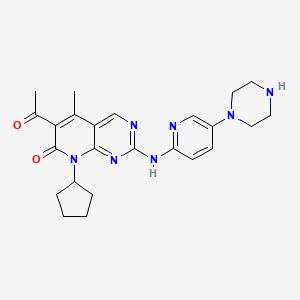
Overview
Palbociclib (brand name Ibrance) is a small-molecule, orally administered inhibitor of cyclin-dependent kinases 4 and 6 (Cdk4/6), developed by Pfizer and approved by the US Food and Drug Administration for the treatment of hormone receptor-positive, human epidermal growth factor receptor 2-negative (HR+/HER2−) metastatic breast cancer. Cdk4 and cyclin-dependent kinase 6 (CDK6) are serine/threonine kinases that, in complex with cyclin D, phosphorylate the retinoblastoma protein (Rb), releasing transcription factors that drive cell cycle progression from G1 into S phase. By competitively inhibiting this Cdk4/6-cyclin D complex, palbociclib arrests tumor cells in G1, suppressing aberrant proliferation. This mechanism positions it as a cornerstone of endocrine-based combination strategies in luminal breast cancer, where cyclin D overactivation is a frequent oncogenic driver.
Beyond its cytostatic role, palbociclib exerts pleiotropic effects on the tumor microenvironment, including the induction of cellular senescence in both cancer cells and stromal compartments. These non-cell-autonomous consequences — encompassing immune modulation, paracrine signaling changes, and metabolic reprogramming — have broadened investigational interest beyond breast cancer to malignancies such as dedifferentiated liposarcoma and esophageal squamous cell carcinoma, and have raised important questions about how Cdk4/6 inhibition reshapes antitumor immunity and treatment resistance.
Recent Publications Summary
Recent publications on palbociclib focused largely on its role as a CDK4/6 inhibitor in advanced breast cancer, but also extended to other tumor types and translational delivery or imaging platforms. In a nationwide retrospective cohort of CDK4/6 inhibitor users with advanced breast cancer, investigators examined how age and age-related comorbidities related to survival outcomes, reflecting ongoing real-world efforts to define the effectiveness of palbociclib-based therapy outside pivotal trials 42301003Jun. A separate real-world study in India also evaluated experience with palbociclib and ribociclib in HR+/HER2-negative metastatic breast cancer, again emphasizing routine clinical use in this setting 42139194May. In HR-positive, HER2-low metastatic breast cancer, endocrine therapy plus a CDK4/6 inhibitor remained the most common treatment approach across multiple lines of therapy, underscoring the central place of this drug class in contemporary management 42474828Jul.
Several studies explored palbociclib in combination strategies aimed at overcoming resistance or enhancing antitumor activity. In treatment-refractory HR+/HER2-negative metastatic breast cancer, the TAKTIC phase 1b trial evaluated ipatasertib with endocrine therapy, with or without palbociclib, based on the premise that PI3K/AKT pathway activation contributes to CDK4/6 inhibitor resistance 42061370Apr. In dedifferentiated liposarcoma, a phase 2 study assessed palbociclib plus retifanlimab, building on preclinical evidence that CDK4/6 inhibition may increase intratumoral inflammation and potentially synergize with checkpoint blockade 42082272May. A review of next-generation meningioma therapies also highlighted palbociclib among candidate CDK4/6 inhibitors being considered for precision-medicine approaches in this disease 42017452Apr.
Mechanistic and translational studies further examined how palbociclib affects tumor biology and the immune microenvironment. In esophageal squamous cell carcinoma, first-line palbociclib was tested in treatment-naive models and identified distinct response subtypes linked to Rb-pathway status; in delayed responders, treatment was associated with DNA damage accumulation, cGAS-enriched micronuclei, interferon-stimulated gene activation, and increased immune cell infiltration in a vascularized 3D microfluidic system 42215475May. In HR+/HER2-negative breast cancer models, palbociclib promoted fibroblast cellular senescence and increased IGF1 and FGF7, which drove macrophage polarization toward an M2-like phenotype through STAT3 Tyr705 phosphorylation and ARG1 upregulation, reducing lymphocyte viability; CSF1R inhibition was investigated as a strategy to counter this immunosuppressive effect 41986650Apr. Another triangulation study comparing abemaciclib and palbociclib reported divergent toxicity profiles, with palbociclib associated with greater reporting of fatigue and anxiety and a higher fatal outcome reporting rate than abemaciclib in pharmacovigilance analyses 42091703May.
Beyond direct therapeutic studies, palbociclib was also incorporated into enabling technologies. A circular-by-design zwitterionic pseudodendrimer platform achieved high loading capacity for palbociclib and enabled efficient in vitro delivery with improved selectivity toward cancer cells 42095698May. In parallel, a near-infrared-II fluorescent probe built from palbociclib or ribociclib conjugated with indocyanine green and assembled with human serum albumin enabled early, noninvasive monitoring of CDK4/6 inhibitor response in breast cancer models, with signal reduction preceding measurable tumor shrinkage and correlating with decreased pRB and MKI67 expression 41825845Mar.
What Changes, What Holds
1. Palbociclib remains a central CDK4/6 inhibitor in routine advanced breast cancer care, with outcomes shaped by patient frailty and disease subtype
REINFORCES Real-world use continues to anchor the drug in HR+/HER2-negative metastatic breast cancer, while the newer cohorts mainly sharpen expectations about who benefits and who does less well outside trials 42301003Jun42139194May. The HER2-low observation also extends the same treatment logic into a broader contemporary subtype without challenging the established mechanism or role.
2. Palbociclib is still being tested as a resistance-modifying partner rather than a replacement for endocrine-based therapy
REINFORCES These studies do not alter the baseline view of palbociclib as a CDK4/6 blocker; instead, they show that current development is focused on combinations meant to bypass pathway escape or extend immune responsiveness 42061370Apr42082272May. The meningioma review is only a signal of broader interest, not evidence of a new established indication.
3. Palbociclib can reshape the immune microenvironment in ways that may both help and hinder antitumor control
NEW DIRECTION The baseline already notes senescence and microenvironmental effects, but these reports add a more specific and potentially conflicting picture: in one setting, CDK4/6 inhibition appears to promote inflammatory signaling and immune infiltration, while in another it drives fibroblast senescence and macrophage polarization toward an immunosuppressive state 42215475May41986650Apr. That tension means the drug’s immune consequences are context dependent and not yet settled.
4. Palbociclib is increasingly being adapted into delivery and imaging platforms that change how response can be monitored or enhanced
METHOD These studies do not revise what palbociclib is known to do biologically; they change how it is formulated and measured, from improved intracellular delivery to early noninvasive response imaging 42095698May41825845Mar. The main implication is methodological: palbociclib is becoming a tool in translational platform development, not just a therapeutic agent.
Overview update candidates: real-world effectiveness in older/comorbid patients; context-dependent immune effects including both inflammatory and immunosuppressive remodeling; palbociclib-based response imaging and delivery platforms.
palbociclib
Background Contexts
In the literature, the biological baseline, pathological conditions, or disease models commonly surrounding palbociclib are described as follows:
- advanced breast cancer (Disease) — 2 papers: PMIDs 42139194, 41851017
- hormone receptor-positive metastatic breast cancer (Disease) — 2 papers: PMIDs 41825845, 39648753
- antibiotic (Therapy) — 1 paper: PMIDs 42481504
- ataxia telangiectasia (Disease) — 1 paper: PMIDs 42384606
- breast adenocarcinoma (Disease) — 1 paper: PMIDs 42301003
- CDK4/6 inhibitors (Therapy) — 1 paper: PMIDs 41986650
- cellular senescence (Biological Process) — 1 paper: PMIDs 42425764
- corticosteroid (Therapy) — 1 paper: PMIDs 42481504
- Cyclin-dependent kinase 4 and 6 inhibitors (Therapy) — 1 paper: PMIDs 39648753
- Cyclin-dependent kinase 4/6 inhibitors (Therapy) — 1 paper: PMIDs 42091703
- cyclin-dependent kinase inhibitors (Biological Process) — 1 paper: PMIDs 42301003
- death (Clinical Metric) — 1 paper: PMIDs 42481504
Methodologies & Technologies Used
Researchers utilize the following experimental methods, imaging platforms, computational models, or biological reagents to study palbociclib:
- Mendelian randomization (Technology) — 2 papers: PMIDs 42091703, 42067686
- ribociclib (Therapy) — 2 papers: PMIDs 41851017, 39648753
- 2-ethyl-2-oxazoline (Chemical) — 1 paper: PMIDs 42095698
- 2342 FDA-approved drugs (Chemical) — 1 paper: PMIDs 42384606
- 3D microfluidic system (Technology) — 1 paper: PMIDs 42215475
- abemaciclib (Therapy) — 1 paper: PMIDs 39648753
- adjuvant radiotherapy (Therapy) — 1 paper: PMIDs 42017452
- advanced breast cancer (Disease) — 1 paper: PMIDs 42301003
- advanced radiation techniques (Technology) — 1 paper: PMIDs 42017452
- Caelyx (Therapy) — 1 paper: PMIDs 42425764
- CIBERSORT (Technology) — 1 paper: PMIDs 42067686
- convolutional neural network (Technology) — 1 paper: PMIDs 42384606
Molecular Interventions & Targets
The primary molecular pathways, regulatory genes, enzymes, or therapeutic agents actively targeted and manipulated in relation to palbociclib include:
- abemaciclib (Therapy) — 3 papers: PMIDs 42301003, 42091703, 42017452
- Cdk4 (Protein) — 3 papers: PMIDs 42095698, 42082272, 41825845
- ribociclib (Therapy) — 3 papers: PMIDs 42301003, 42139194, 41825845
- CDK6 (Protein) — 2 papers: PMIDs 42425764, 42091703
- Cyclin-dependent kinase 4/6 inhibitors (Therapy) — 2 papers: PMIDs 42215475, 42139194
- androgen receptor (Protein) — 1 paper: PMIDs 42310300
- angiogenesis inhibitor (Therapy) — 1 paper: PMIDs 42017452
- antioestrogen (Therapy) — 1 paper: PMIDs 42061370
- ARG1 (Protein) — 1 paper: PMIDs 41986650
- Ataxia telangiectasia Rad3-related (Therapy) — 1 paper: PMIDs 42425764
- ATC code L02 (Therapy) — 1 paper: PMIDs 42474828
- ATM (Protein) — 1 paper: PMIDs 42425764
Observed Outcomes & Phenotypes
The phenotypic changes, physiological endpoints, or clinical metrics observed and measured in connection with palbociclib include:
- progression-free survival (Clinical Metric) — 2 papers: PMIDs 42474828, 41851017
- 16% (8/50), 14% (6/43), and 20% (10/50) (Clinical Metric) — 1 paper: PMIDs 39648753
- 1925 DEGs (Biological Process) — 1 paper: PMIDs 42091703
- 33.5, 42, and 21.5 days (Clinical Metric) — 1 paper: PMIDs 39648753
- anxiety (Disease) — 1 paper: PMIDs 42091703
- AUC∞ (Clinical Metric) — 1 paper: PMIDs 42091703
- calcium signaling pathways (Pathway) — 1 paper: PMIDs 42067686
- CD4-positive T cell (Cellular Component) — 1 paper: PMIDs 42481504
- CDK4/6 inhibitor-resistant tumors (Disease) — 1 paper: PMIDs 41825845
- CDK4/6 inhibitor-sensitive tumors (Disease) — 1 paper: PMIDs 41825845
- central nervous system (Other) — 1 paper: PMIDs 42091703
- Charlson Comorbidity Index (Clinical Metric) — 1 paper: PMIDs 41851017
General Takeaways & Clinical Potentials
The high-level concepts, clinical translations, and overarching conclusions proposed in the research surrounding palbociclib are summarized below:
- antitumor efficacy (Clinical Metric) — 1 paper: PMIDs 41986650
- biomarker-driven, personalized treatment strategies (Therapy) — 1 paper: PMIDs 42017452
- circular nanomedicine (Other) — 1 paper: PMIDs 42095698
- clinical outcomes for meningioma patients (Clinical Metric) — 1 paper: PMIDs 42017452
- distinct neuropsychiatric and systemic toxicity patterns (Other) — 1 paper: PMIDs 42091703
- drug-specific survivorship toxicity profiles (Other) — 1 paper: PMIDs 42091703
- early assessment of therapeutic efficacy (Other) — 1 paper: PMIDs 41825845
- FDA-approved (Other) — 1 paper: PMIDs 39648753
- first-line palbociclib treatment (Therapy) — 1 paper: PMIDs 42215475
- immunosuppressive microenvironment (Other) — 1 paper: PMIDs 41986650
- lymphocyte (Clinical Metric) — 1 paper: PMIDs 41986650
- M2-like phenotype (Biological Process) — 1 paper: PMIDs 41986650