Indocyanine green
Indocyanine green (ICG) is a water-soluble tricarbocyanine dye, a synthetic small molecule whose extended conjugated cyanine backbone gives it strong absorption and emission in the near-infrared (NIR) window of roughly 700–900 nm.
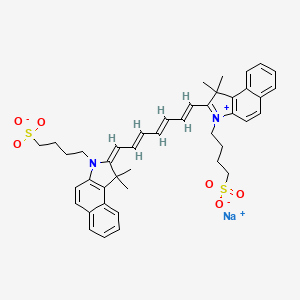
Indocyanine green (ICG) is a water-soluble tricarbocyanine dye, a synthetic small molecule whose extended conjugated cyanine backbone gives it strong absorption and emission in the near-infrared (NIR) window of roughly 700–900 nm. Because biological tissue is relatively transparent and weakly autofluorescent at these wavelengths, ICG functions as an optical contrast agent that permits deep-tissue imaging with high signal-to-background. Following intravenous administration it binds rapidly to plasma proteins, particularly serum albumin, and is cleared almost exclusively by hepatic uptake and biliary excretion without enterohepatic recirculation — a pharmacokinetic profile that has long underpinned its use in assessing hepatic function and hepatobiliary flow.
Clinically, ICG is used chiefly as a diagnostic and intraoperative fluorescence tracer: mapping sentinel lymph nodes in breast, endometrial, and other cancers, angiographically assessing tissue perfusion at surgical anastomoses, and gauging graft function during liver transplantation and machine perfusion. Beyond this diagnostic role, the same photophysical properties make ICG an active photomedicine agent — under NIR irradiation it converts absorbed light into heat for photothermal therapy and generates reactive oxygen species for photodynamic effects. These capabilities, together with its established biocompatibility, have driven its incorporation into nanocarriers and composite biomaterials (for example liposomal, gas-vesicle, hyaluronan-, and chitosan-based constructs) intended to improve its stability, prolong circulation, and target it to tumors or infected tissue, where it is often paired with mechanisms such as cuproptosis or combined photothermal–photodynamic antibacterial action.
Where the papers sit
19 papers from the last 6 months study indocyanine green directly · updated from PubMed 10 Oct 2026
Study type 2 clinical trials · 3 observational · 3 human data · 11 preclinical
Themes 4 themes · 1 paradigm shift · 1 new direction
-
Cancer Photothermal Theranostics
Multifunctional ICG platforms are moving cancer work beyond imaging toward targeted photothermal treatment combined with chemotherapy, immunotherapy, or cell-death activation. NIR fluorescence guides delivery and treatment, while cuproptosis and tumor-cell targeting provide mechanistic aims. Acoustic delivery, membrane-coated probes, peptide-drug conjugates, and optimized interstitial irradiation address localization and dosimetry. Hepatic uptake and lymphatic drainage remain practical determinants of translation.
10 papers · 52.6%
-
Fluorescence-Guided Surgical Staging
ICG fluorescence is consolidating sentinel lymph node mapping as an alternative to patent blue in breast cancer, with sensitivity, specificity, and operative identification as key endpoints. Current work is extending protocols into endometrial cancer and comparing minimally invasive platforms. The field is also applying fluorescence to breast-flap viability, broadening the question from nodal staging to intraoperative tissue perfusion. Prospective validation is still needed to standardize drainage timing, platform performance, and clinical benefit.
4 papers · 21.1%
-
NIR-Activated Nanotherapy
NIR-activated nanoparticle therapy is combining photothermal and photodynamic effects rather than relying on a single cytotoxic mechanism. In cancer, anti-CD33 targeting and curcumin–ICG delivery are being used against acute myeloid leukemia, with reactive oxygen species and cell death as recurring endpoints. Infection-responsive liposomes instead target biofilm penetration and antibacterial activity, while MnFe nanoboxes amplify endoplasmic-reticulum stress. The shared strategy is platform-based, and efficacy remains largely preclinical.
3 papers · 15.8%
-
Quantitative Perfusion Assessment
Quantitative ICG fluorescence is shifting perfusion assessment from visual inspection toward kinetic, model-based prediction. In liver transplantation, fluorescence kinetics during hypothermic oxygenated machine perfusion are being linked to graft function, while colorectal work targets anastomotic perfusion. Interpretable nonlinear machine-learning models aim to convert signal curves into clinically usable risk estimates. External validation must establish thresholds, timing, and whether prediction improves graft selection or leak prevention.
2 papers · 10.5%
Effective ICG photothermal tumor therapy requires engineered delivery rather than ICG alone
The MB49 murine bladder-cancer xenograft study and the 4T1 triple-negative breast-cancer model both found that free ICG was an inadequate therapeutic format: gas-vesicle conjugation prolonged circulation and enabled ultrasound-triggered intratumoral delivery, while PDITC self-assembly improved cellular uptake and photothermal-augmented cytotoxicity, producing stronger tumor control than ICG with laser alone 42127030May 42288225Jun. The assumption that ICG’s established photothermal activity is sufficient for effective tumor treatment is therefore replaced by a delivery-dependent model in which targeting, retention, or combination payloads are required to realize its therapeutic potential.
ICG becomes an infection-responsive antibacterial effector for biofilm eradication
The mixed-species biofilm-associated wound infection model used ICG not for tumor imaging or cancer therapy but as the photodynamic and photothermal antimicrobial component of hyaluronidase-responsive liposomes. Enzyme-triggered deshielding promoted deep biofilm penetration, and irradiation produced reactive oxygen species and heat that disrupted bacterial membranes and disintegrated biofilm, extending ICG’s role to targeted antibacterial treatment 42067348May.
Papers
The 19 papers from the last 6 months that study indocyanine green directly, newest first, by theme and by study type. Study types come from PubMed publication types and MeSH headings.
By theme
Cancer Photothermal Theranostics (10)
- Optical-thermal modeling and treatment planning of ICG-enhanced interstitial photothermal therapy using cylindrical diffuser fibers. Lasers in medical science · 22 Aug 2026 PMID 42631881
- An indocyanine green-potentiated gastrin releasing peptide receptor-targeting multifunctional peptide-drug conjugate for prostate cancer therapy. Journal of controlled release : official journal of the Controlled Release Society · 16 Aug 2026 PMID 42604690
- Development of polymer micelles comprising an alkenylboronic acid pinacol ester as boron agents for BNCT. Journal of materials chemistry. B · 7 Aug 2026 PMID 42563530
- Photothermal Pulse Output-Nanomachines for Enhanced Cuproptosis in Tumor Cells. ACS applied bio materials · 30 Jun 2026 PMID 42378513
- Discrimination, spectrum, and clinical utility: ICG lymphography drainage time in axillary staging. Breast cancer research and treatment · 26 Jun 2026 PMID 42360511
- Rational design of active pharmaceutical ingredient-based co-assembled nanoparticles for cancer immunotherapy. Journal of controlled release : official journal of the Controlled Release Society · 21 Jun 2026 PMID 42324030
- Cytotoxic crosslinker-loaded indocyanine green nanoparticle for near-infrared fluorescence imaging-guided chemo-photothermal eradication of triple-negative breast cancer. European journal of pharmaceutical sciences : official journal of the European Federation for Pharmaceutical Sciences · 13 Jun 2026 PMID 42288225
- Acoustic delivery of indocyanine green via biosynthetic gas vesicles for tumor photothermal therapy. PLoS biology · 13 May 2026 PMID 42127030
- Tumor cell membrane modified clinical lCG nanoprobes for NIR fluorescence imaging of targeted triple negative breast cancer. Biomedical materials (Bristol, England) · 28 Apr 2026 PMID 42049061
- Structure-Activity Relationship of Cyanine Dyes in Relation to the Hepatic Uptake and Excretion. Chembiochem : a European journal of chemical biology · 17 Apr 2026 PMID 41996556
Fluorescence-Guided Surgical Staging (4)
- Use of indocyanine green fluorescence versus patent blue V dye for sentinel lymph node biopsy in early breast cancer, a randomized controlled trial. Journal of the Egyptian National Cancer Institute · 2 Sept 2026 PMID 42684555
- Revolutionizing Precision of Necrosis: Laser Speckle Contrast Imaging versus Indocyanine Green for Breast Flap Viability. Plastic and reconstructive surgery · 28 Jul 2026 PMID 42519935
- Fluorescence imaging using indocyanine green to identify sentinel lymph nodes during surgery for breast cancer (INFINITE): protocol for a hybrid effectiveness-implementation trial using a stepped-wedge cluster design. BMJ open · 24 Jun 2026 PMID 42342397
- Sentinel Lymph Node Mapping with Indocyanine Green in Endometrial Cancer: Does the Minimally Invasive Platform Matter? Journal of investigative surgery : the official journal of the Academy of Surgical Research · 20 May 2026 PMID 42157366
NIR-Activated Nanotherapy (3)
- Multifunctional anti-CD33 antibody- and polydopamine-coated curcumin-indocyanine green nanoparticles for in vitro cytotoxic effects against leukemia cells. International journal of pharmaceutics · 27 Jul 2026 PMID 42508510
- Hyaluronic acid-engineered infection-responsive liposomes achieve biofilm penetration and synergistic photothermal-photodynamic antibacterial therapy. Carbohydrate polymers · 1 May 2026 PMID 42067348
- Hollow MnFe Bimetallic Nanoboxes for Photo/Chemodynamic Therapy via Amplification of Endoplasmic Reticulum Stress. ACS applied materials & interfaces · 27 Apr 2026 PMID 42044265
Quantitative Perfusion Assessment (2)
- Indocyanine green fluorescence kinetics during hypothermic oxygenated machine perfusion might predict graft function after liver transplantation. Langenbeck's archives of surgery · 22 Jul 2026 PMID 42484715
- Interpretable and non-linear machine learning models for quantitative ICG perfusion assessment in colorectal cancer anastomosis: A feasibility study. European journal of surgical oncology : the journal of the European Society of Surgical Oncology and the British Association of Surgical Oncology · 27 May 2026 PMID 42202707
By study type
Clinical trials (2)
- Use of indocyanine green fluorescence versus patent blue V dye for sentinel lymph node biopsy in early breast cancer, a randomized controlled trial. Journal of the Egyptian National Cancer Institute · 2 Sept 2026 PMID 42684555
- Fluorescence imaging using indocyanine green to identify sentinel lymph nodes during surgery for breast cancer (INFINITE): protocol for a hybrid effectiveness-implementation trial using a stepped-wedge cluster design. BMJ open · 24 Jun 2026 PMID 42342397
Observational studies and case reports (3)
- Revolutionizing Precision of Necrosis: Laser Speckle Contrast Imaging versus Indocyanine Green for Breast Flap Viability. Plastic and reconstructive surgery · 28 Jul 2026 PMID 42519935
- Interpretable and non-linear machine learning models for quantitative ICG perfusion assessment in colorectal cancer anastomosis: A feasibility study. European journal of surgical oncology : the journal of the European Society of Surgical Oncology and the British Association of Surgical Oncology · 27 May 2026 PMID 42202707
- Sentinel Lymph Node Mapping with Indocyanine Green in Endometrial Cancer: Does the Minimally Invasive Platform Matter? Journal of investigative surgery : the official journal of the Academy of Surgical Research · 20 May 2026 PMID 42157366
Human data, design not indexed (3)
- Indocyanine green fluorescence kinetics during hypothermic oxygenated machine perfusion might predict graft function after liver transplantation. Langenbeck's archives of surgery · 22 Jul 2026 PMID 42484715
- Photothermal Pulse Output-Nanomachines for Enhanced Cuproptosis in Tumor Cells. ACS applied bio materials · 30 Jun 2026 PMID 42378513
- Discrimination, spectrum, and clinical utility: ICG lymphography drainage time in axillary staging. Breast cancer research and treatment · 26 Jun 2026 PMID 42360511
Preclinical: animal, cell and lab studies (11)
- Optical-thermal modeling and treatment planning of ICG-enhanced interstitial photothermal therapy using cylindrical diffuser fibers. Lasers in medical science · 22 Aug 2026 PMID 42631881
- An indocyanine green-potentiated gastrin releasing peptide receptor-targeting multifunctional peptide-drug conjugate for prostate cancer therapy. Journal of controlled release : official journal of the Controlled Release Society · 16 Aug 2026 PMID 42604690
- Development of polymer micelles comprising an alkenylboronic acid pinacol ester as boron agents for BNCT. Journal of materials chemistry. B · 7 Aug 2026 PMID 42563530
- Multifunctional anti-CD33 antibody- and polydopamine-coated curcumin-indocyanine green nanoparticles for in vitro cytotoxic effects against leukemia cells. International journal of pharmaceutics · 27 Jul 2026 PMID 42508510
- Rational design of active pharmaceutical ingredient-based co-assembled nanoparticles for cancer immunotherapy. Journal of controlled release : official journal of the Controlled Release Society · 21 Jun 2026 PMID 42324030
- Cytotoxic crosslinker-loaded indocyanine green nanoparticle for near-infrared fluorescence imaging-guided chemo-photothermal eradication of triple-negative breast cancer. European journal of pharmaceutical sciences : official journal of the European Federation for Pharmaceutical Sciences · 13 Jun 2026 PMID 42288225
- Acoustic delivery of indocyanine green via biosynthetic gas vesicles for tumor photothermal therapy. PLoS biology · 13 May 2026 PMID 42127030
- Hyaluronic acid-engineered infection-responsive liposomes achieve biofilm penetration and synergistic photothermal-photodynamic antibacterial therapy. Carbohydrate polymers · 1 May 2026 PMID 42067348
- Tumor cell membrane modified clinical lCG nanoprobes for NIR fluorescence imaging of targeted triple negative breast cancer. Biomedical materials (Bristol, England) · 28 Apr 2026 PMID 42049061
- Hollow MnFe Bimetallic Nanoboxes for Photo/Chemodynamic Therapy via Amplification of Endoplasmic Reticulum Stress. ACS applied materials & interfaces · 27 Apr 2026 PMID 42044265
- Structure-Activity Relationship of Cyanine Dyes in Relation to the Hepatic Uptake and Excretion. Chembiochem : a European journal of chemical biology · 17 Apr 2026 PMID 41996556
Written from 19 PubMed abstracts, each one listed by PMID above. Published: 2026-06-15. Last written: 2026-09-04 by GPT. Reviewed by a human editor on 2026-07-24. Drafted by language models from published abstracts; not medical advice.