osimertinib
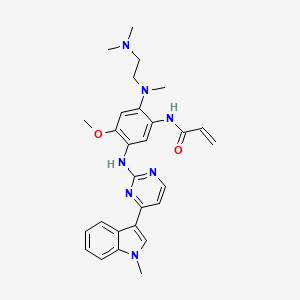
Overview
Osimertinib is a third-generation epidermal growth factor receptor (epidermal growth factor receptor (EGFR)) tyrosine kinase inhibitor (TKI) primarily used in the treatment of advanced non-small cell lung cancer (NSCLC) harboring specific epidermal growth factor receptor (EGFR) mutations, particularly the exon 19 deletions and the L858R point mutation. It functions by irreversibly binding to the epidermal growth factor receptor (EGFR) tyrosine kinase domain, inhibiting downstream signaling pathways that promote tumor growth and survival. This selective inhibition leads to reduced proliferation of cancer cells and has been associated with improved clinical outcomes in patients with epidermal growth factor receptor (EGFR)-mutated NSCLC.
The drug's significance lies in its ability to overcome resistance mechanisms that limit the efficacy of earlier-generation epidermal growth factor receptor (EGFR) TKIs, such as gefitinib and erlotinib. Osimertinib has been shown to provide substantial benefits in terms of progression-free survival (PFS) and overall survival in various clinical settings, making it a cornerstone in the management of epidermal growth factor receptor (EGFR)-mutated lung cancer.
Recent Publications Summary
Recent publications on osimertinib have continued to expand its clinical and translational profile in EGFR-mutated non-small cell lung cancer (NSCLC), particularly in settings of disease progression, central nervous system involvement, and post-chemoradiotherapy consolidation. In the phase II ORCHARD platform study, osimertinib plus selumetinib was evaluated in patients with BRAF alterations after progression on first-line osimertinib 42202477May. Real-world and retrospective studies also examined first-line osimertinib use in Chinese patients and in an Indian cohort, as well as empirical second-line use when EGFR T790M status was unknown, reflecting ongoing efforts to define effectiveness outside randomized trials 42170792May39962869Feb42032945Apr. In unresectable stage III EGFR-mutated NSCLC after definitive chemoradiotherapy, LAURA-related reports described improved progression-free survival with osimertinib versus placebo and reported patient-reported outcomes and China cohort analyses 42019226Apr41785639Mar. A case report also described rescue of suprasellar metastasis of EGFR-mutant NSCLC with daily osimertinib re-escalation supported by filgrastim 42379747Jun.
Several studies focused on resistance biology and combination strategies involving osimertinib. Mechanistic work showed that osimertinib resistance can involve altered sphingolipid metabolism, with resistant lines reducing free ceramides in favor of complex glycosphingolipids and thereby avoiding ceramide-mediated apoptosis; combining osimertinib with D-PDMP was explored as a way to counter this process 41988688Apr. Another study identified adaptive regulation of dNTP homeostasis as a resistance mechanism, in which osimertinib suppressed RRM2 via MYBL2 downregulation and triggered a compensatory CHK2-TNNT3-RRM2B pathway; CHK2 inhibition or combined CHK1/2 blockade delayed resistance in vitro and in xenografts 41941751Apr. A separate report linked early skeletal muscle loss and osimertinib trough concentrations with treatment outcomes in advanced EGFR-mutated NSCLC 41997038Apr. Combination approaches also included osimertinib with chemotherapy in a bioorthogonal prodrug-prodrug strategy for dual activation with doxorubicin or CA4 42138023May, and a cost-effectiveness analysis comparing osimertinib with chemotherapy, monotherapy, and first-generation EGFR-TKIs in advanced NSCLC 41746542Feb.
Other publications addressed safety, pharmacovigilance, and immunologic effects. A WHO-VigiAccess pharmacovigilance analysis of four anti-NSCLC drugs, including osimertinib, found that skin/subcutaneous tissue disorders and gastrointestinal disorders were common adverse-event categories, with osimertinib accounting for the largest number of reports among the four agents studied 42175505May. A retrospective case-series study highlighted life-threatening pneumonitis associated with osimertinib monotherapy as first-line treatment, emphasizing that fatal pneumonitis remains a clinically important toxicity 42049362Apr. In preclinical work, osimertinib was shown to upregulate TGF-β in tumors, and combining osimertinib with TGF-β pathway inhibitors such as nintedanib or vactosertib potentiated antitumor immunity in an EGFR-mutant lung cancer mouse model 41757675Feb. Beyond lung cancer, osimertinib was identified as a previously unrecognized covalent inhibitor of DDRGK1 in a study of UFMylation inhibition; this activity disrupted DDRGK1-UFL1 interaction, suppressed UFMylation, induced ER stress, and in glioblastoma models reduced tumor viability, sensitized cells to temozolomide and radiation therapy, and promoted macrophage polarization toward an anti-tumor M1 state 42472853Jul.
What Changes, What Holds
1. Osimertinib is moving into post-progression and consolidation settings, but these uses remain extensions rather than replacements of its core role
NEW DIRECTION The new work broadens the drug’s clinical map beyond first-line EGFR-mutated NSCLC, showing activity after progression on osimertinib and after definitive chemoradiotherapy in unresectable stage III disease 42202477May42019226Apr. That does not displace the established account of osimertinib as a targeted therapy for EGFR-mutant advanced NSCLC; instead, it suggests the drug may have a wider disease-course role, while the best sequencing and patient selection remain unsettled.
2. Resistance to osimertinib now looks more metabolically and replication-stress driven than previously appreciated
NEW DIRECTION Mechanistic studies add two resistance routes not covered by the baseline: lipid remodeling that evades ceramide-mediated apoptosis and adaptive dNTP homeostasis that sustains survival under drug pressure 41988688Apr41941751Apr. These findings do not contradict osimertinib’s established EGFR-targeted action, but they complicate the resistance story and point to combination strategies that may delay escape. Both are preclinical, so clinical validation is still needed before they can reshape practice.
3. Toxicity and pharmacology may matter more for outcomes than the baseline account suggests
NEW DIRECTION The recent safety and exposure data add clinically relevant harms and modifiers that the overview does not cover: serious pneumonitis remains a real risk, and trough concentrations plus early skeletal muscle loss may help explain outcome variability 42049362Apr41997038Apr. These observations leave the drug’s benefit intact, but they argue for closer monitoring and raise the possibility that pharmacokinetics and frailty influence effectiveness in ways not captured by mutation status alone.
4. Osimertinib is being repurposed as a chemical tool beyond lung cancer, but that role is separate from its established therapeutic identity
NEW DIRECTION The DDRGK1/UFMylation work shows a previously unrecognized covalent target and anti-glioblastoma activity, which is a new biological direction rather than a contradiction of the lung-cancer baseline 42472853Jul. Because the Overview says nothing about non-NSCLC roles, this should be read as an expansion of translational interest, not a change in the drug’s established indication. The evidence is preclinical and would need independent confirmation before any broader claim is made.
Overview update candidates: post-chemoradiotherapy consolidation in unresectable stage III EGFR-mutated NSCLC; clinically important pneumonitis risk; exposure/outcome and frailty associations; preclinical resistance mechanisms and combination strategies.
osimertinib
Background Contexts
In the literature, the biological baseline, pathological conditions, or disease models commonly surrounding osimertinib are described as follows:
- non-small-cell lung carcinoma (Disease) — 8 papers: PMIDs 42203350, 42175505, 42170792, 42049362, etc.
- lung cancer brain metastases (Disease) — 7 papers: PMIDs 42379747, 42308331, 42308042, 42202477, etc.
- advanced Non-Small Cell Lung Cancer (Disease) — 4 papers: PMIDs 41785639, 41757675, 41672191, 41649868
- estimated glomerular filtration rate (Clinical Metric) — 4 papers: PMIDs 42032945, 41920265, 41757675, 41649868
- EGFR (Protein) — 2 papers: PMIDs 42379747, 39962869
- EGFR C797S mutation (Gene) — 2 papers: PMIDs 41950648, 41649868
- glomerular filtration rate (Clinical Metric) — 2 papers: PMIDs 42308331, 41950648
- LAURA study (Other) — 2 papers: PMIDs 42019226, 41785639
- unresectable stage III EGFR-mutated non-small cell lung cancer (Disease) — 2 papers: PMIDs 42386709, 41622600
- adenocarcinoma (Disease) — 1 paper: PMIDs 39962869
- adenocarcinoma of the lung (Disease) — 1 paper: PMIDs 41825439
- baseline estimated glomerular filtration rate (eGFR) (Clinical Metric) — 1 paper: PMIDs 42202477
Methodologies & Technologies Used
Researchers utilize the following experimental methods, imaging platforms, computational models, or biological reagents to study osimertinib:
- 114 patients (Organism) — 1 paper: PMIDs 42390540
- 2-anilinoquinazoline derivatives (Chemical) — 1 paper: PMIDs 41795340
- 2-aryl-4-aminoquinazoline (Chemical) — 1 paper: PMIDs 41950648
- 75 patients (Other) — 1 paper: PMIDs 39962869
- A549 xenograft models (Cell Line) — 1 paper: PMIDs 41795340
- afatinib (Therapy) — 1 paper: PMIDs 41672191
- Bayesian confidence propagation neural network (Other) — 1 paper: PMIDs 42175505
- biochemical binding assay (Technology) — 1 paper: PMIDs 41622600
- biomarker-matched (Other) — 1 paper: PMIDs 42202477
- BMICs (Cell Line) — 1 paper: PMIDs 42308042
- C57BL/6J mice (Organism) — 1 paper: PMIDs 41757675
- computational studies (Technology) — 1 paper: PMIDs 41795340
Molecular Interventions & Targets
The primary molecular pathways, regulatory genes, enzymes, or therapeutic agents actively targeted and manipulated in relation to osimertinib include:
- estimated glomerular filtration rate (Clinical Metric) — 5 papers: PMIDs 42049362, 41988688, 41785639, 41746542, etc.
- serum eGFR (Clinical Metric) — 3 papers: PMIDs 42203350, 42138023, 41941751
- baseline estimated glomerular filtration rate (eGFR) (Clinical Metric) — 2 papers: PMIDs 41997038, 41125377
- gefitinib (Therapy) — 2 papers: PMIDs 42175505, 39962869
- afatinib (Therapy) — 1 paper: PMIDs 42175505
- anti-PD-1 therapy (Therapy) — 1 paper: PMIDs 41672191
- apoptotic markers (Clinical Metric) — 1 paper: PMIDs 41988688
- BRAF gene (Gene) — 1 paper: PMIDs 42202477
- C57BL/6 J mice (Organism) — 1 paper: PMIDs 41920265
- C797S-mediated resistance (Biological Process) — 1 paper: PMIDs 41649868
- CA4 (Therapy) — 1 paper: PMIDs 42138023
- catequentinib (Therapy) — 1 paper: PMIDs 42175505
Observed Outcomes & Phenotypes
The phenotypic changes, physiological endpoints, or clinical metrics observed and measured in connection with osimertinib include:
- 10.68 months (Clinical Metric) — 1 paper: PMIDs 39962869
- 52,978 adverse event reports (Clinical Metric) — 1 paper: PMIDs 42175505
- 8.43 months (Clinical Metric) — 1 paper: PMIDs 39962869
- active human doses (Clinical Metric) — 1 paper: PMIDs 41622600
- Adverse drug reactions (Other) — 1 paper: PMIDs 42175505
- AKT/ERK/Nrf2/HO-1 axis (Pathway) — 1 paper: PMIDs 42308331
- AKT/MAPK signaling pathways (Pathway) — 1 paper: PMIDs 41950648
- apoptotic pathways (Biological Process) — 1 paper: PMIDs 42386709
- B-cell lymphoma 2 (Protein) — 1 paper: PMIDs 41795340
- Bax (Protein) — 1 paper: PMIDs 42386709
- BCL2L1 (Protein) — 1 paper: PMIDs 41795340
- BEAS-2B cells (Cell Line) — 1 paper: PMIDs 41950648
General Takeaways & Clinical Potentials
The high-level concepts, clinical translations, and overarching conclusions proposed in the research surrounding osimertinib are summarized below:
- acquired resistance (Biological Process) — 1 paper: PMIDs 41125377
- biochemical validation (Other) — 1 paper: PMIDs 41795340
- checkpoint inhibitor (Therapy) — 1 paper: PMIDs 41672191
- clinical application potential (Other) — 1 paper: PMIDs 41740831
- Clinical Practice (Other) — 1 paper: PMIDs 41920265
- coadministered with primary tumor standard of care treatments (Other) — 1 paper: PMIDs 42308042
- cost effectiveness (Other) — 1 paper: PMIDs 41746542
- Cost of Treatment (Other) — 1 paper: PMIDs 39962869
- DNA damage (Biological Process) — 1 paper: PMIDs 41920265
- dNTP metabolism (Biological Process) — 1 paper: PMIDs 41941751
- EGFR-mutated non-small cell lung cancer (Disease) — 1 paper: PMIDs 41757675
- EGFR-MYBL2-RRM2 and CHK2-TNNT3-RRM2B regulatory axis (Pathway) — 1 paper: PMIDs 41941751