carboplatin
Overview
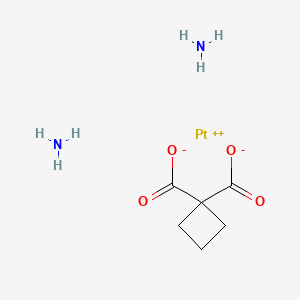
Carboplatin is a platinum-based antineoplastic agent used across a wide range of solid tumors. Like other platinum compounds it acts by forming DNA adducts, chiefly 1,2-intrastrand crosslinks between adjacent guanines, which distort the helix and block replication and transcription until the damage either is repaired or triggers apoptosis. It differs from cisplatin in the chemistry of its leaving group: the bidentate cyclobutanedicarboxylate departs far more slowly than cisplatin's chlorides, so the drug is less reactive, circulates longer and produces the same adducts more gradually. That single difference accounts for the clinical profile — substantially less nephrotoxicity, ototoxicity and emesis than cisplatin, at the cost of greater myelosuppression, with thrombocytopenia its most characteristic dose-limiting effect.
Because carboplatin is cleared almost entirely by glomerular filtration and its toxicity tracks total exposure rather than body size, it is dosed to a target area under the concentration-time curve calculated from renal function rather than by body surface area — an unusual practice among cytotoxics and the main safeguard against overdosing patients with impaired kidneys. Repeated exposure also produces a distinctive hypersensitivity that typically appears after several cycles rather than on first administration, often requiring desensitization in patients being retreated. Resistance develops through increased nucleotide excision repair and adduct tolerance, altered platinum influx and efflux, and inactivation by intracellular thiols.
In practice it is given in combination — with paclitaxel, pemetrexed, gemcitabine or etoposide, and increasingly with targeted and immune agents including pembrolizumab, durvalumab, atezolizumab, amivantamab and serplulimab. It is a standard backbone in lung cancer, gynecologic malignancies, breast cancer and pediatric or rare tumors; in ovarian cancer the interval between completing platinum and relapsing defines platinum sensitivity, which governs whether it is used again and what follows it. Carboplatin also appears in veterinary oncology and in experimental drug-delivery research.
Recent Publications Summary
Recent publications demonstrate carboplatin's continued role as a foundational chemotherapy across multiple cancer types, particularly within combination regimens incorporating immunotherapy and targeted agents. In non-small cell lung cancer, carboplatin-pemetrexed has emerged as a preferred chemotherapy backbone for combinations with immune checkpoint inhibitors and targeted therapies. Amivantamab, a bispecific EGFR/met-targeting antibody, combined with carboplatin-pemetrexed improved progression-free survival in first-line treatment of NSCLC with EGFR exon 20 insertions and showed clinical benefit in both global and Asian populations 42166539May41671628Feb. Similarly, atezolizumab plus carboplatin-nab-paclitaxel demonstrated activity in neoadjuvant settings for resectable non-squamous NSCLC, achieving major pathologic response in 45% of patients 42003237Apr, while long-term follow-up data from the APPLE trial with atezolizumab, carboplatin, and pemetrexed in advanced nonsquamous NSCLC reported sustained clinical benefit 42127535May. Third-generation EGFR tyrosine kinase inhibitors combined with carboplatin-pemetrexed also extended progression-free survival in patients with concomitant tumor suppressor gene mutations 41818162Mar, and perioperative serplulimab with taxane-carboplatin regimens showed feasibility in resectable squamous NSCLC 42114951May.
Across gynecologic malignancies, carboplatin-based regimens demonstrated efficacy in both neoadjuvant and metastatic settings. In endometrial cancer, dostarlimab combined with carboplatin-paclitaxel showed clinical benefit as first-line treatment for advanced or recurrent disease, with budget impact modeling suggesting cost-effectiveness in health systems 42535775Jul, while durvalumab plus carboplatin-paclitaxel followed by durvalumab maintenance improved progression-free survival in the phase 3 DUO-E trial 41690202Feb. In cervical cancer, neoadjuvant paclitaxel-carboplatin chemotherapy followed by cesarean radical hysterectomy proved feasible in pregnant patients, with manageable maternal and neonatal outcomes despite significant perioperative blood loss 42489393Jul. Multi-omics analysis of high-grade serous ovarian cancer revealed that carboplatin-based neoadjuvant therapy reshapes the tumor microenvironment through B-cell and NK-cell infiltration, and identified mitochondrial Complex I as a therapeutic vulnerability; pharmacologic or genetic inhibition of Complex I complex selectively restored carboplatin sensitivity in platinum-resistant cells and xenograft models 42474029Jul. Mechanistic studies identified sphingomyelin synthase 1 as a regulator of platinum chemotherapy sensitivity, with SMS1 depletion enhancing sensitivity to both carboplatin and paclitaxel in ovarian cancer cells 42593674Aug.
In other solid tumors and emerging applications, carboplatin demonstrated activity as a component of multimodal therapy. Cabazitaxel-carboplatin combined with abiraterone and androgen deprivation therapy was evaluated in high-volume metastatic castration-sensitive prostate cancer 41880596Mar, while pembrolizumab combined with carboplatin-paclitaxel achieved a 43% overall response rate in metastatic melanoma, with baseline immune markers including low CD8 naïve cell frequency correlating with objective response 41732954Feb. In glioblastoma, a complex 3D spheroid model incorporating astrocytes revealed reduced efficacy of carboplatin when compared to simpler tumor-only models, suggesting the tumor microenvironment modulates drug response 42172901May. Computational screening identified carboplatin as a candidate sonosensitizer for sonodynamic therapy of glioblastoma via artificial intelligence and 3D bioprinting platforms 42585241Aug.
Novel drug delivery strategies and mechanistic insights have expanded carboplatin's therapeutic potential. A modular microgel platform enabling sequential delivery of carboplatin followed by the ferroptosis inducer RSL3 overcame chemotherapy resistance and extended survival in preclinical models 41846001Mar. Theoretical studies using density functional theory revealed that functionalized calix[4]arene carriers enable enhanced carboplatin adsorption and delivery under electric field conditions 41604751Jan, while magnesia-based drug delivery platforms demonstrated high-affinity carboplatin adsorption with enhanced hydrolysis activation and efficient DNA targeting, establishing a framework for lower-toxicity platinum nanotherapeutics 42300117Jun. Emerging evidence also suggests anti-inflammatory properties of carboplatin; in astrocytic models of amyotrophic lateral sclerosis, carboplatin inhibited NF-κB phosphorylation and restored mitochondrial function in neurons through astrocyte-mediated mechanisms, suggesting potential utility beyond oncology 42134762May.
What Changes, What Holds
1. Immune checkpoint inhibitors and targeted agents with carboplatin-pemetrexed extended progression-free survival in NSCLC
REINFORCES Amivantamab paired with carboplatin-pemetrexed improved progression-free survival in EGFR exon 20-insertion NSCLC, while atezolizumab with carboplatin-based regimens showed major pathologic responses in neoadjuvant settings and sustained benefit in advanced disease. These outcomes confirm the established role of combining platinum with immune and targeted agents in NSCLC that the Overview already describes as increasingly routine 42166539May42127535May.
2. Mitochondrial Complex I and sphingomyelin synthase 1 regulate carboplatin sensitivity in platinum-resistant ovarian cancer
NEW DIRECTION Multi-omics analysis identified mitochondrial Complex I as a therapeutic vulnerability in carboplatin-treated high-grade serous ovarian cancer, with Complex I inhibition restoring sensitivity in platinum-resistant cells. Separately, sphingomyelin synthase 1 emerged as a regulator of sensitivity, where SMS1 depletion enhanced carboplatin efficacy. Neither mechanism appears in the Overview's established account of resistance through nucleotide excision repair, adduct tolerance, and metal efflux 42474029Jul42593674Aug.
3. Microenvironment-induced resistance impairs carboplatin efficacy in glioblastoma models
NEW DIRECTION Glioblastoma spheroid models incorporating astrocytes showed markedly reduced carboplatin efficacy compared to tumor-only systems, demonstrating that stromal context functionally impairs drug response. While the Overview remains silent on carboplatin's role in glioblastoma, this finding identifies a tumor where established platinum pharmacology may not reliably predict efficacy, and flags microenvironment as a critical modulator of carboplatin activity 42172901May.
4. Carboplatin reversed neuroinflammation and mitochondrial dysfunction in astrocytic models of amyotrophic lateral sclerosis
NEW DIRECTION Carboplatin inhibited NF-κB phosphorylation and restored astrocyte-mediated neuronal mitochondrial function in ALS models, suggesting therapeutic potential outside oncology. While the Overview establishes carboplatin as a chemotherapy agent, this finding indicates an entirely new direction for non-oncologic application through mechanisms distinct from its DNA-damaging effects, though current evidence remains limited to cell culture 42134762May.
Overview update candidates: Mitochondrial Complex I and sphingomyelin synthase 1 as molecular regulators of platinum sensitivity in ovarian cancer represent mechanistic advances that expand the Overview's account of resistance pathways.
carboplatin
Background Contexts
In the literature, the biological baseline, pathological conditions, or disease models commonly surrounding carboplatin are described as follows:
- ovarian cancer (Disease) — 4 papers: PMIDs 42593674, 42585241, 42138099, 41998207
- chemotherapy (Therapy) — 3 papers: PMIDs 42571049, 42172901, 42138099
- metastatic non-small cell lung cancer (Disease) — 3 papers: PMIDs 42031384, 42003237, 41961582
- triple-negative breast cancer (Disease) — 3 papers: PMIDs 42535874, 42442848, 42329463
- adenocarcinoma of the lung (Disease) — 2 papers: PMIDs 42586593, 42003237
- breast cancer (Disease) — 2 papers: PMIDs 42571049, 42503543
- checkpoint inhibitor (Therapy) — 2 papers: PMIDs 42586593, 42142352
- endometrial cancer (Disease) — 2 papers: PMIDs 42535775, 41690202
- glioblastoma (Disease) — 2 papers: PMIDs 42585241, 42172901
- non-small-cell lung carcinoma (Disease) — 2 papers: PMIDs 42166539, 41671628
- oxaliplatin (Therapy) — 2 papers: PMIDs 42350154, 42001507
- retinoblastoma (Protein) — 2 papers: PMIDs 42406787, 42210589
Methodologies & Technologies Used
Researchers utilize the following experimental methods, imaging platforms, computational models, or biological reagents to study carboplatin:
- paclitaxel (Therapy) — 7 papers: PMIDs 42535974, 42521492, 42503543, 42478852, etc.
- cyclophosphamide (Therapy) — 5 papers: PMIDs 42535974, 42478852, 42442848, 42329463, etc.
- pembrolizumab (Therapy) — 5 papers: PMIDs 42535874, 42521492, 42442848, 42031384, etc.
- doxorubicin (Therapy) — 3 papers: PMIDs 42478852, 42329463, 42210589
- etoposide (Therapy) — 3 papers: PMIDs 42498486, 42486133, 42210589
- taxane (Therapy) — 3 papers: PMIDs 42329463, 41998207, 41576297
- bevacizumab (Therapy) — 2 papers: PMIDs 42521492, 42478852
- chemotherapy (Therapy) — 2 papers: PMIDs 42593674, 42586593
- cisplatin (Therapy) — 2 papers: PMIDs 42535974, 42050839
- ClinicalTrials.gov (Other) — 2 papers: PMIDs 42535874, 42486133
- Computed Tomography Scans (Technology) — 2 papers: PMIDs 42216429, 42210589
- docetaxel (Therapy) — 2 papers: PMIDs 42571049, 42503543
Molecular Interventions & Targets
The primary molecular pathways, regulatory genes, enzymes, or therapeutic agents actively targeted and manipulated in relation to carboplatin include:
- paclitaxel (Therapy) — 8 papers: PMIDs 42593674, 42535775, 42489393, 42474029, etc.
- pembrolizumab (Therapy) — 4 papers: PMIDs 42535874, 42329463, 42142352, 41732954
- pemetrexed (Therapy) — 4 papers: PMIDs 42166539, 42127535, 41818162, 41671628
- Nab-Paclitaxel (Therapy) — 3 papers: PMIDs 42474029, 42114951, 42003237
- amivantamab (Therapy) — 2 papers: PMIDs 42166539, 41671628
- atezolizumab (Therapy) — 2 papers: PMIDs 42127535, 42003237
- doxorubicin (Therapy) — 2 papers: PMIDs 42172901, 41846001
- epidermal growth factor receptor (Protein) — 2 papers: PMIDs 42138099, 41671628
- olaparib (Therapy) — 2 papers: PMIDs 41998207, 41690202
- taxane (Therapy) — 2 papers: PMIDs 42503543, 42373242
- 3-((2-chlorobenzyl)oxy)-5-(1-(piperidin-4-yl)-1H-pyrazol-4-yl)pyridine (32) (Chemical) — 1 paper: PMIDs 42593935
- abiraterone (Therapy) — 1 paper: PMIDs 41880596
Observed Outcomes & Phenotypes
The phenotypic changes, physiological endpoints, or clinical metrics observed and measured in connection with carboplatin include:
- overall survival (Clinical Metric) — 5 papers: PMIDs 42535874, 42498486, 42489393, 42486133, etc.
- progression-free survival (Clinical Metric) — 5 papers: PMIDs 42535874, 42498486, 42207168, 42166539, etc.
- objective response rate (Clinical Metric) — 3 papers: PMIDs 42535874, 42001507, 41961582
- bone marrow suppression (Disease) — 2 papers: PMIDs 42142352, 41961582
- chemotherapy (Therapy) — 2 papers: PMIDs 42498486, 42489393
- cytotoxicity (Clinical Metric) — 2 papers: PMIDs 42585241, 42138099
- lipid peroxidation (Biological Process) — 2 papers: PMIDs 42593674, 42406787
- oxidative stress (Biological Process) — 2 papers: PMIDs 42593674, 42474029
- recurrence (Clinical Metric) — 2 papers: PMIDs 42489393, 42172901
- Ribosomal protein L36 Dmel_CG7622 (Clinical Metric) — 2 papers: PMIDs 42585241, 42172901
- safety (Other) — 2 papers: PMIDs 42593935, 42535874
- treatment-related adverse events (Clinical Metric) — 2 papers: PMIDs 42498486, 42003237
General Takeaways & Clinical Potentials
The high-level concepts, clinical translations, and overarching conclusions proposed in the research surrounding carboplatin are summarized below:
- progression-free survival (Clinical Metric) — 2 papers: PMIDs 41818162, 41671628
- 3-((2-chlorobenzyl)oxy)-5-(1-(piperidin-4-yl)-1H-pyrazol-4-yl)pyridine (32) (Chemical) — 1 paper: PMIDs 42593935
- 96.6% success rate (Clinical Metric) — 1 paper: PMIDs 42050839
- Adverse Events (Other) — 1 paper: PMIDs 41732954
- alternative strategies (Other) — 1 paper: PMIDs 42521492
- atezolizumab (Therapy) — 1 paper: PMIDs 42498486
- Biomarkers of Response (Biological Process) — 1 paper: PMIDs 42003237
- C-C motif chemokine ligand 3 (Protein) — 1 paper: PMIDs 41732954
- capillary density (Clinical Metric) — 1 paper: PMIDs 42503543
- Capillary length (Clinical Metric) — 1 paper: PMIDs 42503543
- Capillary loop diameter (Clinical Metric) — 1 paper: PMIDs 42503543
- CD4+CD39+ T cells (Cellular Component) — 1 paper: PMIDs 41732954