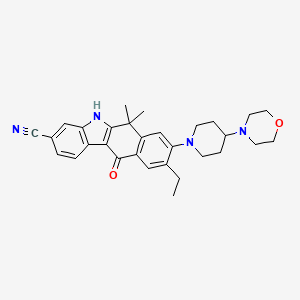
alectinib
Overview
Alectinib is a targeted anticancer therapy used primarily in Anaplastic Lymphoma Kinase (ALK)–positive non-small-cell lung cancer (NSCLC). It is a second-generation ALK inhibitor designed to suppress oncogenic signaling driven by ALK rearrangements, a molecular subtype that defines a clinically important subset of lung Cancers. By inhibiting ALK signaling, alectinib helps reduce tumor cell proliferation and disease progression in ALK-positive malignancies.
Clinically, alectinib has become an important treatment option in both advanced and resected early-stage ALK-positive NSCLC. Recent research continues to evaluate its comparative effectiveness, resistance mechanisms, toxicity profile, and potential interactions with immune and cellular pathways such as PD-1/PD-L1 signaling, cancer-associated fibroblasts, and autophagy-related processes.
Recent Publications Summary
Recent work on alectinib spans confirmatory efficacy analyses, real-world and health-economic evaluations, and mechanistic studies of toxicity and acquired resistance, reflecting the drug's established position as a first-line ALK inhibitor for ALK-rearranged non-small cell lung cancer (NSCLC).
An individual patient-level pooled analysis of the phase III ALEX and J-ALEX trials (500 patients; alectinib n = 249, crizotinib n = 251) reaffirmed superior progression-free survival with alectinib over crizotinib (HR 0.41, 95% CI 0.31–0.55, p < 0.001) without a significant overall survival difference at a median follow-up of 17.1 months (HR 0.80, 95% CI 0.50–1.28, p = 0.353) 42269244Jun. That analysis identified high baseline tumor burden — sum of RECIST v1.1 target lesions above the median — as an adverse prognostic factor for both PFS (HR 1.88; multivariate HR 1.66) and OS (HR 2.24), with a significant treatment-by-tumor-burden interaction in the PFS Cox model, alongside body mass index as a candidate baseline characteristic 42269244Jun. In the early-stage setting, an exploratory analysis of the phase III ALINA trial examined whether the disease-free survival benefit of adjuvant alectinib versus platinum-based chemotherapy in resected ALK-positive NSCLC held across surgical subgroups and after restaging under the AJCC/UICC 8th edition 41996761Apr. A small Japanese multi-institutional retrospective series of 10 patients treated with first-line alectinib for postoperative recurrence reported a median OS of 96.8 months from surgery and 82.8 months from recurrence, with median PFS from recurrence not reached, a 5-year PFS rate of 58.3%, and only one discontinuation for adverse events 41342940Dec.
Comparative and economic questions figure prominently. A retrospective cohort study using Veradigm electronic health records linked to Komodo closed claims compared alectinib, brigatinib, and lorlatinib in TKI-naïve patients with ALK-positive metastatic NSCLC who initiated therapy between May 2020 and December 2024, using unweighted and propensity score-weighted Cox models to assess real-world time to treatment discontinuation, time to next treatment, and progression-free survival, together with adverse event occurrence and healthcare costs 42423952Jul. Two cost-effectiveness analyses framed alectinib as the comparator or the intervention: one evaluated first-line lorlatinib — a third-generation ALK TKI with high central nervous system penetration and activity against resistance mutations, relevant to lung cancer brain metastases — against alectinib in the Italian healthcare system 42043888Apr, and another assessed adjuvant alectinib versus adjuvant platinum-based chemotherapy for resectable stage IB–IIIA ALK-positive disease from a US societal perspective 41066159Oct.
Mechanistic work addressed alectinib's characteristic toxicities. A multi-omics study showed that alectinib-induced dermatotoxicity is secondary to hepatotoxicity, driven by excessive hepatic macroautophagic degradation of biotinidase (BTD) and consequent systemic biotin deficiency that produces both hepatocyte apoptosis and skin barrier dysfunction; phosphorylation of NBR1 at a previously uncharacterized site, Ser656, stabilized the receptor and promoted selective BTD degradation, and exogenous biotin supplementation mitigated both toxicities 42107012May. This positions inter-organ crosstalk as a mechanistic element of drug-induced multi-organ injury and suggests a practical mitigation strategy.
Resistance and tumor-ecology studies round out the picture. Single-cell transcriptomic analysis of the GSE191078 dataset with pseudotime modeling, combined with CCK8 and TUNEL assays in alectinib-resistant H2228/Al cells, PD-L1/CD8 co-culture rescue experiments, and nude mouse xenografts, indicated that gilteritinib overcomes second-generation ALK TKI resistance in ALK-rearranged NSCLC by suppressing PD-L1 and CD8 co-expression, linking resistance to PD-1/PD-L1 signaling 42059267Apr. Separately, a mathematical modeling study fit two-population evolutionary game-theoretic models to in vitro NSCLC data tracking drug-sensitive and drug-resistant cells with and without alectinib and cancer-associated fibroblasts; a logistic growth model with ratio-dependent drug efficacy best fit monoculture dynamics, and growth rate and carrying capacity remained stable across CAF conditions while competition and drug efficacy parameters varied 42224394Jun.
What Changes, What Holds
1. Alectinib’s role is now more firmly defined as first-line standard therapy, with the main open questions shifting to comparative value and resistance biology
REINFORCES This paragraph does not alter the baseline’s core account of alectinib as an ALK-targeted treatment for ALK-rearranged NSCLC; it strengthens that position by framing the recent literature as confirmatory rather than disruptive 42269244Jun42423952Jul. What changes is the emphasis: the drug’s place is established enough that current work is increasingly about how well it performs against other ALK inhibitors, how durable benefit is in practice, and what limits its long-term use.
2. Baseline efficacy is confirmed, but high tumor burden emerges as a clinically important modifier of outcome
REINFORCES The pooled trial analysis sharpens the existing view that alectinib outperforms crizotinib on disease control, while also showing that not all patients share the same prognosis 42269244Jun. The new signal is not a new indication or a challenge to ALK targeting; it is a refinement of risk stratification, suggesting that baseline tumor burden may help identify patients with worse outcomes and possibly different relative benefit. The early-stage and postoperative recurrence data extend the established use into resected disease and relapse settings without displacing the baseline account.
3. Comparative effectiveness and cost now matter as much as target inhibition itself
NEW DIRECTION This work moves beyond the Overview’s focus on alectinib as an effective ALK inhibitor and into questions the baseline does not cover: how it compares in routine practice with other next-generation ALK TKIs and whether its value holds under different health-system assumptions 42423952Jul42043888Apr41066159Oct. The drug’s role is not overturned, but the center of gravity shifts toward sequencing, real-world durability, adverse-event burden, and economic justification.
4. Alectinib toxicity can arise through liver-to-skin crosstalk driven by biotin depletion
NEW DIRECTION The mechanistic work adds a new adverse-effect pathway that the Overview did not specify: dermatotoxicity appears secondary to hepatotoxicity rather than an isolated skin effect 42107012May. That does not contradict the baseline, which already allowed for toxicity studies; it expands understanding of how injury is produced and suggests biotin supplementation as a mitigation strategy. The practical implication is that monitoring and management may need to consider systemic metabolic consequences, not just organ-specific toxicity.
5. Resistance may be linked to immune signaling and fibroblast-driven ecology, opening non-ALK escape routes
NEW DIRECTION These studies do not displace the established ALK-inhibition model, but they broaden the resistance story beyond simple kinase escape, which the Overview only hinted at in general terms 42059267Apr42224394Jun. The new evidence points to PD-L1/CD8-associated signaling and cancer-associated fibroblast effects as part of the resistant state, implying that alectinib failure may reflect tumor-immune-microenvironment interactions as much as target mutation. That makes combination strategies and ecological modeling relevant to understanding durability of response.
Overview update candidates: high baseline tumor burden as an adverse prognostic factor and potential treatment-effect modifier; liver-to-skin toxicity via hepatic biotinidase degradation with possible biotin mitigation; immune and fibroblast-associated resistance mechanisms beyond ALK signaling.
alectinib
Background Contexts
In the literature, the biological baseline, pathological conditions, or disease models commonly surrounding alectinib are described as follows:
- ALK receptor tyrosine kinase (Protein) — 2 papers: PMIDs 42107012, 41342940
- ALK-positive Non-small Cell Lung Cancer (Disease) — 2 papers: PMIDs 41996761, 41066159
- non-small-cell lung carcinoma (Disease) — 2 papers: PMIDs 42107012, 42059267
- adenocarcinoma (Disease) — 1 paper: PMIDs 41342940
- ALK rearrangement-positive metastatic non-small cell lung cancer (Disease) — 1 paper: PMIDs 42423952
- ALK-mutant neuroblastoma (Disease) — 1 paper: PMIDs 41866626
- lung cancer brain metastases (Disease) — 1 paper: PMIDs 42224394
- pharmacologic and surgical management (Therapy) — 1 paper: PMIDs 41342940
- Resectable (stage IB to IIIA) (Other) — 1 paper: PMIDs 41066159
Methodologies & Technologies Used
Researchers utilize the following experimental methods, imaging platforms, computational models, or biological reagents to study alectinib:
- 8th edition of the Cancer Staging Manual (Other) — 1 paper: PMIDs 41996761
- cancer-associated fibroblast (Cellular Component) — 1 paper: PMIDs 42224394
- Cholecystokinin a (Protein) — 1 paper: PMIDs 42059267
- cost-effectiveness analysis (Other) — 1 paper: PMIDs 42043888
- FindClusters function (Technology) — 1 paper: PMIDs 42059267
- Gompertz model (Technology) — 1 paper: PMIDs 42224394
- GSE191078 (Other) — 1 paper: PMIDs 42059267
- H2228/Al (Cell Line) — 1 paper: PMIDs 42059267
- Komodo closed claims (Technology) — 1 paper: PMIDs 42423952
- linear model (Technology) — 1 paper: PMIDs 42224394
- logistic regression model (Technology) — 1 paper: PMIDs 42224394
- macroautophagic/autophagic degradation (Biological Process) — 1 paper: PMIDs 42107012
Molecular Interventions & Targets
The primary molecular pathways, regulatory genes, enzymes, or therapeutic agents actively targeted and manipulated in relation to alectinib include:
- ALK receptor tyrosine kinase (Protein) — 3 papers: PMIDs 42423952, 42059267, 42043888
- lorlatinib (Therapy) — 2 papers: PMIDs 42423952, 42043888
- ALK-TKI (Therapy) — 1 paper: PMIDs 41342940
- biotin (Therapy) — 1 paper: PMIDs 42107012
- brigatinib (Therapy) — 1 paper: PMIDs 42423952
- BTD (biotinidase) (Protein) — 1 paper: PMIDs 42107012
- Cluster of Differentiation 8 (Protein) — 1 paper: PMIDs 42059267
- disialoganglioside 2 chimeric antigen receptor T cells (Therapy) — 1 paper: PMIDs 41866626
- gilteritinib (Therapy) — 1 paper: PMIDs 42059267
- metastatic non-small cell lung cancer (Disease) — 1 paper: PMIDs 42043888
- PD-1/PD-L1 (Pathway) — 1 paper: PMIDs 42059267
- platinum-based chemotherapy (Therapy) — 1 paper: PMIDs 41066159
Observed Outcomes & Phenotypes
The phenotypic changes, physiological endpoints, or clinical metrics observed and measured in connection with alectinib include:
- 5-year PFS rate (Clinical Metric) — 1 paper: PMIDs 41342940
- anti-tumor efficacy (Other) — 1 paper: PMIDs 42059267
- carrying capacity (Clinical Metric) — 1 paper: PMIDs 42224394
- coexistence between resistant and sensitive cells (Biological Process) — 1 paper: PMIDs 42224394
- competition and drug efficacy parameters (Clinical Metric) — 1 paper: PMIDs 42224394
- competitive exclusion (Biological Process) — 1 paper: PMIDs 42224394
- dermatotoxicity (Clinical Metric) — 1 paper: PMIDs 42107012
- disease-free survival (DFS) (Clinical Metric) — 1 paper: PMIDs 41996761
- glycolytic process (Biological Process) — 1 paper: PMIDs 42059267
- growth rate (Clinical Metric) — 1 paper: PMIDs 42224394
- Healthcare Costs (Clinical Metric) — 1 paper: PMIDs 42423952
- hepatocyte apoptosis (Biological Process) — 1 paper: PMIDs 42107012
General Takeaways & Clinical Potentials
The high-level concepts, clinical translations, and overarching conclusions proposed in the research surrounding alectinib are summarized below:
- follow-up time (Other) — 1 paper: PMIDs 42423952
- inter-organ crosstalk (Biological Process) — 1 paper: PMIDs 42107012
- Precision-Targeted Intervention (Therapy) — 1 paper: PMIDs 41342940
- safer clinical application (Other) — 1 paper: PMIDs 42107012
- sample sizes (Other) — 1 paper: PMIDs 42423952
- therapeutic modeling of cancer (Other) — 1 paper: PMIDs 42224394