rosmarinic acid
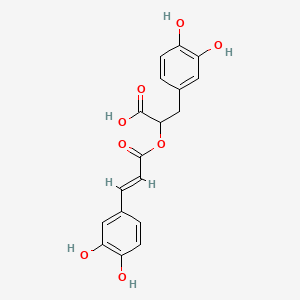
Overview
Rosmarinic acid is a naturally occurring phenolic compound widely found in plants of the Lamiaceae family, including Salvia species and chia (Salvia hispanica). Chemically, it is a caffeic acid ester with strong antioxidant properties, and it is frequently studied as a bioactive phytochemical rather than as a conventional drug. In biomedical research, rosmarinic acid is of interest because it can modulate oxidative stress, inflammatory signaling, and cell survival pathways, which has led to investigation in metabolic, neuroprotective, antimicrobial, and anticancer contexts.
Recent studies have continued to position rosmarinic acid as a multifunctional natural product with potential pharmaceutical relevance. Its reported activities include antioxidant effects, enzyme inhibition, and support for nanomedicine-based delivery systems. In the publications summarized here, rosmarinic acid was examined both as a major plant metabolite and as an active component incorporated into engineered nanoparticles, including PLGA nanoparticles, polydopamine-based nanotherapeutics, and RA-Se@M self-assembled systems. These studies collectively reflect its role as a bioactive scaffold in oxidative stress-related disease models, including Parkinson’s disease, pancreatic cancer, triple-negative breast cancer, and postprandial glucose modulation.
Recent Publications Summary
Recent studies have examined rosmarinic acid in several nanotechnology-based and formulation-driven therapeutic contexts, most often leveraging its antioxidant and anti-inflammatory properties. In diabetic wound repair, a multifunctional rosmarinic acid–cerium nanozyme hydrogel was designed to combine reactive oxygen species scavenging, controlled oxygen generation, antibacterial effects, and promotion of neovascularization; both in vitro and in vivo experiments indicated that this approach alleviated hypoxia and supported angiogenesis to accelerate healing 42587488Aug. In another wound- and inflammation-related plant chemistry study, rosmarinic acid was identified as a major phenolic constituent in a 70% ethanol extract of Echium italicum, and a separate Salvia heldreichiana analysis also detected rosmarinic acid among the major bioactive compounds with measurable antioxidant and enzyme-inhibitory properties 42274011Jun42220228Jun.
Rosmarinic acid has also been incorporated into delivery systems aimed at reducing toxicity or enhancing bioavailability. In a rat model of chlorfenapyr-induced testicular toxicity, nano-encapsulation of rosmarinic acid in chitosan nanoparticles was tested alongside crude rosmarinic acid; the study reported that chlorfenapyr caused reproductive damage associated with oxidative stress, pro-inflammatory cytokine production, apoptosis, and activation of NF-κB/NLRP3 signaling, while the nano-formulation was evaluated for improved protective efficacy 42478942Jul. A separate neuronal delivery platform used PLGA nanoparticles to entrap rosmarinic acid together with an antisense oligonucleotide, with physicochemical stability preserved and measurable radical scavenging activity retained after formulation 42069271May. In Parkinson’s disease research, rosmarinic acid was co-delivered with curcumin and plasmid DNA in a borneol-modified chitosan nanoparticle system; in mice, this nanocarrier improved blood-brain barrier penetration and was associated with reduced motor dysfunction, less neuronal damage, lowered α-synuclein expression, restored mitochondrial function, and reduced oxidative stress 42390437Jul.
Several publications focused on rosmarinic acid as an anti-aggregation or anti-tumor agent. In insulin amyloidosis experiments, rosmarinic acid inhibited insulin fibrillation in a dose-dependent manner by binding aggregation-prone regions of the protein, and insulin-phytochemical formulations containing rosmarinic acid were more effective than monomeric insulin alone in a Drosophila diabetes model 42331169Jun. In triple-negative breast cancer, rosmarinic acid was self-assembled with selenium ions into nanoparticles coated with homologous cancer cell membranes; this platform showed tumor targeting, induced apoptosis and immunogenic cell death, and enhanced anti-PD-1 therapy in vivo 41512467Jan. A brain-targeted nanoparticle study for Parkinson’s disease likewise incorporated rosmarinic acid as part of a multitarget strategy against α-synuclein aggregation, mitochondrial dysfunction, and oxidative stress 42390437Jul.
Rosmarinic acid also appeared in analytical, docking, and screening studies of natural products. In chia seed phenolic profiling, the methanolic extract showed the highest phenolic content and antioxidant activity, with rosmarinic acid described as a dominant constituent in the extract 42313210Jun. In a β-lactamase inhibitor screening workflow using HPTLC-bioautography, rosmarinic acid was among the herbal constituents of interest identified through the method, which was designed for rapid localization of inhibitory compounds in complex matrices 42068824May. Overall, these publications present rosmarinic acid as a recurring bioactive phenolic linked to antioxidant effects, anti-inflammatory or anti-aggregation activity, and diverse nanomedicine applications 42587488Aug42478942Jul42390437Jul42331169Jun41512467Jan.
What Changes, What Holds
1. Multifunctional wound-healing use is now more explicit, but it still extends the known antioxidant profile
REINFORCES Cerium-based nanoformulation work strengthens the view of rosmarinic acid as a bioactive antioxidant and anti-inflammatory scaffold, now with a more concrete regenerative application in hypoxic diabetic wounds. It does not overturn the baseline’s account of rosmarinic acid as a multifunctional phytochemical; instead, it sharpens one translational direction by linking ROS scavenging and antimicrobial activity to angiogenesis and faster repair 42587488Aug. The plant-extract findings also fit the established antioxidant/enzyme-inhibitory profile 42274011Jun42220228Jun.
2. Nano-encapsulation adds a delivery-and-safety dimension without changing the core biological account
NEW DIRECTION chitosan and PLGA formulations place rosmarinic acid in a new role as a payload whose value depends on bioavailability, tissue targeting, and toxicity mitigation, not just intrinsic activity. The baseline already covers nanomedicine, but not this specific protective use against chlorfenapyr-linked reproductive injury or this neuronal co-formulation strategy. One result also points to preserved radical-scavenging after encapsulation, so formulation appears to retain rather than replace activity 42478942Jul42069271May.
3. Anti-aggregation and anti-tumor activity are reinforced, with one notable new disease mechanism
REINFORCES Rosmarinic acid is still being mapped onto the same broad antioxidant and anticancer logic already in the Overview, and the new insulin-amyloid data extend that into protein misfolding control rather than a different biological class. The membrane-coated selenium nanoparticle work similarly strengthens its relevance in tumor-targeted nanotherapy, including immune activation. The Parkinson’s nanoparticle result sits alongside the baseline’s neuroprotective framing rather than displacing it 42331169Jun41512467Jan42390437Jul.
4. Screening and profiling studies sharpen rosmarinic acid’s status as a common phenolic marker
REINFORCES Chia and Salvia chemistry analyses do not add a new function so much as confirm that rosmarinic acid remains a dominant, recurrent phenolic associated with high antioxidant readouts in plant matrices. The HPTLC-bioautography screen is mainly methodological, but it also keeps rosmarinic acid visible among herbal compounds of interest in inhibitor searches. Together, these findings reinforce the baseline’s picture of rosmarinic acid as a frequent bioactive constituent rather than a newly redefined entity 42313210Jun42068824May.
Overview update candidates: wound-healing nanotherapy with angiogenesis support; formulation-dependent delivery/toxicity mitigation; anti-aggregation activity in insulin fibrillation; cell-membrane-coated selenium nanotherapy for triple-negative breast cancer.
rosmarinic acid
Background Contexts
In the literature, the biological baseline, pathological conditions, or disease models commonly surrounding rosmarinic acid are described as follows:
- defective angiogenesis (Biological Process) — 1 paper: PMIDs 42587488
- diabetes mellitus (Disease) — 1 paper: PMIDs 42331169
- diabetic wound (Disease) — 1 paper: PMIDs 42587488
- Dopaminergic cell groups (Other) — 1 paper: PMIDs 42159234
- Echium italicum (Organism) — 1 paper: PMIDs 42274011
- Ehretia macrophylla Wall. (Organism) — 1 paper: PMIDs 42314604
- excessive oxidative stress (Biological Process) — 1 paper: PMIDs 42587488
- Extended-spectrum beta-lactamase (Other) — 1 paper: PMIDs 42156860
- Gastrointestinal Disorders (Disease) — 1 paper: PMIDs 41997435
- hypoxia (Biological Process) — 1 paper: PMIDs 42587488
- Mesosphaerum pectinatum (Organism) — 1 paper: PMIDs 41997435
- Metabolic Dysregulation (Biological Process) — 1 paper: PMIDs 42587488
Methodologies & Technologies Used
Researchers utilize the following experimental methods, imaging platforms, computational models, or biological reagents to study rosmarinic acid:
- 2,2-diphenyl-1-picrylhydrazyl (Technology) — 3 papers: PMIDs 42313210, 42274011, 42156860
- response surface methodology (Technology) — 2 papers: PMIDs 42533630, 42314604
- Ultrasound-assisted extraction (Technology) — 2 papers: PMIDs 42533630, 42314604
- 3-(4,5-dimethylthiazol-2-yl)-2,5-diphenyltetrazolium bromide assay (Technology) — 1 paper: PMIDs 41895184
- 4T1 tumors (Cell Line) — 1 paper: PMIDs 41512467
- ABTS•+ (Technology) — 1 paper: PMIDs 42313210
- Acidified ethanol (Chemical) — 1 paper: PMIDs 41997435
- adult male Wistar rats (Organism) — 1 paper: PMIDs 42313210
- aggregation-prone regions (Biological Process) — 1 paper: PMIDs 42331169
- anti-PD-1 immunotherapy (Therapy) — 1 paper: PMIDs 41512467
- ATP-sensitive potassium channel (Protein) — 1 paper: PMIDs 41997435
- borneol-modified carboxymethyl chitosan nanoparticle system (Other) — 1 paper: PMIDs 42390437
Molecular Interventions & Targets
The primary molecular pathways, regulatory genes, enzymes, or therapeutic agents actively targeted and manipulated in relation to rosmarinic acid include:
- 1ACJ (Protein) — 1 paper: PMIDs 42220228
- 2Y9X (Protein) — 1 paper: PMIDs 42220228
- 3,5-dicaffeoylquinic acid (Chemical) — 1 paper: PMIDs 42068824
- 3NVY (Protein) — 1 paper: PMIDs 42220228
- 4-hydroxybenzoic acid (Chemical) — 1 paper: PMIDs 42220228
- acarbose (Therapy) — 1 paper: PMIDs 42313210
- Acetylcholinesterase (AChE) (Protein) — 1 paper: PMIDs 42220228
- Acid α-glucosidase (AAG) (Protein) — 1 paper: PMIDs 42313210
- antisense oligonucleotide (Therapy) — 1 paper: PMIDs 42069271
- apoptotic markers (Clinical Metric) — 1 paper: PMIDs 41895184
- Aqueous extract of the aerial parts of Mesosphaerum pectinatum (Chemical) — 1 paper: PMIDs 41997435
- Astragalin (Chemical) — 1 paper: PMIDs 42274011
Observed Outcomes & Phenotypes
The phenotypic changes, physiological endpoints, or clinical metrics observed and measured in connection with rosmarinic acid include:
- antioxidant activity (Biological Process) — 2 papers: PMIDs 42533630, 42314604
- apoptotic process (Biological Process) — 2 papers: PMIDs 42478942, 41895184
- mitochondrial integrity (Biological Process) — 2 papers: PMIDs 42390437, 42159234
- oxidative stress (Biological Process) — 2 papers: PMIDs 42478942, 42390437
- total phenolic content (Clinical Metric) — 2 papers: PMIDs 42533630, 42220228
- 1-octacosanol (Chemical) — 1 paper: PMIDs 42274011
- 1-octadecene (Chemical) — 1 paper: PMIDs 42274011
- 2,2'-azino-bis(3-ethylbenzothiazoline-6-sulfonic acid) (Other) — 1 paper: PMIDs 42156860
- 5-eicosene (Chemical) — 1 paper: PMIDs 42274011
- 74 metabolites (Other) — 1 paper: PMIDs 41895184
- 9-octadecenoic acid methyl ester (Chemical) — 1 paper: PMIDs 42274011
- Acid α-glucosidase (AAG) (Protein) — 1 paper: PMIDs 42274011
General Takeaways & Clinical Potentials
The high-level concepts, clinical translations, and overarching conclusions proposed in the research surrounding rosmarinic acid are summarized below:
- angiogenesis-promoting (Biological Process) — 1 paper: PMIDs 42587488
- Anti-inflammatory (Therapy) — 1 paper: PMIDs 42587488
- antibacterial (Other) — 1 paper: PMIDs 42587488
- Antibacterial activity (Clinical Metric) — 1 paper: PMIDs 42533630
- antioxidant (Other) — 1 paper: PMIDs 42274011
- antioxidant capacity (Clinical Metric) — 1 paper: PMIDs 42533630
- biomimetic strategy (Other) — 1 paper: PMIDs 41512467
- borneol-modified carboxymethyl chitosan nanoparticle system (Other) — 1 paper: PMIDs 42390437
- CD4+ T cells and antitumor immunity (Biological Process) — 1 paper: PMIDs 41512467
- Chia seed extracts (Other) — 1 paper: PMIDs 42313210
- DNA-protective effects (Biological Process) — 1 paper: PMIDs 42274011
- enzyme inhibitory (Biological Process) — 1 paper: PMIDs 42274011