lenalidomide
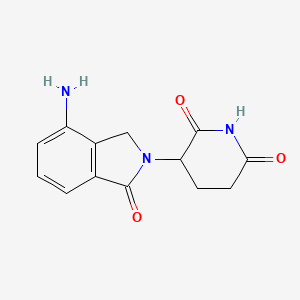
Overview
Lenalidomide is an immunomodulatory antineoplastic agent used primarily in hematologic malignancies. It is a thalidomide analog and is best known for its ability to modulate the tumor microenvironment, enhance immune effector function, and exert direct anti-myeloma and anti-lymphoma activity. A key molecular feature of lenalidomide is its interaction with cereblon, the substrate receptor component of the CRL4 E3 ubiquitin ligase complex, which underlies many of its downstream biological effects and has also made lenalidomide a widely used chemical tool in targeted protein degradation research.
Clinically, lenalidomide is an established backbone therapy in multiple myeloma and several B-cell lymphomas, often combined with dexamethasone, rituximab, bortezomib, daratumumab, carfilzomib, tafasitamab, or other agents. Its use in combination regimens reflects both its immunostimulatory properties and its synergy with monoclonal antibodies and other anti-cancer drugs. In recent research, lenalidomide has also been explored in T-cell lymphoma and in mechanistic studies involving cereblon-binding and PROTAC design.
Recent Publications Summary
Recent clinical studies demonstrate lenalidomide's broad efficacy in combination regimens across multiple hematologic malignancies. In newly diagnosed multiple myeloma, lenalidomide-based triplet and quadruplet regimens have shown high response rates. The XVRd regimen (selinexor, bortezomib, lenalidomide, and dexamethasone) achieved an overall response rate of 93.3% in patients with high-risk disease 42544613Aug, while daratumumab-based quadruplet therapy (DVRd) demonstrated a 63% lower risk of disease progression or death compared to VRd triplet therapy 42444515Jul. Belantamab mafodotin combined with carfilzomib, lenalidomide, and dexamethasone achieved 89.5% overall response rate in relapsed/refractory multiple myeloma, with 78.9% of patients reaching very good partial response or better 41719502Feb. In intermediate-fit and frail newly diagnosed patients, belantamab mafodotin with lenalidomide and dexamethasone demonstrated 97.6% overall response rate with manageable ocular toxicity 41346230Dec.
The optimal duration of lenalidomide maintenance therapy remains an area of investigation. A phase 3 trial comparing indefinite-duration versus fixed-duration (2-year) lenalidomide maintenance in standard-risk newly diagnosed multiple myeloma found no significant difference in overall survival between treatment groups after 86 months of median follow-up 42456135Jul. Population pharmacokinetic studies identified important pharmacological differences across geographic regions; simulated lenalidomide exposure was approximately 25% higher in Korean patients compared to multinational trial populations, with potential implications for dosing and efficacy outcomes 42515832Jul.
In non-Hodgkin lymphomas, lenalidomide-based combinations have demonstrated superior efficacy over chemotherapy-based approaches. Epcoritamab combined with lenalidomide and rituximab (R2) improved overall response rate (96.9% vs. 80.5%) and duration of response compared to rituximab-based chemotherapy in relapsed/refractory follicular lymphoma 42415230Jul. In the AUGMENT trial of relapsed/refractory indolent non-Hodgkin lymphoma, R2 improved both progression-free survival and overall survival compared to rituximab with placebo at long-term follow-up (median 65.9 months) 41990300Apr. The RELEVANCE trial of previously untreated advanced follicular lymphoma found comparable 10-year progression-free survival rates between R2 and rituximab-based chemotherapy (46.4% vs. 46.6%), with 10-year overall survival rates of 82.4% and 81.1%, respectively 41915772Mar. Zanubrutinib combined with lenalidomide in relapsed/refractory diffuse large B-cell lymphoma achieved 89.5% overall response rate, with grade ≥3 neutropenia as the most common adverse event 41824782Mar. A phase 1 trial of romidepsin, azacitidine, dexamethasone, and lenalidomide in relapsed/refractory T-cell lymphoma identified a maximum tolerated dose of 20 mg lenalidomide, with 89% objective response rate among patients treated at this dose 41779512Mar.
safety considerations warrant attention in lenalidomide-containing regimens. Pooled analysis of the MAIA and ALCYONE trials showed higher incidence of grade 3/4 infections with daratumumab-based regimens versus standard combinations, though exposure-adjusted rates were comparable 42085642May. Real-world safety data from the FAERS database identified elevated signals for infections associated with daratumumab-lenalidomide-dexamethasone combinations and neurological disorders linked to bortezomib-lenalidomide-dexamethasone regimens 42171749May. At the molecular level, lenalidomide's interaction with the thalidomide-binding domain of cereblon has been characterized by NMR spectroscopy, providing structural insights relevant to its mechanism as an immunomodulatory agent 42101529May.
What Changes, What Holds
1. Lenalidomide now looks like a broadly effective backbone across more myeloma combinations, not just a standard partner drug
REINFORCES These studies strengthen the baseline view that lenalidomide is a central component of multi-agent hematologic regimens, while also showing that its utility extends into newer triplet and quadruplet strategies with very high response rates. The main change is not a new role, but a sharper sense that lenalidomide remains highly compatible with emerging agents and can anchor intensified frontline and relapsed/refractory myeloma therapy 42544613Aug42444515Jul.
2. Maintenance duration remains unsettled, and exposure may vary enough by population to affect dosing assumptions
NEW DIRECTION Lenalidomide’s established place as maintenance therapy is not overturned, but the new work weakens any assumption that indefinite treatment is clearly superior to a fixed course in standard-risk disease. It also adds a pharmacokinetic caution: the same nominal dose may yield meaningfully different exposure across regions, which could complicate cross-trial comparisons and dose selection. The baseline did not address either duration uncertainty or regional exposure differences 42456135Jul42515832Jul.
3. Lenalidomide is consolidating its role in lymphoma as a comparator and partner that can outperform chemotherapy-based approaches
REINFORCES These findings do not change the baseline’s lymphoma framing so much as extend and sharpen it: lenalidomide-based regimens continue to show durable activity across indolent and aggressive B-cell lymphomas, and now also in a T-cell lymphoma combination. The important implication is that lenalidomide is not merely an add-on to rituximab-based therapy; in several settings it appears to be a competitive backbone with meaningful long-term disease control 42415230Jul41990300Apr.
4. safety and mechanism are becoming more specific, with regimen-linked toxicities and direct cereblon binding better defined
NEW DIRECTION The baseline already recognizes lenalidomide’s immunomodulatory mechanism, but these data add two distinct refinements: first, certain lenalidomide-containing combinations carry measurable infection and neurologic safety signals that should inform monitoring; second, structural work gives a more detailed picture of how lenalidomide engages cereblon’s thalidomide-binding domain. That is an extension rather than a contradiction, but it shifts the article toward more explicit regimen-specific risk and molecular detail 42085642May42101529May.
Overview update candidates: broader combination efficacy in myeloma; maintenance duration uncertainty; regional pharmacokinetic variability; regimen-specific safety signals; structural cereblon-binding detail.
lenalidomide
Background Contexts
In the literature, the biological baseline, pathological conditions, or disease models commonly surrounding lenalidomide are described as follows:
- multiple myeloma (Disease) — 13 papers: PMIDs 42544613, 42526890, 42515832, 42496822, etc.
- relapsed/refractory follicular lymphoma (Disease) — 2 papers: PMIDs 42415230, 41915772
- anti-CD38 antibody (Therapy) — 1 paper: PMIDs 42289183
- Anti-CD38 monoclonal antibody (Therapy) — 1 paper: PMIDs 42212933
- Asian populations (Organism) — 1 paper: PMIDs 42515832
- AUGMENT trial (Other) — 1 paper: PMIDs 41990300
- blood flow (Biological Process) — 1 paper: PMIDs 42541591
- bone marrow (Organism) — 1 paper: PMIDs 42526890
- Cutaneous hyperpigmentation (Clinical Metric) — 1 paper: PMIDs 42496822
- D-Asp (Chemical) — 1 paper: PMIDs 41785830
- Drug exposure (Other) — 1 paper: PMIDs 42515832
- Drug response (Biological Process) — 1 paper: PMIDs 42515832
Methodologies & Technologies Used
Researchers utilize the following experimental methods, imaging platforms, computational models, or biological reagents to study lenalidomide:
- 1.4 or 1.9 mg/kg (Other) — 1 paper: PMIDs 41719502
- 15, 20, or 25 mg (Other) — 1 paper: PMIDs 41824782
- Alcyone (Other) — 1 paper: PMIDs 42085642
- anaplastic large-cell lymphoma (Disease) — 1 paper: PMIDs 41779512
- Autologous stem cell transplantation (Therapy) — 1 paper: PMIDs 42374568
- axitinib (Therapy) — 1 paper: PMIDs 42387647
- azd-8055 (Therapy) — 1 paper: PMIDs 42387647
- BGB-3111-110 (Other) — 1 paper: PMIDs 41824782
- Bilateral peripheral antecubital venous access (Technology) — 1 paper: PMIDs 42541591
- Bone marrow cytogenetics (Technology) — 1 paper: PMIDs 42541591
- bortezomib (Therapy) — 1 paper: PMIDs 42387202
- bortezomib-lenalidomide (Therapy) — 1 paper: PMIDs 42387202
Molecular Interventions & Targets
The primary molecular pathways, regulatory genes, enzymes, or therapeutic agents actively targeted and manipulated in relation to lenalidomide include:
- dexamethasone (Therapy) — 10 papers: PMIDs 42544613, 42444515, 42374568, 42289183, etc.
- bortezomib (Therapy) — 6 papers: PMIDs 42544613, 42444515, 42374568, 42171749, etc.
- carfilzomib (Therapy) — 3 papers: PMIDs 42515832, 42289183, 41719502
- daratumumab (Therapy) — 3 papers: PMIDs 42444515, 42171749, 42085642
- B cell maturation antigen (BCMA) (Protein) — 2 papers: PMIDs 42212933, 41719502
- belantamab mafodotin (Therapy) — 2 papers: PMIDs 41719502, 41346230
- intravitreal rituximab (Therapy) — 2 papers: PMIDs 41990300, 41915772
- rituximab (Therapy) — 2 papers: PMIDs 42415230, 41587420
- selinexor (Therapy) — 2 papers: PMIDs 42544613, 41564431
- anti-CD19 antibody-drug conjugates (ADCs) (Therapy) — 1 paper: PMIDs 41587420
- anti-CD20 mAb (Therapy) — 1 paper: PMIDs 41587420
- Autologous stem cell transplantation (Therapy) — 1 paper: PMIDs 41564431
Observed Outcomes & Phenotypes
The phenotypic changes, physiological endpoints, or clinical metrics observed and measured in connection with lenalidomide include:
- progression-free survival (Clinical Metric) — 7 papers: PMIDs 42544613, 42456135, 42415230, 42289183, etc.
- Overall Response Rate (Clinical Metric) — 4 papers: PMIDs 42544613, 42515832, 41824782, 41719502
- infection (Disease) — 3 papers: PMIDs 42289183, 42212933, 42085642
- oxidative stress (Biological Process) — 3 papers: PMIDs 42415230, 42387647, 42387202
- very good partial response (Clinical Metric) — 3 papers: PMIDs 42544613, 42374568, 41719502
- complete response (Clinical Metric) — 2 papers: PMIDs 42544613, 42212933
- death (Clinical Metric) — 2 papers: PMIDs 42444515, 42289183
- overall survival (Clinical Metric) — 2 papers: PMIDs 42544613, 42212933
- partial response (Clinical Metric) — 2 papers: PMIDs 42544613, 42374568
- 14.9 months (Clinical Metric) — 1 paper: PMIDs 41824782
- 2.8 months (Clinical Metric) — 1 paper: PMIDs 41824782
- 24-month progression-free survival (Clinical Metric) — 1 paper: PMIDs 41719502
General Takeaways & Clinical Potentials
The high-level concepts, clinical translations, and overarching conclusions proposed in the research surrounding lenalidomide are summarized below:
- dexamethasone (Therapy) — 2 papers: PMIDs 42541591, 42444515
- progression-free survival (Clinical Metric) — 2 papers: PMIDs 41564431, 41346230
- acceptable tolerability and antitumor activity (Other) — 1 paper: PMIDs 41824782
- allogeneic transplantation (Other) — 1 paper: PMIDs 41779512
- bortezomib (Therapy) — 1 paper: PMIDs 42444515
- Bruton's tyrosine kinase inhibitor (Therapy) — 1 paper: PMIDs 42533525
- Chemoimmunotherapy (Therapy) — 1 paper: PMIDs 42533525
- chemotherapy-free alternative (Other) — 1 paper: PMIDs 41915772
- chemotherapy-free treatment option (Other) — 1 paper: PMIDs 42415230
- clinical benefit in RRMM (Other) — 1 paper: PMIDs 41719502
- complete response (CR) (Other) — 1 paper: PMIDs 41587420
- D-Asp homeostasis (Biological Process) — 1 paper: PMIDs 41785830