L-ascorbate
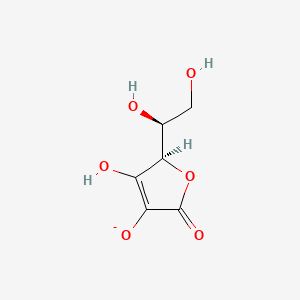
Overview
L-ascorbate is the deprotonated, biologically relevant form of ascorbic acid (vitamin C) and a central small-molecule antioxidant in human and other mammalian physiology. It participates in redox chemistry, supports collagen biosynthesis through its role in maintaining metal cofactors in enzymatic reactions, and is widely used in biomedical research as a reducing agent, antioxidant comparator, and activatable component in drug-delivery and sensing systems.
In medical and pharmaceutical contexts, L-ascorbate is studied both as a nutrient-related metabolite and as a functional chemical trigger. Its reducing properties make it useful in formulations that respond to oxidative or redox conditions, in nanoparticle synthesis, and in assays of antioxidant capacity. Recent studies also connect L-ascorbate metabolism to disease-associated microbial and host pathways, including altered vitamin C degradation in gut dysbiosis, while other work uses ascorbate or vitamin C conditioning to modulate immune-cell fitness and therapeutic performance.
Recent Publications Summary
Recent publications on L-ascorbate focused largely on its antioxidant, nutritional, and bioactive roles in plant-derived extracts and formulated products. In green acerola, extraction conditions were optimized to maximize ascorbic acid recovery, with pure water at 35 °C yielding the highest recovery and strong ABTS/DPPH antioxidant activity; the optimized extract also preserved Saccharomyces cerevisiae viability under menadione-induced oxidative stress and was successfully spray-dried into a stable vitamin C-rich powder without significant loss of antioxidant composition or activity 42397599Jul. Similarly, in Sonneratia apetala fruit and derived products, vitamin C was isolated at high purity and characterized alongside pectin and amino acid profiles, supporting the nutritional valorization of this underutilized fruit 42361004Jun.
L-ascorbate was also examined in applied formulations and biomaterial contexts. A skin-focused in vitro study reported that formulations containing ascorbic acid, collagen blend, and botanical extracts enhanced expression of prolyl 4-hydroxylase and lysyl hydroxylase, enzymes involved in collagen post-translational modification and stabilization, suggesting potential support for collagen biosynthesis and skin integrity 42126974May. In a flexible hydrogel sensor platform, ascorbic acid was used as the target analyte for sweat detection, where electrostatic interaction strategies improved selectivity and enabled low-limit, real-time sensing of AA in sweat 42108055May.
Beyond direct formulation studies, L-ascorbate appeared in disease-related and translational contexts. A multi-omics analysis in Chinese ALS patients found enrichment of microbial pathways involved in L-ascorbate degradation, alongside gut dysbiosis and altered energy metabolism, suggesting a possible link between vitamin C metabolism and systemic oxidative stress in ALS 42059647Apr. In pancreatic disease, a scoping review protocol highlighted growing interest in vitamin C as an antioxidant and anti-inflammatory agent in pancreatitis and as a cytotoxic/modulatory agent in PDAC, particularly in stromal and epithelial compartments 42330555Jun. Vitamin C conditioning was also used to generate CD19-targeting CAR T cells with improved transduction, proliferation, and cytotoxicity in a posttransplant lymphoproliferative disorder model, indicating a manufacturing strategy in which vitamin C enhanced cellular fitness and antitumor function 41416402Dec.
What Changes, What Holds
1. Plant extracts and fruit products extend L-ascorbate’s role as a nutritional antioxidant, without changing the baseline account
REINFORCES These studies mainly sharpen the established picture of L-ascorbate as a bioactive reducing agent and antioxidant used in nutritional and formulation settings. The added value is practical: extraction, drying, and product characterization can preserve vitamin C content and activity while retaining stress-protective effects in a food matrix 42397599Jul42361004Jun. Nothing here displaces the overview; it supports the same antioxidant and nutraceutical framing in new plant-derived sources.
2. Ascorbic acid remains a useful collagen-supporting ingredient and a measurable sweat analyte
REINFORCES The skin-formulation work is consistent with the overview’s collagen-biosynthesis role, adding a more applied claim that ascorbic-acid-containing formulations may support enzymes involved in collagen maturation 42126974May. The sensor study does not alter biology at all; it shows a new detection platform for monitoring AA in sweat 42108055May. Together these findings extend established uses in formulation and assay contexts rather than introducing a new function.
3. Vitamin C metabolism now appears relevant to ALS-associated gut dysbiosis and to translational disease and cell-manufacturing strategies
NEW DIRECTION The ALS multi-omics result adds a disease association the overview did not cover: microbial L-ascorbate degradation may be part of the metabolic disturbance in ALS, linking vitamin C handling to systemic oxidative stress 42059647Apr. The pancreatitis/PDAC review protocol and CAR T-cell conditioning work also broaden use into inflammatory and manufacturing settings 42330555Jun41416402Dec. These are additions, not contradictions, because the baseline was silent on these roles.
Overview update candidates: possible addition of ALS-associated microbial L-ascorbate degradation as a disease-linked pathway; possible addition of vitamin C conditioning as a cell-manufacturing strategy.
l-ascorbate
Background Contexts
In the literature, the biological baseline, pathological conditions, or disease models commonly surrounding l-ascorbate are described as follows:
- acute pancreatitis (Disease) — 1 paper: PMIDs 42330555
- Almond (Organism) — 1 paper: PMIDs 42430401
- amyotrophic lateral sclerosis (Disease) — 1 paper: PMIDs 42059647
- Aronia melanocarpa (Organism) — 1 paper: PMIDs 41880966
- Benign/Inflammatory Pancreatic Diseases (Disease) — 1 paper: PMIDs 42330555
- cancer-related fatigue (Disease) — 1 paper: PMIDs 42049445
- Chikungunya virus (Other) — 1 paper: PMIDs 42132069
- cholinergic dysfunction (Biological Process) — 1 paper: PMIDs 41871474
- chronic pancreatitis (Disease) — 1 paper: PMIDs 42330555
- cystic fibrosis (Disease) — 1 paper: PMIDs 41722739
- drug-resistant glioblastoma (Disease) — 1 paper: PMIDs 41942054
- Endocrine-disrupting chemicals (Chemical) — 1 paper: PMIDs 41604759
Methodologies & Technologies Used
Researchers utilize the following experimental methods, imaging platforms, computational models, or biological reagents to study l-ascorbate:
- 2,2-diphenyl-1-picrylhydrazyl (Technology) — 2 papers: PMIDs 42361004, 41880966
- 2,2'-azino-bis(3-ethylbenzothiazoline-6-sulfonic acid) (Other) — 1 paper: PMIDs 41880966
- ABTS•+ (Technology) — 1 paper: PMIDs 42397599
- alkaline phosphatase (Protein) — 1 paper: PMIDs 41604759
- Almond powder (Chemical) — 1 paper: PMIDs 42430401
- antioxidant and anti-inflammatory activity (Biological Process) — 1 paper: PMIDs 42126974
- apple juice (Other) — 1 paper: PMIDs 42268732
- aptamer (Other) — 1 paper: PMIDs 41604759
- Arabic Gum (Other) — 1 paper: PMIDs 42397599
- ascorbic acid 2-phosphate (Chemical) — 1 paper: PMIDs 41604759
- Aspergillus luchuensis (Organism) — 1 paper: PMIDs 42268732
- Au nanoparticles (Chemical) — 1 paper: PMIDs 42132069
Molecular Interventions & Targets
The primary molecular pathways, regulatory genes, enzymes, or therapeutic agents actively targeted and manipulated in relation to l-ascorbate include:
- (+)-catechin (Chemical) — 1 paper: PMIDs 41880966
- 17β-estradiol (Chemical) — 1 paper: PMIDs 41604759
- acerola pulp powder (Other) — 1 paper: PMIDs 42360395
- acetylcholinesterase (Protein) — 1 paper: PMIDs 41871474
- Akkermansia (Organism) — 1 paper: PMIDs 42059647
- ascorbate (Chemical) — 1 paper: PMIDs 42373261
- azo-imidazolones-based azo dye (Chemical) — 1 paper: PMIDs 41713102
- bisphenol A (Chemical) — 1 paper: PMIDs 41604759
- botanical extracts (Other) — 1 paper: PMIDs 42126974
- butyrylcholinesterase (Protein) — 1 paper: PMIDs 41871474
- catechol oxidase (Protein) — 1 paper: PMIDs 42268732
- CD19-targeting CAR T cells (Therapy) — 1 paper: PMIDs 41416402
Observed Outcomes & Phenotypes
The phenotypic changes, physiological endpoints, or clinical metrics observed and measured in connection with l-ascorbate include:
- antioxidant and anti-inflammatory activity (Biological Process) — 2 papers: PMIDs 42397599, 41880966
- Escherichia coli (Organism) — 2 papers: PMIDs 42300577, 42093444
- total phenolic content (Clinical Metric) — 2 papers: PMIDs 42430401, 42361004
- tumor cell proliferation (Clinical Metric) — 2 papers: PMIDs 42201953, 41722376
- 271 differentially expressed metabolites (Clinical Metric) — 1 paper: PMIDs 42059647
- 34 clinical serum samples (Other) — 1 paper: PMIDs 42132069
- 4 nm/Gy (Clinical Metric) — 1 paper: PMIDs 42067297
- 5-Hydroxynoracronycine (Chemical) — 1 paper: PMIDs 41871474
- adipose tissue (Clinical Metric) — 1 paper: PMIDs 42430401
- Allograft inflammatory factor 1 (Gene) — 1 paper: PMIDs 41871474
- alpha carotene (stereochemistry specified) (Chemical) — 1 paper: PMIDs 42201953
- anti-tumor immunity (Other) — 1 paper: PMIDs 41942054
General Takeaways & Clinical Potentials
The high-level concepts, clinical translations, and overarching conclusions proposed in the research surrounding l-ascorbate are summarized below:
- Accuracy (Clinical Metric) — 1 paper: PMIDs 42067297
- acerola powder (Other) — 1 paper: PMIDs 42360395
- anti-tumor therapy (Therapy) — 1 paper: PMIDs 42373261
- antimicrobial efficacy (Biological Process) — 1 paper: PMIDs 42300577
- clinical X-ray dose monitoring (Other) — 1 paper: PMIDs 42067297
- collagen biosynthetic process (Biological Process) — 1 paper: PMIDs 42126974
- deep-processing industry for AM (Other) — 1 paper: PMIDs 41880966
- dose rate independence (Clinical Metric) — 1 paper: PMIDs 42067297
- food industrial applications (Other) — 1 paper: PMIDs 42361004
- functional food (Other) — 1 paper: PMIDs 42201953
- linear responsivity (Clinical Metric) — 1 paper: PMIDs 42067297
- Long-term prevention of GBM recurrence (Other) — 1 paper: PMIDs 41942054