irinotecan hydrochloride
Overview
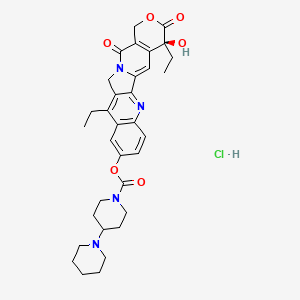
Irinotecan hydrochloride (CPT-11) is a semisynthetic derivative of camptothecin and an inhibitor of topoisomerase I (Topo I), the enzyme that relieves torsional stress by nicking one DNA strand, allowing rotation, and resealing it. Irinotecan stabilizes the covalent Topo I–DNA cleavage complex so the nick is not resealed; the trapped complex is itself reversible, and the lethal lesion forms when a replication fork collides with it, converting a protein-linked single-strand break into a double-strand break — which is why the drug kills S-phase cells and why exposure duration matters more than peak concentration. It is a prodrug: carboxylesterases convert it to SN-38, which carries essentially all the activity and is 100- to 1000-fold more potent than the parent compound.
Its toxicity follows the metabolism closely. Hepatic and intestinal UGT1A1 conjugates SN-38 to an inactive glucuronide (SN-38G), a detoxification step, and patients carrying the reduced-function UGT1A1*28 allele clear SN-38 poorly and require dose reduction for neutropenia. Delayed diarrhea arises further downstream: SN-38G is excreted in bile, and bacterial β-glucuronidase in the gut lumen cleaves it back to active SN-38, exposing the intestinal epithelium to the drug directly — so the diarrhea reflects insufficient net glucuronidation and enterohepatic reactivation rather than the conjugation step itself. A separate, early diarrhea occurring during or shortly after infusion is cholinergic, caused by acetylcholinesterase inhibition, and is treated with atropine — a distinction that matters because the two have opposite management.
Irinotecan is used first- and second-line in advanced and metastatic colorectal cancer, forming the backbone of FOLFIRI (fluorouracil, folinic acid and irinotecan) and a component of FOLFIRINOX, which combines it with oxaliplatin, folinic acid and 5-fluorouracil in pancreatic cancer. Its use extends to gastric carcinoma, neuroblastoma and other solid tumors, often with targeted agents such as cetuximab and bevacizumab or cytotoxic partners such as temozolomide and oxaliplatin; a liposomal formulation extends SN-38 exposure in pancreatic cancer after gemcitabine failure.
Recent Publications Summary
Recent publications on irinotecan hydrochloride focused on formulation strategies, combination regimens, mechanistic biomarkers, and toxicity mitigation. In colorectal cancer, a self-assembled nanomedicine incorporating irinotecan and indole-3-carbinol was designed to counter irinotecan-associated steatohepatitis and the resulting liver metastasis-promoting effect, while also enhancing antitumor activity through improved cellular uptake, caveolin-dependent endocytosis, ER stress induction, and AHR-mediated metabolic effects 42007878Apr. Another delivery-oriented study developed a multistage system combining irinotecan hydrochloride with bevacizumab in zein nanoparticles embedded in a thermo-sensitive hydrogel, reporting sustained release, favorable physicochemical properties, and in vitro cytotoxic profiles intended to improve therapeutic performance in human colorectal carcinoma 41881271Mar. In embolization research, sodium alginate sulfate microspheres were shown to support high irinotecan hydrochloride loading capacity and stable drug delivery for arterial embolization applications 41832022Mar.
Several studies examined irinotecan hydrochloride in combination therapy settings. In relapsed/refractory neuroblastoma, the bevacizumab/irinotecan/temozolomide (BIT) regimen was highlighted as a guideline-supported option in the UK based on prior BEACON trial data 41840813Mar. In pancreatic ductal adenocarcinoma, a ratiometric fluorescent sensor for carboxylesterase 2 (CES2) was used to predict response to irinotecan-based therapy, showing strong correlations between CES2 activity and irinotecan (CPT-11) response as well as FOLFIRINOX sensitivity in cell lines 42043185Apr. In colorectal cancer models, irinotecan was also reported to induce both genotoxic damage and reactive oxygen species production in TP53 wild-type and TP53-null HCT116 cells, supporting a context-dependent oxidative and DNA-damaging mechanism 41870588Mar.
Other publications addressed irinotecan-related supportive care and comparative pharmacology. Xiao-Chaihu-Tang was reported to ameliorate irinotecan-evoked delayed diarrhea by preserving the intestinal barrier and acting through an AhR-UGT1A1-microbiota axis, with endogenous tryptophol implicated in the mechanism 41713817Feb. In a camptothecin-focused medicinal chemistry study, a TOP1-degrading derivative of SN-38 achieved superior tumor regression in xenograft models compared with clinical irinotecan, underscoring ongoing efforts to improve upon irinotecan-class agents 42378337Jun.
What Changes, What Holds
1. Irinotecan is being repositioned as a formulation and delivery platform as much as a cytotoxic drug
NEW DIRECTION New nanocarrier and depot strategies do not alter the established topoisomerase I/SN-38 mechanism, but they do broaden how irinotecan hydrochloride is being used: to improve local delivery, sustain release, and potentially reduce liver-related toxicity while preserving antitumor activity 42007878Apr41881271Mar. The embolization microsphere work likewise extends the drug into procedural delivery rather than changing its core pharmacology 41832022Mar. These are application-expanding studies, not replacements for the baseline account.
2. biomarker-guided use and oxidative injury add nuance without displacing the core mechanism
REINFORCES CES2-linked response prediction sharpens the baseline prodrug story by suggesting that activation capacity may help explain who benefits from irinotecan-based therapy, especially in FOLFIRINOX settings 42043185Apr. The HCT116 findings also fit the established DNA-damaging model while adding reactive oxygen species as a context-dependent co-mechanism 41870588Mar. Neither result overturns the Topo I/SN-38 framework; together they make response and injury look more biologically heterogeneous than the overview alone implies.
3. Delayed diarrhea remains modifiable through gut-barrier and microbiome-directed support
REINFORCES Xiao-Chaihu-Tang’s reported benefit against irinotecan-evoked delayed diarrhea strengthens, rather than challenges, the baseline link between SN-38 handling in the intestine and this toxicity 41713817Feb. The new work suggests that barrier preservation and AhR-UGT1A1-microbiota signaling can mitigate a known adverse effect, with endogenous tryptophol implicated in the pathway. That adds a plausible supportive-care angle, but it does not require revising the established toxicity mechanism.
4. SN-38-class optimization is still outpacing irinotecan itself
NEW DIRECTION A TOP1-degrading SN-38 derivative outperforming clinical irinotecan in xenografts points to an active effort to move beyond irinotecan hydrochloride as the preferred camptothecin-class agent 42378337Jun. The baseline already frames irinotecan as a prodrug whose active metabolite carries most cytotoxicity; this work suggests that further chemical redesign around SN-38 may yield better antitumor performance than the parent drug. That is not a contradiction, but it does show the field is no longer treating irinotecan as the endpoint of optimization.
Overview update candidates: formulation/delivery expansion; biomarker-guided response via CES2; supportive-care mitigation of delayed diarrhea; SN-38 derivative optimization beyond irinotecan.
irinotecan hydrochloride
Background Contexts
In the literature, the biological baseline, pathological conditions, or disease models commonly surrounding irinotecan hydrochloride are described as follows:
- (chemo)radiotherapy (Biological Process) — 1 paper: PMIDs 41713817
- Aromatic camptothecins (Therapy) — 1 paper: PMIDs 42378337
- camptothecin (Chemical) — 1 paper: PMIDs 41812429
- Chemoimmunotherapy (Therapy) — 1 paper: PMIDs 41823156
- colorectal cancer (Disease) — 1 paper: PMIDs 41510948
- dinutuximab (Therapy) — 1 paper: PMIDs 41823156
- high-risk neuroblastoma (Disease) — 1 paper: PMIDs 41840813
- irinotecan (Chemical) — 1 paper: PMIDs 42191000
- KrasLSL-G12D; Tp53fl/fl mice (Organism) — 1 paper: PMIDs 41870588
- metastatic CRC (Disease) — 1 paper: PMIDs 41671078
- multi-modal treatment (Other) — 1 paper: PMIDs 41840813
- multistage drug delivery systems (Technology) — 1 paper: PMIDs 41881271
Methodologies & Technologies Used
Researchers utilize the following experimental methods, imaging platforms, computational models, or biological reagents to study irinotecan hydrochloride:
- fluorouracil (Therapy) — 2 papers: PMIDs 41671078, 41510948
- 2,3,4-Triphenylpyridine (Chemical) — 1 paper: PMIDs 41812411
- 2D monolayers (Technology) — 1 paper: PMIDs 41881271
- 3D intestinal model (Other) — 1 paper: PMIDs 41881271
- 3D multicellular colorectal cancer spheroids (Other) — 1 paper: PMIDs 41881271
- A549 xenograft models (Cell Line) — 1 paper: PMIDs 41812429
- A549 xenograft mouse models (Organism) — 1 paper: PMIDs 41812429
- adamantane (Chemical) — 1 paper: PMIDs 42378337
- alkaline comet assay (Technology) — 1 paper: PMIDs 41510948
- ammonium sulfate (Chemical) — 1 paper: PMIDs 42191000
- BALB/c CT26 (Organism) — 1 paper: PMIDs 42191000
- BEACON trial (Other) — 1 paper: PMIDs 41840813
Molecular Interventions & Targets
The primary molecular pathways, regulatory genes, enzymes, or therapeutic agents actively targeted and manipulated in relation to irinotecan hydrochloride include:
- bevacizumab (Therapy) — 2 papers: PMIDs 41881271, 41840813
- Topoisomerase 1 Dmel_CG6146 (Protein) — 2 papers: PMIDs 42378337, 41812411
- Topoisomerase I inhibitor SN-38 (Therapy) — 2 papers: PMIDs 42043185, 41812429
- (+)-matrine (Chemical) — 1 paper: PMIDs 41812411
- (+)-sophoridine (Therapy) — 1 paper: PMIDs 41812411
- 10-Methoxycamptothecin (Therapy) — 1 paper: PMIDs 41812429
- AHR (Protein) — 1 paper: PMIDs 42007878
- AhR-UGT1A1-microbiota axis (Pathway) — 1 paper: PMIDs 41713817
- aztreonam (Therapy) — 1 paper: PMIDs 41661672
- BRCA1 (Gene) — 1 paper: PMIDs 41661672
- CCDC6 (Therapy) — 1 paper: PMIDs 41812411
- CDK6 (Protein) — 1 paper: PMIDs 41812429
Observed Outcomes & Phenotypes
The phenotypic changes, physiological endpoints, or clinical metrics observed and measured in connection with irinotecan hydrochloride include:
- G0/G1 cell cycle arrest (Biological Process) — 2 papers: PMIDs 41812429, 41812411
- tumor cell apoptosis (Biological Process) — 2 papers: PMIDs 41812429, 41812411
- γH2AX foci (Cellular Component) — 1 paper: PMIDs 41661672
- 40% Iri and 20% BVZ released (Other) — 1 paper: PMIDs 41881271
- antitumor efficacy (Clinical Metric) — 1 paper: PMIDs 42007878
- baseline tumor burden (Clinical Metric) — 1 paper: PMIDs 42007878
- Benz-AP measurements (Clinical Metric) — 1 paper: PMIDs 42043185
- biosafety (Clinical Metric) — 1 paper: PMIDs 42007878
- CA19-9 (Clinical Metric) — 1 paper: PMIDs 41510948
- carcinoembryonic antigen (Protein) — 1 paper: PMIDs 41510948
- cell viability (Clinical Metric) — 1 paper: PMIDs 41881271
- cellular response to DNA damage stimulus (Biological Process) — 1 paper: PMIDs 41661672
General Takeaways & Clinical Potentials
The high-level concepts, clinical translations, and overarching conclusions proposed in the research surrounding irinotecan hydrochloride are summarized below:
- aromaticity (Biological Process) — 1 paper: PMIDs 42378337
- Astragalus membranaceus (Fisch.) Bge (Other) — 1 paper: PMIDs 41832022
- clinical translation potential (Other) — 1 paper: PMIDs 41713817
- clinician choice of chemotherapeutic treatment (Other) — 1 paper: PMIDs 42043185
- GI toxicity (Disease) — 1 paper: PMIDs 42191000
- irinotecan (Chemical) — 1 paper: PMIDs 42191000
- MG16 (Therapy) — 1 paper: PMIDs 41812429
- noninvasive biomarker (Other) — 1 paper: PMIDs 41510948
- Risk Stratification (Biological Process) — 1 paper: PMIDs 41510948
- targeted combinatorial therapies (Therapy) — 1 paper: PMIDs 41870588
- TP53-mutated tumors (Disease) — 1 paper: PMIDs 41870588