gefitinib
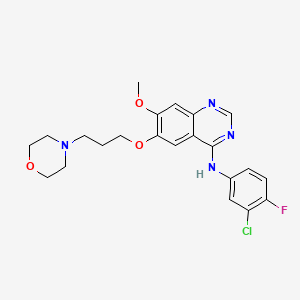
Overview
Gefitinib is an epidermal growth factor receptor (epidermal growth factor receptor (EGFR)) tyrosine kinase inhibitor used in the treatment of epidermal growth factor receptor (EGFR)-mutant non-small cell lung cancer (NSCLC). By inhibiting epidermal growth factor receptor (EGFR) signaling, it can suppress downstream proliferative and survival pathways that drive tumor growth in susceptible Cancers. Its clinical role is most established in molecularly selected NSCLC, where epidermal growth factor receptor (EGFR) dependence makes tumors more responsive to epidermal growth factor receptor (EGFR)-targeted therapy.
In recent biomedical research, gefitinib has also served as a model drug for studying acquired resistance to epidermal growth factor receptor (EGFR)-TKIs. Investigators have used gefitinib-resistant cell and tumor systems to examine compensatory signaling networks, including AKT/P70S6K, Wnt/β-catenin pathway activity, STING1-associated immune signaling, and ferroptosis-related regulators such as GPX4 and SLC7A11/xCT. These studies reflect the broader challenge that, although gefitinib can be effective initially, resistance frequently limits durable benefit in NSCLC.
Recent Publications Summary
Recent studies have continued to examine gefitinib in both mechanistic cancer models and clinical real-world settings. In HepG2 hepatocellular carcinoma cells, gefitinib reduced cell viability, induced apoptosis, and increased caspase expression while inhibiting PI3K/AKT and MAPK/ERK-related gene expression, suggesting suppression of tumor-promoting signaling pathways 42461339Jul. In non-small cell lung cancer (NSCLC), a pharmacovigilance analysis of WHO-VigiAccess reports collected 10,294 gefitinib adverse event reports and found that, at the system organ class level, skin and subcutaneous tissue disorders and gastrointestinal disorders were common across EGFR-targeted agents, including gefitinib 42175505May. A real-world retrospective study in EGFR-mutated metastatic NSCLC compared first- and third-generation EGFR-TKIs and reported median progression-free survival of 10.68 months for gefitinib/erlotinib versus 8.43 months for osimertinib in that cohort, with no statistically significant differences in response rates or disease control 39962869Feb.
Several recent studies focused on gefitinib resistance and strategies to restore sensitivity. CAMK2D isoform 15 was reported to facilitate gefitinib resistance in lung adenocarcinoma through AKT phosphorylation 42152470May. Galangin was identified as a sensitizer that restored tumor sensitivity to gefitinib in resistant NSCLC models, with the study implicating dysregulated efferocytosis and showing suppression of M2 macrophage polarization and reduced expression of CAMK2A and MERTK 42007639Apr. Artesunate also reversed gefitinib resistance in lung adenocarcinoma, inhibiting cell viability, migration, invasion, and colony formation while inducing ferroptosis through increased Fe2+, ROS, and MDA, decreased GSH/GSSG ratio, and downregulation of SLC7A11 and GPX4; this effect was linked to inhibition of the Wnt/β-catenin pathway 41967624Apr. In another study, Yifei Sanjie pill combined with gefitinib was reported to reduce progression of EGFR-TKI-resistant NSCLC via the YAP/ANKRD1 axis 41865688Mar.
Clinical research also continued to compare gefitinib with other EGFR-targeted approaches in EGFR-mutated NSCLC, including patients with central nervous system metastases. In the phase III REZOR study, patients were randomized to rezivertinib plus gefitinib placebo or gefitinib plus rezivertinib placebo, and prior results had shown improved progression-free survival with rezivertinib and a favorable safety profile; the updated analysis focused on CNS outcomes in patients with baseline CNS metastases 41924561Apr. Together, these publications portray gefitinib as a well-established EGFR-targeted therapy whose recent study has centered on antitumor mechanisms, resistance biology, combination strategies, and safety surveillance across liver cancer, lung cancer, and breast cancer-related models 42461339Jul42175505May42152470May42007639Apr41967624Apr41865688Mar41924561Apr39962869Feb.
What Changes, What Holds
1. Gefitinib now looks like a broader antitumor probe, but its clinical role remains unchanged
NEW DIRECTION HepG2 findings extend gefitinib beyond the EGFR-mutant NSCLC setting described in the Overview, showing activity in a liver cancer model through suppression of survival signaling and induction of apoptosis 42461339Jul. That broadens its experimental footprint, but it does not displace its established use in molecularly selected NSCLC. The pharmacovigilance and real-world comparison data mainly add safety and comparative-effectiveness context rather than changing the core therapeutic account 42175505May39962869Feb.
2. Resistance biology is becoming more specific, and several sensitizers point to actionable escape routes
REINFORCES These studies sharpen the Overview’s resistance theme by identifying additional mechanisms that can sustain gefitinib failure and by showing that resistance can be partially reversed in preclinical models 42152470May42007639Apr. The new work does not overturn the established view that acquired resistance limits durable benefit; instead, it adds candidate nodes such as AKT-linked signaling, efferocytosis, ferroptosis control, and YAP-associated signaling that may help explain why some tumors escape and how sensitivity might be restored.
3. CNS-focused combination testing adds a new clinical comparison without changing gefitinib’s core role
NEW DIRECTION The REZOR analysis introduces a brain-metastasis context that the Overview does not cover, so this is an added clinical dimension rather than a contradiction of the established NSCLC account 41924561Apr. It suggests gefitinib remains part of active comparative strategy-building in EGFR-mutated disease, especially where CNS control matters, but the paragraph does not establish a new standard use or displace the baseline view of gefitinib as an EGFR-targeted therapy for susceptible NSCLC.
Overview update candidates: gefitinib has emerging preclinical activity in hepatocellular carcinoma models; resistance mechanisms and reversal strategies are expanding; CNS-outcome comparison data in EGFR-mutated NSCLC add a new clinical context.
gefitinib
Background Contexts
In the literature, the biological baseline, pathological conditions, or disease models commonly surrounding gefitinib are described as follows:
- adenocarcinoma of the lung (Disease) — 2 papers: PMIDs 42152470, 41967624
- advanced Non-Small Cell Lung Cancer (Disease) — 2 papers: PMIDs 42059424, 41672191
- estimated glomerular filtration rate (Clinical Metric) — 2 papers: PMIDs 42059424, 41924561
- lung cancer brain metastases (Disease) — 2 papers: PMIDs 41865688, 41795340
- non-small-cell lung carcinoma (Disease) — 2 papers: PMIDs 42175505, 41924561
- adenocarcinoma (Disease) — 1 paper: PMIDs 39962869
- antimicrobial resistance (Other) — 1 paper: PMIDs 42007639
- central nervous system (Other) — 1 paper: PMIDs 41924561
- ClinicalTrials.gov identifier (Other) — 1 paper: PMIDs 41924561
- CNS metastasis (Disease) — 1 paper: PMIDs 41924561
- disulfidptosis (Biological Process) — 1 paper: PMIDs 42464330
- EGFR (Protein) — 1 paper: PMIDs 39962869
Methodologies & Technologies Used
Researchers utilize the following experimental methods, imaging platforms, computational models, or biological reagents to study gefitinib:
- NCI-H1975 (Cell Line) — 2 papers: PMIDs 42059424, 41795340
- 2-anilinoquinazoline derivatives (Chemical) — 1 paper: PMIDs 41795340
- 75 patients (Other) — 1 paper: PMIDs 39962869
- A549 xenograft models (Cell Line) — 1 paper: PMIDs 41795340
- afatinib (Therapy) — 1 paper: PMIDs 41672191
- AKT/P70S6K (Pathway) — 1 paper: PMIDs 42059424
- axitinib (Therapy) — 1 paper: PMIDs 42387647
- azd-8055 (Therapy) — 1 paper: PMIDs 42387647
- Bayesian confidence propagation neural network (Other) — 1 paper: PMIDs 42175505
- caspase (Protein) — 1 paper: PMIDs 42461339
- CCND1 (Gene) — 1 paper: PMIDs 41967624
- checkpoint inhibitor (Therapy) — 1 paper: PMIDs 42440056
Molecular Interventions & Targets
The primary molecular pathways, regulatory genes, enzymes, or therapeutic agents actively targeted and manipulated in relation to gefitinib include:
- osimertinib (Therapy) — 2 papers: PMIDs 42175505, 39962869
- afatinib (Therapy) — 1 paper: PMIDs 42175505
- agomelatine (Therapy) — 1 paper: PMIDs 42461339
- Akt1 (Protein) — 1 paper: PMIDs 42152470
- anti-PD-1 therapy (Therapy) — 1 paper: PMIDs 41672191
- apoptotic cell clearance (Biological Process) — 1 paper: PMIDs 42007639
- artesunate (Therapy) — 1 paper: PMIDs 41967624
- CAMK2A (Gene) — 1 paper: PMIDs 42007639
- catequentinib (Therapy) — 1 paper: PMIDs 42175505
- cepharanthine (Therapy) — 1 paper: PMIDs 42059424
- DL-methionine (Chemical) — 1 paper: PMIDs 42387647
- EGFR-MET (Protein) — 1 paper: PMIDs 41795340
Observed Outcomes & Phenotypes
The phenotypic changes, physiological endpoints, or clinical metrics observed and measured in connection with gefitinib include:
- CXCL10 (Protein) — 2 papers: PMIDs 42059424, 41672191
- erlotinib (Therapy) — 2 papers: PMIDs 42464330, 42440056
- tumor mutation burden (Biological Process) — 2 papers: PMIDs 42464330, 42440056
- 10.68 months (Clinical Metric) — 1 paper: PMIDs 39962869
- 52,978 adverse event reports (Clinical Metric) — 1 paper: PMIDs 42175505
- 8.43 months (Clinical Metric) — 1 paper: PMIDs 39962869
- activated NK cells (Cellular Component) — 1 paper: PMIDs 42440056
- Adverse drug reactions (Other) — 1 paper: PMIDs 42175505
- afatinib (Therapy) — 1 paper: PMIDs 42464330
- Akt inhibitor VIII (Therapy) — 1 paper: PMIDs 42464330
- apoptotic process (Biological Process) — 1 paper: PMIDs 42461339
- B-cell lymphoma 2 (Protein) — 1 paper: PMIDs 41795340
General Takeaways & Clinical Potentials
The high-level concepts, clinical translations, and overarching conclusions proposed in the research surrounding gefitinib are summarized below:
- checkpoint inhibitor (Therapy) — 2 papers: PMIDs 42440056, 41672191
- artesunate (Therapy) — 1 paper: PMIDs 41967624
- biochemical validation (Other) — 1 paper: PMIDs 41795340
- Cost of Treatment (Other) — 1 paper: PMIDs 39962869
- disulfidptosis-related molecular heterogeneity (Other) — 1 paper: PMIDs 42464330
- endoplasmic reticulum (ER) stress pathways (Biological Process) — 1 paper: PMIDs 41672191
- erlotinib (Therapy) — 1 paper: PMIDs 39962869
- ferroptosis induction (Other) — 1 paper: PMIDs 42440056
- four-gene prognostic signature (Other) — 1 paper: PMIDs 42464330
- hepatocellular carcinoma (Disease) — 1 paper: PMIDs 42461339
- highly lethal malignancy (Other) — 1 paper: PMIDs 42440056
- in vivo efficacy evaluation (Other) — 1 paper: PMIDs 41795340