erlotinib
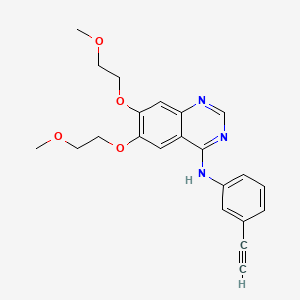
Overview
Erlotinib is a small-molecule tyrosine kinase inhibitor used in oncology as a targeted therapy against the epidermal growth factor receptor (epidermal growth factor receptor (EGFR)). By inhibiting epidermal growth factor receptor (EGFR) signaling, erlotinib can reduce downstream pathways that promote tumor cell proliferation, survival, and migration. It is therefore commonly used as a reference epidermal growth factor receptor (EGFR) inhibitor in medicinal chemistry and cancer pharmacology studies, especially in work focused on lung cancer and other epidermal growth factor receptor (EGFR)-driven malignancies.
In recent biomedical research, erlotinib continues to serve both as a comparator drug and as a mechanistic probe for epidermal growth factor receptor (EGFR)-dependent signaling. The publications provided here place it in studies of dual-target strategies, including epidermal growth factor receptor (EGFR)/CDK-2 inhibition, epidermal growth factor receptor (EGFR)/PARP-1 inhibition, and combination approaches with RAF inhibition or radiotherapy. These contexts reflect its role as a benchmark for potency and as part of broader efforts to improve Targeted Cancer Therapy in diseases such as colorectal carcinoma, pancreatic cancer, diffuse intrinsic pontine glioma, and lung cancer.
Recent Publications Summary
Recent publications have continued to use erlotinib as a reference EGFR-targeted therapy in medicinal chemistry and translational oncology studies. Several reports compared newly designed small molecules against erlotinib in kinase assays and docking studies, including dual PARP-1/EGFR inhibitors, dual EGFR/CDK2 inhibitors, and other EGFR-directed scaffolds, with the reference drug used to benchmark binding poses or enzymatic potency 42207930May42200498May41962189Apr41795438Mar. These studies generally aimed to overcome EGFR-driven resistance or improve selectivity in cancer models, especially colorectal and lung cancer cell lines.
In erlotinib-resistant lung cancer, one study focused on phosphoglycerate dehydrogenase (PHGDH) inhibition as a strategy to restore sensitivity. The investigators identified two potent PHGDH inhibitors, compounds 43 and 47, which suppressed de novo serine biosynthesis, inhibited growth in PHGDH-overexpressing cancer cells, and showed antiproliferative activity in erlotinib-resistant PC9 and HCC827 cells. Importantly, both compounds acted synergistically with erlotinib, and compound 47 enhanced antitumor efficacy in an erlotinib-resistant PC9 xenograft model when combined with erlotinib 42263187Jun.
Erlotinib was also evaluated clinically in the randomized phase 2 BIOMEDE trial in children with diffuse intrinsic pontine glioma, where it was given with radiotherapy and compared with everolimus and dasatinib. The trial enrolled biomarker-selected patients, including those with EGFR overexpression or PTEN loss, but was stopped for futility because overall survival from biopsy was not improved versus a historical control cohort 42032072Apr. In a separate real-world study of EGFR-mutated metastatic non-small cell lung cancer, gefitinib/erlotinib were grouped together and compared with osimertinib; the study reported objective response, disease control, progression-free survival, and adverse events, with median PFS of 10.68 months for the gefitinib/erlotinib group 39962869Feb.
Overall, these publications position erlotinib as both a benchmark EGFR inhibitor in preclinical drug-development programs and an active comparator or treatment arm in clinical and translational studies. The recent literature emphasizes combination strategies, resistance mechanisms, and biomarker-guided use, while also showing that erlotinib remains a standard reference for assessing the EGFR-targeting activity of emerging anticancer agents 42207930May42200498May41962189Apr41795438Mar42263187Jun42032072Apr39962869Feb.
What Changes, What Holds
1. Erlotinib remains a benchmark comparator rather than a newly redefined therapeutic role
REINFORCES Recent work keeps using erlotinib as the reference point for EGFR-directed drug design and potency testing, which strengthens its standing as the standard comparator in this space rather than changing how it is understood. The main implication is practical: emerging dual-target scaffolds are still being judged against erlotinib’s EGFR activity, especially in resistance-focused and lung cancer studies 42207930May42200498May.
2. Erlotinib resistance can be pharmacologically bypassed through metabolic co-targeting
NEW DIRECTION The new PHGDH findings add a resistance-management strategy that sits alongside, rather than against, the Overview’s EGFR-inhibition account. They suggest that erlotinib-resistant lung cancer may be vulnerable to combination treatment when serine-biosynthesis dependence is blocked, but this is still preclinical and needs broader validation before it can be treated as a generalizable way to restore erlotinib sensitivity 42263187Jun.
3. Clinical use remains context-dependent, and erlotinib is not clearly superior in biomarker-selected settings
REINFORCES The clinical data do not overturn erlotinib’s role as an EGFR-targeted therapy, but they do temper expectations about benefit in difficult biomarker-defined disease and in comparison with newer EGFR inhibitors. The mixed real-world and trial findings reinforce that erlotinib’s value is conditional on setting, and that biomarker selection alone has not yet made its benefit reliable across these populations 42032072Apr39962869Feb.
4. Erlotinib’s current literature now spans benchmark use, resistance biology, and comparative clinical positioning
REINFORCES This synthesis mainly consolidates the baseline rather than revising it: erlotinib is still functioning as a reference EGFR inhibitor, but the recent papers sharpen the emphasis on combination strategies, resistance mechanisms, and biomarker-guided treatment choices. Nothing here displaces the established account; instead, the new work shows where the drug is being used to test the limits of EGFR targeting and where its clinical role remains unsettled 42207930May42263187Jun42032072Apr39962869Feb.
Overview update candidates: resistance-bypassing combination strategies in erlotinib-resistant lung cancer; continued clinical uncertainty in biomarker-selected diffuse intrinsic pontine glioma and comparative EGFR-mutant NSCLC settings.
erlotinib
Background Contexts
In the literature, the biological baseline, pathological conditions, or disease models commonly surrounding erlotinib are described as follows:
- adenocarcinoma (Disease) — 1 paper: PMIDs 39962869
- BIOMEDE (Technology) — 1 paper: PMIDs 42032072
- diffuse midline glioma (Disease) — 1 paper: PMIDs 42032072
- EGFR (Protein) — 1 paper: PMIDs 39962869
- FDA-approved drugs (Therapy) — 1 paper: PMIDs 41558185
- lung cancer brain metastases (Disease) — 1 paper: PMIDs 41795438
- neoplasm (Disease) — 1 paper: PMIDs 41558185
- nonsquamous non-small cell lung cancer (Disease) — 1 paper: PMIDs 39962869
- pancreatic cancer (Disease) — 1 paper: PMIDs 42030284
- serine biosynthesis pathway (Pathway) — 1 paper: PMIDs 42263187
Methodologies & Technologies Used
Researchers utilize the following experimental methods, imaging platforms, computational models, or biological reagents to study erlotinib:
- human HEK-293 and HCT-116 cell lines (Cell Line) — 2 papers: PMIDs 42200498, 41795438
- (Z)-1-(4-fluorophenyl)-N-(4-iodobut-3-yn-2-ylidene)-3-methyl-1H-pyrazol-5-amine (Chemical) — 1 paper: PMIDs 41795438
- 100-ns molecular dynamics simulations (Technology) — 1 paper: PMIDs 42200498
- 75 patients (Other) — 1 paper: PMIDs 39962869
- A549 lung adenocarcinoma cells (Cell Line) — 1 paper: PMIDs 41558185
- ADMET analysis (Technology) — 1 paper: PMIDs 41795438
- Annexin V-FITC (Technology) — 1 paper: PMIDs 41795438
- BEAS-2B (Cell Line) — 1 paper: PMIDs 41558185
- biopsy (Other) — 1 paper: PMIDs 42032072
- compound 43 (Chemical) — 1 paper: PMIDs 42263187
- compound 47 (Chemical) — 1 paper: PMIDs 42263187
- Compounds 3a-o (Therapy) — 1 paper: PMIDs 42207930
Molecular Interventions & Targets
The primary molecular pathways, regulatory genes, enzymes, or therapeutic agents actively targeted and manipulated in relation to erlotinib include:
- estimated glomerular filtration rate (Clinical Metric) — 2 papers: PMIDs 42032072, 42030284
- serum eGFR (Clinical Metric) — 2 papers: PMIDs 42207930, 42200498
- 1,2,4-triazolo[1,5-a]pyrimidine derivatives (Chemical) — 1 paper: PMIDs 42200498
- BET inhibitor (Therapy) — 1 paper: PMIDs 42361193
- Cyclin-dependent kinase 2 (Protein) — 1 paper: PMIDs 42200498
- dasatinib (Therapy) — 1 paper: PMIDs 42032072
- doxorubicin (Therapy) — 1 paper: PMIDs 42207930
- EGFR kinase (Protein) — 1 paper: PMIDs 41795438
- EGFR-MET (Protein) — 1 paper: PMIDs 41795438
- everolimus (Therapy) — 1 paper: PMIDs 42032072
- fused isoxazole and fused 1,2,3-triazole derivatives (Chemical) — 1 paper: PMIDs 41795438
- gefitinib (Therapy) — 1 paper: PMIDs 39962869
Observed Outcomes & Phenotypes
The phenotypic changes, physiological endpoints, or clinical metrics observed and measured in connection with erlotinib include:
- 10.68 months (Clinical Metric) — 1 paper: PMIDs 39962869
- 50% inhibition concentration (IC50) (Clinical Metric) — 1 paper: PMIDs 42263187
- 6 Years (Other) — 1 paper: PMIDs 42032072
- 8.43 months (Clinical Metric) — 1 paper: PMIDs 39962869
- A549 xenograft models (Cell Line) — 1 paper: PMIDs 41795438
- ADMET profiles (Other) — 1 paper: PMIDs 42200498
- anti-proliferative effects (Clinical Metric) — 1 paper: PMIDs 42030284
- antitumor activity (Clinical Metric) — 1 paper: PMIDs 42263187
- apoptotic markers (Clinical Metric) — 1 paper: PMIDs 42200498
- baseline tumor burden (Clinical Metric) — 1 paper: PMIDs 42030284
- Bcl-2 proteins (Protein) — 1 paper: PMIDs 42200498
- caspase-3 (Protein) — 1 paper: PMIDs 42200498
General Takeaways & Clinical Potentials
The high-level concepts, clinical translations, and overarching conclusions proposed in the research surrounding erlotinib are summarized below:
- Clinical Recommendations (Other) — 1 paper: PMIDs 41558185
- ClinicalTrials.gov: NCT02233049 (Clinical Metric) — 1 paper: PMIDs 42032072
- Cost of Treatment (Other) — 1 paper: PMIDs 39962869
- dual EGFR/CDK-2 inhibitors (Therapy) — 1 paper: PMIDs 42200498
- EGFR-targeted therapies (Therapy) — 1 paper: PMIDs 41795438
- fused isoxazole and fused 1,2,3-triazole derivatives (Chemical) — 1 paper: PMIDs 41795438
- gefitinib (Therapy) — 1 paper: PMIDs 39962869
- in vivo radiographic studies (Other) — 1 paper: PMIDs 41795438
- independent data monitoring committee (Other) — 1 paper: PMIDs 42032072
- osimertinib (Therapy) — 1 paper: PMIDs 39962869
- pathway-targeted inhibitors (Therapy) — 1 paper: PMIDs 42030284
- PHGDH-targeted anticancer therapies (Other) — 1 paper: PMIDs 42263187