enzalutamide
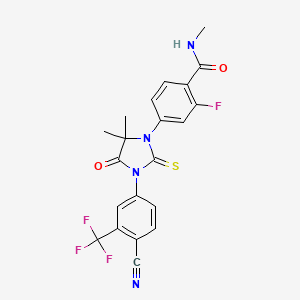
Overview
Enzalutamide is a second-generation nonsteroidal Androgen receptor (AR) (AR) inhibitor approved for the treatment of prostate cancer across multiple disease stages, including metastatic castration-resistant prostate cancer (mCRPC), nonmetastatic castration-resistant prostate cancer (nmCRPC), and metastatic hormone-sensitive prostate cancer (mHSPC). Unlike earlier antiandrogens, enzalutamide inhibits Androgen receptor (AR) signaling at multiple steps: it blocks ligand binding to the AR ligand-binding domain (LBD), prevents nuclear translocation of the receptor, and impairs AR binding to DNA. This multi-modal blockade confers substantially greater suppression of the AR signaling axis than first-generation agents. Enzalutamide's mechanism centers on its high-affinity binding to the AR LBD, an interaction that has served as the benchmark against which newer AR-targeting strategies — including AR transactivation domain inhibitors (AR-TAD inhibitors) — are measured.
Beyond its established role in prostate cancer, enzalutamide has attracted growing interest as a combination partner in oncology, given that AR signaling intersects with a range of resistance mechanisms, cell survival pathways, and tumor-biology phenomena including ferroptosis and lipid remodeling. Its deployment as a pharmacological probe in both clinical and preclinical settings has made it a central tool for understanding castration-resistant disease biology and for identifying co-vulnerabilities that can be exploited therapeutically.
Recent Publications Summary
Recent publications on enzalutamide have focused largely on prostate cancer, spanning real-world safety surveillance, biomarker and resistance studies, and combination or sequencing strategies. A FAERS disproportionality analysis compared post-marketing adverse event reporting for enzalutamide, olaparib, and lutetium Lu-177 vipivotide tetraxetan in prostate cancer, with time-dependent and age-stratified signal detection and a descriptive review of sparse concomitant-use reports involving all three agents 42446704Jul. Another study examined radiographic progression occurring without a prostate-specific antigen rise in patients with advanced prostate cancer treated with enzalutamide, specifically in metastatic hormone-sensitive prostate cancer and nonmetastatic castration-resistant prostate cancer 41894648Mar.
Several reports addressed enzalutamide in combination regimens. The phase II ARROW study evaluated 131I-LNTH-1095 radioligand therapy plus enzalutamide versus enzalutamide alone in men with PSMA-avid metastatic castration-resistant prostate cancer after progression on abiraterone 41779000Mar. A phase Ib RENAPCA trial protocol described neoadjuvant/adjuvant relugolix plus enzalutamide for high-risk locally advanced prostate cancer, aiming to assess safety and efficacy alongside definitive local treatment 42031503Apr. In high-risk biochemical recurrence, EMBARK secondary end points further examined enzalutamide monotherapy versus leuprolide alone, extending the phase 3 trial’s earlier efficacy and safety findings 41349040Dec.
Mechanistic and resistance-focused studies also featured enzalutamide as a key comparator or tool compound. Longitudinal ctDNA analysis from the phase III Alliance A031201 trial investigated AR and non-AR genomic alterations associated with resistance to androgen receptor pathway inhibitors, including enzalutamide and abiraterone, in metastatic prostate cancer 41587107Jan. A separate study on drugging the intrinsically disordered transactivation domain of the androgen receptor discussed the broader challenge of resistance to ligand-binding-domain targeting and used prostate cancer cell and xenograft models to evaluate AR-TAD inhibitors in relation to AR and AR-V7 signaling 42045150Apr. Outside prostate cancer, enzalutamide was tested in glioblastoma models, where it enhanced honokiol-induced apoptosis in drug-resistant glioblastoma cells through an intrinsic Bak-mitochondrion-caspase cascade mechanism 42203314May.
What Changes, What Holds
1. Post-marketing and progression-pattern data refine enzalutamide’s risk and monitoring profile
METHOD Real-world pharmacovigilance and imaging-pattern analyses do not alter enzalutamide’s established role as an AR inhibitor, but they do sharpen how it should be followed in practice. The safety signal work adds post-approval surveillance context for use alongside other advanced prostate cancer agents, while the radiographic-progression finding highlights that PSA alone may miss clinically relevant progression in some treated patients 42446704Jul41894648Mar.
2. Combination and sequencing studies extend enzalutamide into new treatment strategies without displacing its core mechanism
NEW DIRECTION These reports do not challenge the Overview’s account of enzalutamide as an AR-pathway blocker; instead, they broaden its therapeutic context into radioligand combinations, perioperative intensification, and biochemical-recurrence sequencing. The main implication is that enzalutamide is increasingly being positioned as a backbone or comparator in multi-modality regimens, but the optimal place of these strategies remains unsettled and will depend on whether added benefit outweighs cumulative toxicity and complexity 41779000Mar42031503Apr.
3. Resistance biology now points to genomic escape routes beyond the androgen receptor ligand-binding domain
REINFORCES Longitudinal ctDNA work strengthens the baseline view that enzalutamide is a central probe for castration-resistant disease biology by showing how resistance can be tracked through evolving AR and non-AR alterations. Rather than revising the drug’s mechanism, this deepens the picture of why ligand-binding-domain targeting eventually fails and supports the need for biomarkers that can distinguish AR-dependent from AR-independent escape 41587107Jan.
4. Targeting the androgen receptor transactivation domain remains a plausible way around enzalutamide-class resistance
REINFORCES Work on intrinsically disordered AR transactivation-domain inhibition does not replace enzalutamide’s established mechanism; it reinforces the rationale for moving beyond ligand-binding-domain blockade when AR-V7 or related resistance states emerge. The important consequence is conceptual: enzalutamide remains the benchmark comparator, but the new data keep AR-TAD inhibition in the category of a credible next-step strategy rather than a proven substitute 42045150Apr.
5. Enzalutamide may have activity outside prostate cancer, but that role is still exploratory
NEW DIRECTION The glioblastoma findings sit outside the Overview’s prostate-cancer-centered account and therefore add a new potential use rather than revising the established one. They suggest enzalutamide can participate in pro-apoptotic combinations in a non-AR tumor context, but the evidence is preclinical and does not yet establish a generalizable oncology role beyond prostate cancer 42203314May.
Overview update candidates: PSA-discordant radiographic progression during enzalutamide therapy; emerging real-world safety surveillance; exploratory non-prostate-cancer activity remains too preliminary for the Overview.
enzalutamide
Background Contexts
In the literature, the biological baseline, pathological conditions, or disease models commonly surrounding enzalutamide are described as follows:
- Castration-resistant prostate cancer (Disease) — 4 papers: PMIDs 42067541, 41861540, 41529070, 41347288
- androgen receptor (Protein) — 2 papers: PMIDs 42203314, 41529070
- high-risk locally advanced prostate cancer (Disease) — 2 papers: PMIDs 42045150, 42031503
- metastatic castration-resistant prostate cancer (Disease) — 2 papers: PMIDs 41779000, 41587107
- abiraterone (Therapy) — 1 paper: PMIDs 41779000
- androgen-receptor pathway inhibitors (Therapy) — 1 paper: PMIDs 41587107
- epithelial to mesenchymal transition (Biological Process) — 1 paper: PMIDs 42329344
- glioblastoma (Disease) — 1 paper: PMIDs 42203314
- High-Risk Biochemical Recurrence (Disease) — 1 paper: PMIDs 41349040
- high-risk prostate cancer (Disease) — 1 paper: PMIDs 42067541
- Metastatic Hormone-Sensitive Prostate Cancer (Disease) — 1 paper: PMIDs 41894648
- metastatic prostate carcinoma (Disease) — 1 paper: PMIDs 42329344
Methodologies & Technologies Used
Researchers utilize the following experimental methods, imaging platforms, computational models, or biological reagents to study enzalutamide:
- LNCaP (Cell Line) — 2 papers: PMIDs 41861540, 41347288
- xenograft models (Technology) — 2 papers: PMIDs 42067541, 42045150
- AR pathway inhibitors (Therapy) — 1 paper: PMIDs 42067541
- AR-TAD inhibitors (Chemical) — 1 paper: PMIDs 42045150
- ARROW study (Other) — 1 paper: PMIDs 41779000
- C4-2B cells (Cell Line) — 1 paper: PMIDs 41347288
- C4-2B MDVR cells (Cell Line) — 1 paper: PMIDs 41347288
- Calcium-dependent Protein Kinase C Beta II (Protein) — 1 paper: PMIDs 41861540
- circulating tumour DNA (Other) — 1 paper: PMIDs 41587107
- cultured prostate cancer cells (Cell Line) — 1 paper: PMIDs 42045150
- CWR-R1 (Cell Line) — 1 paper: PMIDs 41347288
- drug-resistant glioblastoma cells (Cell Line) — 1 paper: PMIDs 42203314
Molecular Interventions & Targets
The primary molecular pathways, regulatory genes, enzymes, or therapeutic agents actively targeted and manipulated in relation to enzalutamide include:
- androgen receptor (Protein) — 2 papers: PMIDs 42067541, 42045150
- 131I-LNTH-1095 (Therapy) — 1 paper: PMIDs 41779000
- abiraterone (Therapy) — 1 paper: PMIDs 41587107
- Acyl-CoA synthetase long chain family member 4 (Protein) — 1 paper: PMIDs 41861540
- B-cell lymphoma 2 (Protein) — 1 paper: PMIDs 42067541
- Decorin (Protein) — 1 paper: PMIDs 41861540
- glutamate carboxypeptidase II (Protein) — 1 paper: PMIDs 41779000
- honokiol (Chemical) — 1 paper: PMIDs 42203314
- IGFBP3 (Protein) — 1 paper: PMIDs 41347288
- intrinsically disordered transactivation domain (Protein) — 1 paper: PMIDs 42045150
- Jaboticaba Peel Extract (Therapy) — 1 paper: PMIDs 42329344
- leuprolide (Therapy) — 1 paper: PMIDs 41349040
Observed Outcomes & Phenotypes
The phenotypic changes, physiological endpoints, or clinical metrics observed and measured in connection with enzalutamide include:
- apoptotic insults (Biological Process) — 1 paper: PMIDs 42203314
- AR Protein (Protein) — 1 paper: PMIDs 42329344
- Cadherin 2 (Protein) — 1 paper: PMIDs 42329344
- cellular response to DNA damage stimulus (Biological Process) — 1 paper: PMIDs 41529070
- circulating tumor cell (Cellular Component) — 1 paper: PMIDs 42067541
- cysteine 129 (Protein) — 1 paper: PMIDs 42045150
- disease-free survival (Clinical Metric) — 1 paper: PMIDs 41347288
- Estrogen receptor 2 (beta) (Protein) — 1 paper: PMIDs 42329344
- ferroptosis (Biological Process) — 1 paper: PMIDs 41861540
- genomic features of ARPI resistance (Other) — 1 paper: PMIDs 41587107
- Gleason scores (Clinical Metric) — 1 paper: PMIDs 41347288
- homologous recombination repair (Biological Process) — 1 paper: PMIDs 41529070
General Takeaways & Clinical Potentials
The high-level concepts, clinical translations, and overarching conclusions proposed in the research surrounding enzalutamide are summarized below:
- AR+/-BCL-2+/- PCa cell subpopulation dynamics (Biological Process) — 1 paper: PMIDs 42067541
- Bak-mitochondrion-caspase cascade (Biological Process) — 1 paper: PMIDs 42203314
- BCL-2 as a vital therapeutic target (Other) — 1 paper: PMIDs 42067541
- Castration-resistant prostate cancer (Disease) — 1 paper: PMIDs 41861540
- IGFBP3/SphK1/S1P axis (Other) — 1 paper: PMIDs 41347288
- MECOM overexpression (Clinical Metric) — 1 paper: PMIDs 41529070
- metastatic prostate carcinoma (Disease) — 1 paper: PMIDs 42329344
- therapeutic potential of targeting alternative AR domains (Therapy) — 1 paper: PMIDs 42045150