apixaban
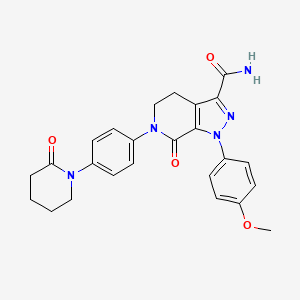
Overview
Apixaban is a small-molecule, direct oral anticoagulant (DOAC) that acts as a selective inhibitor of coagulation Factor Xa, a serine protease central to both the intrinsic and extrinsic pathways of the coagulation cascade. By blocking Factor Xa, apixaban prevents the conversion of prothrombin to thrombin, thereby inhibiting fibrin clot formation without requiring routine laboratory monitoring or dietary restrictions — features that distinguish it from vitamin K antagonists such as warfarin. It is administered orally, reaches peak plasma concentrations within approximately three to four hours, and is partially eliminated via renal excretion, a pharmacokinetic property that carries clinical significance in patients with chronic renal insufficiency or end-stage kidney disease.
Apixaban is approved for a range of thromboembolic indications, including stroke prevention in non-valvular atrial fibrillation (NVAF), treatment and secondary prevention of deep vein thrombosis (DVT) and pulmonary embolism (PE), and thromboprophylaxis following orthopedic surgery. Its favorable efficacy and safety profile relative to other anticoagulants — including warfarin, dabigatran, edoxaban, and rivaroxaban — has driven its widespread adoption in clinical practice and made it a central subject of comparative effectiveness and health economics research. Interest in apixaban expanded further during and after the COVID-19 pandemic, as the pandemic highlighted the clinical burden of thromboembolic complications across diverse patient populations.
Recent Publications Summary
Recent work on apixaban spans real-world safety in surgical and renal populations, head-to-head comparisons with aspirin, economic evaluation, and analytical monitoring methods. Bariatric surgery has emerged as a notable focus for extended thromboprophylaxis: a single-centre retrospective cohort at a high-volume tertiary centre evaluated the safety of apixaban for post-discharge VTE prophylaxis after bariatric surgery, motivated by the unresolved question of optimal post-discharge chemoprophylaxis and the still-evolving real-world safety data in this population 42250128Jun. A related evaluation compared apixaban 2.5 mg twice daily against weight-based enoxaparin (40 mg or 60 mg twice daily) given for 30 days after discharge following sleeve gastrectomy, in a program where direct oral anticoagulants are offered to patients who cannot tolerate or obtain enoxaparin 41813545Mar.
In atrial fibrillation, dosing fidelity and patient selection dominate. A heart failure registry analysis of patients with nonvalvular AF and end-stage kidney disease treated between 2018 and 2024 examined how frequently clinicians deviate from guideline-recommended dosing based on kidney function: among 480 patients, 265 (55.2%, mean age 77.3 ± 10.1 years) received an off-label underdose, with CHA2DS2-VASc and HAS-BLED scores similar across dose groups. Over a median follow-up of 48 months, no significant differences in systemic thromboembolic events or mortality were observed between the off-label underdose group and the comparator 42216360May. Apixaban has also been assessed against aspirin rather than against other anticoagulants: a bleeding-endpoint comparison within the ARCADIA trial addressed the unresolved relative hemorrhage risk of the two agents 41741942Feb, and a subgroup analysis of ARTESiA examined apixaban versus aspirin for stroke prevention specifically in patients whose subclinical atrial fibrillation was detected by an implantable cardiac monitor, as distinct from those with a pacemaker or implantable cardioverter-defibrillator 40752875Aug.
Beyond clinical outcomes, two studies address the system-level and technical infrastructure surrounding apixaban use. A cost-effectiveness analysis from the Belgian payer perspective compared apixaban with warfarin, dabigatran, edoxaban, and rivaroxaban for non-valvular atrial fibrillation, reflecting guideline preference for DOACs over vitamin K antagonists for stroke and systemic embolism prevention 42223336Jun. On the reversal side, an analysis using the OpenPrescribing Hospitals platform reported trends and variation in andexanet alfa uptake across NHS trusts in England, following the 2021 NICE recommendation for life-threatening gastrointestinal bleeding in patients taking apixaban or rivaroxaban and NICE's January 2025 inability to make a recommendation for intracranial haemorrhage — against a background of highly variable local hospital protocols 41406988Dec.
Analytical chemistry work supports therapeutic monitoring in the perioperative setting. A magnetic dispersive solid-phase extraction method using an Fe3O4@carbon nano-onion@molecularly imprinted polymer sorbent, coupled with high-performance liquid chromatography–tandem mass spectrometry, was developed and validated to quantify apixaban in plasma from patients undergoing hip fracture surgery, where measuring drug concentration may help prevent adverse clinical effects around surgery 41932170Apr.
What Changes, What Holds
1. Post-discharge apixaban is becoming a plausible bariatric-surgery prophylaxis option, but the evidence remains local and comparative practice is unsettled
NEW DIRECTION Bariatric surgery is a new use-case beyond the Overview’s established thromboembolic indications, so this does not revise apixaban’s core role but extends it into a setting where post-discharge VTE prevention is still being worked out 42250128Jun41813545Mar. The practical implication is that apixaban may be considered when extended prophylaxis is needed after bariatric procedures, yet the real-world safety and optimal comparator strategy remain insufficiently settled for broad generalization.
2. Kidney failure and atrial fibrillation dosing may be less straightforward than guidelines imply, and aspirin remains an active comparator for stroke prevention
NEW DIRECTION Apixaban’s established use in non-valvular AF stands, but these data highlight a dosing and selection problem in end-stage kidney disease that the Overview only flags as pharmacokinetically important, not clinically resolved 42216360May. The off-label underdosing signal suggests practice variation may be common without obvious short-term harm, while the aspirin comparisons keep open whether apixaban’s advantage is uniform across device-detected or subclinical AF populations 41741942Feb40752875Aug.
3. Economic value and reversal infrastructure now matter as much as efficacy when apixaban is used at scale
METHOD The Belgian cost-effectiveness analysis and the NHS uptake study do not change what apixaban is, but they sharpen how it is evaluated and supported in practice 42223336Jun41406988Dec. Together they show that comparative value against other DOACs and warfarin, plus access to andexanet alfa for major bleeding, are now part of the operational context of apixaban use. That adds system-level evidence without displacing the Overview’s clinical efficacy account.
4. Perioperative apixaban measurement is moving toward more practical laboratory monitoring
METHOD Analytical work on plasma quantification in hip fracture surgery changes the measurement toolkit rather than the drug’s therapeutic role 41932170Apr. The significance is that perioperative management may increasingly rely on validated concentration assays when timing, bleeding risk, or urgent surgery make drug exposure relevant. This supports a more instrumented approach to apixaban handling around operations, but it does not alter the Overview’s statement that routine monitoring is generally unnecessary.
Overview update candidates: bariatric-surgery post-discharge prophylaxis as a plausible new use-case; clinically important dosing uncertainty in end-stage kidney disease with AF; perioperative concentration measurement methods for apixaban.
apixaban
Background Contexts
In the literature, the biological baseline, pathological conditions, or disease models commonly surrounding apixaban are described as follows:
- rivaroxaban (Therapy) — 2 papers: PMIDs 42397147, 42332398
- venous thromboembolism (Disease) — 2 papers: PMIDs 42397147, 42250128
- Artesia (Other) — 1 paper: PMIDs 40752875
- bariatric surgery (Other) — 1 paper: PMIDs 42250128
- coagulation factor X (Protein) — 1 paper: PMIDs 42332398
- dabigatran (Therapy) — 1 paper: PMIDs 42397147
- edoxaban (Therapy) — 1 paper: PMIDs 42397147
- end stage renal failure (Disease) — 1 paper: PMIDs 42216360
- heart failure (Disease) — 1 paper: PMIDs 42216360
- hip fracture surgery (Other) — 1 paper: PMIDs 41932170
- low molecular weight heparin (Therapy) — 1 paper: PMIDs 42397147
- National Institute for Health and Care Excellence (Other) — 1 paper: PMIDs 41406988
Methodologies & Technologies Used
Researchers utilize the following experimental methods, imaging platforms, computational models, or biological reagents to study apixaban:
- Anti-Inflammatory Drugs Remodel the Tumor Immune Environment to Enhance Immune Checkpoint Blockade Efficacy (Therapy) — 1 paper: PMIDs 42031390
- anticoagulation (Therapy) — 1 paper: PMIDs 42031390
- APX-pectin-NS (Other) — 1 paper: PMIDs 41861921
- APX-SA-NS (Other) — 1 paper: PMIDs 41861921
- ARCADIA trial (Other) — 1 paper: PMIDs 41741942
- artificial pacemaker (Therapy) — 1 paper: PMIDs 40752875
- biosimilar (Therapy) — 1 paper: PMIDs 42059345
- CHADS2 score (Clinical Metric) — 1 paper: PMIDs 42216360
- CT pulmonary angiography (Technology) — 1 paper: PMIDs 42031390
- emulsification solvent evaporation technique (Technology) — 1 paper: PMIDs 41861921
- endocrine drugs (Therapy) — 1 paper: PMIDs 42059345
- Fe3O4@carbon nano-onion@ molecularly imprinted polymer (Technology) — 1 paper: PMIDs 41932170
Molecular Interventions & Targets
The primary molecular pathways, regulatory genes, enzymes, or therapeutic agents actively targeted and manipulated in relation to apixaban include:
- andexanet alfa (Therapy) — 2 papers: PMIDs 42332398, 41406988
- aspirin (Therapy) — 2 papers: PMIDs 41741942, 40752875
- rivaroxaban (Therapy) — 2 papers: PMIDs 42223336, 41406988
- dabigatran (Therapy) — 1 paper: PMIDs 42223336
- edoxaban (Therapy) — 1 paper: PMIDs 42223336
- enoxaparin (Therapy) — 1 paper: PMIDs 41813545
- hypoalbuminaemia (Clinical Metric) — 1 paper: PMIDs 42031390
- intracranial hemorrhage (Other) — 1 paper: PMIDs 41406988
- oral marketed tablet Apixatrack (Therapy) — 1 paper: PMIDs 41861921
- phospholipase A2 receptor-positive membranous nephropathy (Disease) — 1 paper: PMIDs 42031390
- proteinuria (Clinical Metric) — 1 paper: PMIDs 42031390
- rac-warfarin (Therapy) — 1 paper: PMIDs 42223336
Observed Outcomes & Phenotypes
The phenotypic changes, physiological endpoints, or clinical metrics observed and measured in connection with apixaban include:
- $190.5 billion (Clinical Metric) — 1 paper: PMIDs 42059345
- $42.9 billion (Clinical Metric) — 1 paper: PMIDs 42059345
- $915.2 billion (Clinical Metric) — 1 paper: PMIDs 42059345
- 265 patients (Other) — 1 paper: PMIDs 42216360
- 48 months (Other) — 1 paper: PMIDs 42216360
- 480 patients (Other) — 1 paper: PMIDs 42216360
- abdominal venous thromboses (Disease) — 1 paper: PMIDs 42031390
- acceptable precision (Clinical Metric) — 1 paper: PMIDs 41932170
- acute kidney injury (Disease) — 1 paper: PMIDs 42031390
- All-cause mortality (Clinical Metric) — 1 paper: PMIDs 42216360
- APX-pectin-MNs (Other) — 1 paper: PMIDs 41861921
- APX-SA-MNs (Other) — 1 paper: PMIDs 41861921
General Takeaways & Clinical Potentials
The high-level concepts, clinical translations, and overarching conclusions proposed in the research surrounding apixaban are summarized below:
- 10.0% to 12.0% (Clinical Metric) — 1 paper: PMIDs 42059345
- 14.0%-16.0% (Clinical Metric) — 1 paper: PMIDs 42059345
- 4.0%-6.0% (Clinical Metric) — 1 paper: PMIDs 42059345
- Asian populations (Organism) — 1 paper: PMIDs 42216360
- enhanced drug efficacy (Other) — 1 paper: PMIDs 41861921
- increased patient compliance (Other) — 1 paper: PMIDs 41861921
- larger clinical validation (Other) — 1 paper: PMIDs 41932170
- lower dosing frequency (Other) — 1 paper: PMIDs 41861921
- nephrology and haematology follow-up (Clinical Metric) — 1 paper: PMIDs 42031390
- urine protein testing (Clinical Metric) — 1 paper: PMIDs 42031390