amoxicillin
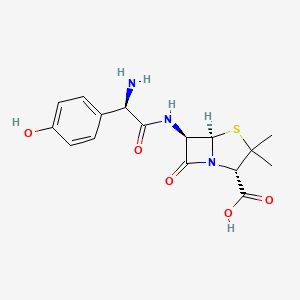
Overview
Amoxicillin is a widely used β-lactam antibiotic in the penicillin class. It acts by inhibiting bacterial cell-wall synthesis through binding to penicillin-binding proteins, thereby impairing peptidoglycan cross-linking and leading to bacterial growth inhibition and cell death in susceptible organisms. Clinically, it is used for a range of bacterial infections, and its role in therapy is often considered alongside related agents such as amoxicillin-clavulanate, cefiderocol, and ceftazidime-avibactam when resistance patterns or infection severity influence antibiotic selection.
Beyond its established antimicrobial use, amoxicillin has also been studied as a biologically active exposure in developmental and environmental contexts. Recent work has examined its effects on dental enamel formation, where it was considered alongside fluoride, calcium, and vitamin D in a rat incisor model. Other studies have used amoxicillin as a model compound in analytical chemistry and environmental monitoring, reflecting its relevance as both a pharmaceutical and a contaminant of interest.
Recent Publications Summary
Recent clinical trials have evaluated amoxicillin in combination therapies for bacterial infections. In the treatment of Helicobacter pylori infection, a 14-day dual therapy regimen of amoxicillin combined with either keverprazan or esomeprazole was assessed in a prospective, multicenter randomized controlled trial; keverprazan-amoxicillin achieved eradication rates of 87.9% to 93.5% depending on analysis type, compared to 80.3% to 88.3% for esomeprazole-amoxicillin, with non-inferiority confirmed 42572417Aug. Amoxicillin and amoxicillin-clavulanate remain first-line treatment options recommended by clinical guidelines for acute otitis media in children, with prescribing rates of approximately 80% documented across pediatric hospital populations 42036512Apr. For acute sinusitis in adults, clinical practice has not yet established consensus regarding whether amoxicillin or amoxicillin-clavulanate should be preferred as initial therapy 41999289Apr.
Pharmacokinetic studies have investigated amoxicillin's tissue penetration in complex infections. In patients with infected diabetic foot ulcers, the achievement of adequate tissue and serum concentrations of amoxicillin-clavulanate was compared across bolus and continuous administration strategies to optimize bactericidal activity and therapeutic outcomes 42218112May.
Developmental toxicology studies have documented unintended effects of amoxicillin exposure. Combined exposure to fluoride and amoxicillin was associated with impaired enamel formation in animal models, resulting in disorganization of enamel prisms and increased apoptotic activity in ameloblasts; vitamin D and calcium supplementation were investigated as potential protective factors against these enamel alterations 42184017May.
Emerging analytical applications have employed amoxicillin as a model compound for pharmaceutical detection. Using graphene-based electrochemical sensors, amoxicillin was detected in water at sub-ppb sensitivity levels, demonstrating the applicability of hydrogen peroxide-assisted redox mediation coupled with chronoamperometric detection for quantifying pharmaceutical contaminants in aquatic systems 42060697Apr.
What Changes, What Holds
1. Keverprazan establishes a novel dual-therapy role for amoxicillin in H. pylori eradication
NEW DIRECTION Keverprazan is a previously untested combination partner for amoxicillin not discussed in the Overview 42572417Aug, achieving competitive H. pylori eradication rates. First-line status for acute otitis media stands established, whereas acute sinusitis therapy remains without consensus guidance.
2. Amoxicillin-clavulanate efficacy in diabetic foot ulcers depends critically on infusion strategy
NEW DIRECTION Bolus and continuous infusion routes achieve distinct tissue and serum concentration profiles 42218112May, establishing a previously unspecified pharmacokinetic optimization parameter for complex wound infection. The Overview's general discussion of amoxicillin-clavulanate use does not address this specific indication or the optimization dimension this work reveals.
3. Combined fluoride-amoxicillin exposure damages developing enamel through specific cellular mechanisms
NEW DIRECTION Enamel prism disorganization and enhanced ameloblast apoptosis are now documented mechanisms of harm in co-exposure models 42184017May. The Overview notes only that amoxicillin affects enamel and is studied in developmental contexts, without characterizing the nature or mechanisms of those effects.
4. Graphene electrochemical sensing achieves sub-ppb detection of amoxicillin in environmental samples
METHOD Graphene-based electrodes with hydrogen peroxide-assisted chronoamperometric detection attain picomolar-scale sensitivity for pharmaceutical residue quantification 42060697Apr. The Overview already identifies amoxicillin's role in environmental monitoring applications; this work advances the analytical measurement platform and detection sensitivity available for that purpose.
Overview update candidates: H. pylori eradication with keverprazan-amoxicillin; amoxicillin-clavulanate tissue penetration optimization in diabetic foot ulcers; fluoride-amoxicillin co-exposure harm mechanisms.
amoxicillin
Background Contexts
In the literature, the biological baseline, pathological conditions, or disease models commonly surrounding amoxicillin are described as follows:
- antibiotic (Therapy) — 2 papers: PMIDs 42218112, 42214386
- 1,3,4-Oxadiazole (Chemical) — 1 paper: PMIDs 41733769
- Acute Otitis Media (Disease) — 1 paper: PMIDs 42036512
- Acute Sinusitis (Disease) — 1 paper: PMIDs 41999289
- ameloblast (Cellular Component) — 1 paper: PMIDs 42184017
- antimicrobial therapy (Therapy) — 1 paper: PMIDs 41837616
- bacterial resistance (Biological Process) — 1 paper: PMIDs 41733769
- Chinese Population (Organism) — 1 paper: PMIDs 42572417
- contaminants of emerging concern (Other) — 1 paper: PMIDs 42060697
- diabetic foot ulcer (Disease) — 1 paper: PMIDs 42218112
- Escherichia coli (Organism) — 1 paper: PMIDs 41733769
- Haemophilus influenzae type b (Disease) — 1 paper: PMIDs 42446531
Methodologies & Technologies Used
Researchers utilize the following experimental methods, imaging platforms, computational models, or biological reagents to study amoxicillin:
- 13carbon nuclear magnetic resonance spectroscopy (Technology) — 1 paper: PMIDs 41733769
- ADME analysis (Technology) — 1 paper: PMIDs 41733769
- autologous fecal microbiota transplantation (FMT) (Technology) — 1 paper: PMIDs 42214386
- bolus administration (Technology) — 1 paper: PMIDs 42218112
- ceftriaxone (Therapy) — 1 paper: PMIDs 42446531
- clindamycin (Therapy) — 1 paper: PMIDs 42446531
- clinical trial data (Technology) — 1 paper: PMIDs 42214386
- continuous administration (Technology) — 1 paper: PMIDs 42218112
- culture-enriched metagenomic populations (Other) — 1 paper: PMIDs 41837616
- electro-Fenton (Technology) — 1 paper: PMIDs 42060697
- Elemental microanalysis (Technology) — 1 paper: PMIDs 41733769
- Hi-C-assisted resistome profiling (Technology) — 1 paper: PMIDs 42214386
Molecular Interventions & Targets
The primary molecular pathways, regulatory genes, enzymes, or therapeutic agents actively targeted and manipulated in relation to amoxicillin include:
- Amoxicillin-Clavulanate (Therapy) — 2 papers: PMIDs 42036512, 41999289
- 17β-estradiol (Chemical) — 1 paper: PMIDs 42060697
- Antibacterial Agents (Therapy) — 1 paper: PMIDs 41733769
- calcium (Chemical) — 1 paper: PMIDs 42184017
- ceftazidime (Therapy) — 1 paper: PMIDs 42218112
- ceftazidime-avibactam (Therapy) — 1 paper: PMIDs 41940815
- clavulanate (Chemical) — 1 paper: PMIDs 42218112
- Diclofenac (Therapy) — 1 paper: PMIDs 42060697
- DNA topoisomerase II alpha (Protein) — 1 paper: PMIDs 41733769
- Escherichia coli DNA gyrase (Protein) — 1 paper: PMIDs 41733769
- Escherichia coli DNA gyrase B (Protein) — 1 paper: PMIDs 41733769
- esomeprazole (Therapy) — 1 paper: PMIDs 42572417
Observed Outcomes & Phenotypes
The phenotypic changes, physiological endpoints, or clinical metrics observed and measured in connection with amoxicillin include:
- 1,240 children (Clinical Metric) — 1 paper: PMIDs 42036512
- 393 children (Other) — 1 paper: PMIDs 42036512
- 5-day course of treatment (Therapy) — 1 paper: PMIDs 42036512
- acylcarnitine (Chemical) — 1 paper: PMIDs 42214386
- Adverse Events (Other) — 1 paper: PMIDs 42572417
- Ameloblast homeostasis (Biological Process) — 1 paper: PMIDs 42184017
- Ameloblastin (Protein) — 1 paper: PMIDs 42184017
- Amelotin (Protein) — 1 paper: PMIDs 42184017
- amino acid (Chemical) — 1 paper: PMIDs 42214386
- antibacterial and bactericidal activity (Biological Process) — 1 paper: PMIDs 42218112
- antibiotic resistance genes (Gene) — 1 paper: PMIDs 42214386
- antimicrobial susceptibility (Biological Process) — 1 paper: PMIDs 41837616
General Takeaways & Clinical Potentials
The high-level concepts, clinical translations, and overarching conclusions proposed in the research surrounding amoxicillin are summarized below:
- Acid suppression (Biological Process) — 1 paper: PMIDs 42572417
- epidemiological surveillance (Other) — 1 paper: PMIDs 42446531
- Fluoride and amoxicillin administration (Chemical) — 1 paper: PMIDs 42184017
- immunodeficiency (Other) — 1 paper: PMIDs 42446531
- Indigenous populations (Other) — 1 paper: PMIDs 42446531
- non-inferiority (Other) — 1 paper: PMIDs 42572417
- P. aeruginosa infections (Disease) — 1 paper: PMIDs 41940815
- Pharmacogenomic independence (Other) — 1 paper: PMIDs 42572417
- respiratory microbiome (Other) — 1 paper: PMIDs 42214386
- total oxidizable contaminant burden (Clinical Metric) — 1 paper: PMIDs 42060697
- Trial registration (Other) — 1 paper: PMIDs 42214386
- Vitamin D and calcium supplementation (Therapy) — 1 paper: PMIDs 42184017