tofacitinib
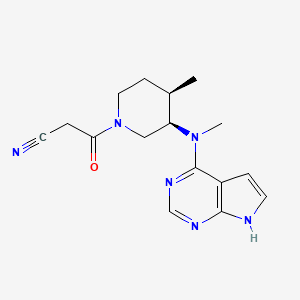
Overview
Tofacitinib is a small-molecule Janus kinase inhibitor targeting JAK1 and JAK3 with some activity against JAK2, blocking the downstream signal transducer and activator of transcription (STAT) pathways. That pairing matters mechanistically: JAK3 associates exclusively with the common gamma chain, so inhibiting the JAK1/JAK3 combination shuts down the interleukin-2, -4, -7, -9, -15 and -21 signals that drive lymphocyte activation, while residual JAK2 activity accounts for the anemia and cytopenias seen at higher exposure, since JAK2 carries erythropoietin and thrombopoietin signaling. Classified under ATC code L04, it was among the first oral JAK inhibitors approved for clinical use, a targeted immunotherapy that interrupts JAK/STAT-mediated cytokine signaling — including pathways driven by proinflammatory interleukins and interferons — suppressing the immune activation central to immune-mediated inflammatory diseases. Being a small molecule with a short half-life given twice daily, it differs practically from biologics such as adalimumab, etanercept and rituximab, which are injected, act on a single extracellular target, and persist for weeks: JAK inhibition can be stopped quickly when infection appears, but covers many cytokines at once rather than one.
It is approved for rheumatoid arthritis (RA), psoriatic arthritis and ulcerative colitis (UC), and has been investigated off-label across numerous dermatologic and inflammatory conditions, including ankylosing spondylitis. As a first-generation agent it sits alongside newer, more selective ones such as upadacitinib, baricitinib, abrocitinib and deucravacitinib.
Its safety profile has shaped the entire class. A post-authorization trial in rheumatoid arthritis patients over 50 with a cardiovascular risk factor, comparing tofacitinib against TNF inhibitors, found higher rates of major adverse cardiovascular events and malignancy — the basis of boxed warnings now applied across JAK inhibitors, alongside serious infection and thrombosis. Herpes zoster reactivation is characteristic and notably more frequent than with biologics. The findings have restricted use in many settings to patients who have failed a TNF inhibitor, and continue to drive real-world safety research.
Recent Publications Focus
Recent studies have continued to evaluate tofacitinib across inflammatory and immune-mediated diseases, with several reports focusing on alopecia areata and ulcerative colitis. In a retrospective multicenter cohort of refractory alopecia areata, tofacitinib was associated with substantial reductions in SALT scores after 12 weeks, along with eyebrow and eyelash regrowth and improvements in patient-reported outcomes; responses were stronger in severe disease and were consistent in pediatric and adult patients 42012333Apr. In another real-world cohort of long-standing alopecia areata episodes lasting at least 8 years, tofacitinib was studied alongside other JAK inhibitors, and the overall response at week 24 was limited, although a subset of patients achieved clinically meaningful hair regrowth; folliculitis and acne were the most frequent adverse events 42377046Jun. A comparative cohort study of acute versus non-acute alopecia areata also included tofacitinib and found that tofacitinib treatment was a significant predictor of super-responder status, with better outcomes observed in acute disease overall 42186168May.
In ulcerative colitis, tofacitinib remains under active real-world and trial evaluation. A multicenter real-world cohort compared tofacitinib, filgotinib, and upadacitinib in ulcerative colitis refractory or intolerant to advanced therapy, although the abstract provided does not report the comparative outcomes 42105145May. Another real-world study specifically assessed endo-histologic outcomes in ulcerative colitis patients responding to tofacitinib, reflecting the field’s shift toward deeper disease control, but the abstract does not provide the numerical results 40551084Jun. In addition, the STOPit trial is a multicentre open-label induction with randomized, double-blind, placebo-controlled maintenance study designed to determine whether tofacitinib can induce and maintain clinical remission in chronic pouchitis after ileal pouch-anal anastomosis; it includes assessment of clinical response, endoscopic healing, biomarkers, quality of life, flare rates, and safety, with open-label induction at 10 mg twice daily for 8 weeks followed by maintenance randomization among responders 42468955Jul.
Mechanistic and translational studies have also explored how tofacitinib modulates immune pathways. In inflammatory arthritis, one study examined the effects of JAK/STAT inhibition on T cell activation, polyfunctionality, proliferation, and metabolism, specifically highlighting tofacitinib as the JAK/STAT pathway inhibitor of interest 42084739May. Another study in rheumatoid arthritis macrophages found that tofacitinib downregulated GM-CSF receptor alpha expression, inhibited STAT5 signaling, reduced inflammatory and mitochondrial dysregulation, and shifted GM-CSF-reprogrammed macrophages toward a regulatory phenotype in human specimens and preclinical models 41781698Mar. These findings suggest that tofacitinib may act not only as a broad anti-inflammatory agent but also as a modulator of macrophage metabolic and mitochondrial dysfunction in rheumatoid arthritis 41781698Mar.
Additional publications addressed formulation and safety questions. A beagle dog study of a tofacitinib free base tablet found comparable systemic exposure to a marketed reference tablet despite pH-dependent dissolution differences, with bioequivalence criteria met under fasted and fed conditions 42091763May. A separate formulation study using tofacitinib as a model drug showed that organic acids in extended-release hydrophilic matrix tablets could reduce pH-dependent release to varying degrees, with effects attributed to microenvironmental pH changes as well as interactions among the acids, tofacitinib, and polymers 42002148Apr. On the safety side, a multinational cohort of skin immune-mediated inflammatory diseases that included tofacitinib among several JAK inhibitors found no increased 2-year risk of mortality, major adverse cardiovascular events, venous thromboembolism, or malignancy compared with conventional immunomodulators 41830903Mar.
What Changes, What Holds
1. Tofacitinib now has a stronger but still mixed signal in alopecia areata, with better responses in acute disease and severe cases
NEW DIRECTION These reports extend the drug beyond the Overview’s listed immune-mediated indications by supporting a clinically meaningful role in alopecia areata, but they do not overturn the established account of broad JAK inhibition. The main implication is that response may depend on disease chronicity and severity, with pediatric and adult patients both represented. The long-duration cohort tempers enthusiasm by showing limited overall benefit in very chronic disease 42012333Apr42377046Jun42186168May.
2. Tofacitinib’s ulcerative colitis use is moving toward deeper and more specialized outcome assessment, not a new indication
REINFORCES These studies do not change the baseline claim that tofacitinib is an approved ulcerative colitis therapy; instead, they show that current work is refining how success is judged, including endo-histologic control and comparative positioning against other advanced therapies. The pouchitis trial is the most notable extension, but it still sits within the drug’s established anti-inflammatory role rather than displacing it. What remains unsettled is comparative effectiveness and durability in these newer settings 42105145May40551084Jun42468955Jul.
3. Tofacitinib may act on macrophage metabolic reprogramming as well as cytokine signaling
NEW DIRECTION The mechanistic work broadens the Overview’s JAK/STAT-centered account by suggesting an additional cellular effect in rheumatoid arthritis: modulation of GM-CSF-driven macrophage dysfunction, including mitochondrial and inflammatory changes. That does not contradict JAK inhibition, but it adds a more specific downstream phenotype that the baseline does not mention. The evidence is translational and preclinical, so it should be treated as hypothesis-generating until linked to clinical benefit 41781698Mar42084739May.
4. Formulation behavior and class safety signals remain compatible with the existing clinical picture
REINFORCES The tablet and release studies mainly inform how tofacitinib can be delivered and modeled, not what it does biologically, so they are methodological rather than conceptual additions. The safety cohort is more clinically relevant: it does not identify a new excess of mortality, cardiovascular events, thrombosis, or malignancy over two years, which is consistent with ongoing efforts to contextualize the boxed warnings rather than negate them. The baseline caution still stands, but these data soften the sense of inevitable short-term harm 42091763May42002148Apr41830903Mar.
Overview update candidates: alopecia areata as a supported off-label use with response variation by disease chronicity/severity; mechanistic macrophage reprogramming in rheumatoid arthritis; deeper endo-histologic assessment in ulcerative colitis and pouchitis as emerging clinical contexts.
tofacitinib
Background Contexts
In the literature, the biological baseline, pathological conditions, or disease models commonly surrounding tofacitinib are described as follows:
- alopecia areata (Disease) — 4 papers: PMIDs 42377046, 42186168, 42012333, 41830903
- rheumatoid arthritis (Disease) — 4 papers: PMIDs 42062075, 42053669, 41781698, 41263666
- ulcerative colitis (Disease) — 4 papers: PMIDs 42105145, 41786642, 41263666, 40551084
- anti-IL6R (Protein) — 1 paper: PMIDs 41781698
- anti-TNFi (Therapy) — 1 paper: PMIDs 41781698
- Atopic diseases (Disease) — 1 paper: PMIDs 41830903
- chronic pouchitis (Disease) — 1 paper: PMIDs 42468955
- Csf2 (Gene) — 1 paper: PMIDs 41781698
- cytokine-mediated signaling pathway (Biological Process) — 1 paper: PMIDs 41263666
- glycolysis-derived ATP (Biological Process) — 1 paper: PMIDs 41781698
- GM-CSF-Ms (Protein) — 1 paper: PMIDs 41781698
- GM-CSFRα (Protein) — 1 paper: PMIDs 41781698
Methodologies & Technologies Used
Researchers utilize the following experimental methods, imaging platforms, computational models, or biological reagents to study tofacitinib:
- 24 Weeks (Other) — 1 paper: PMIDs 42468955
- 72 patients (Other) — 1 paper: PMIDs 42468955
- ATC code L04 (Therapy) — 1 paper: PMIDs 41263666
- Beagle dogs (Organism) — 1 paper: PMIDs 42091763
- cardiometabolic risk factors (Other) — 1 paper: PMIDs 41830903
- Certolizumab (Therapy) — 1 paper: PMIDs 42053669
- DLQI/CDLQI (Clinical Metric) — 1 paper: PMIDs 42012333
- etanercept (Therapy) — 1 paper: PMIDs 42053669
- filgotinib (Therapy) — 1 paper: PMIDs 41786642
- folic acid (FA) (Chemical) — 1 paper: PMIDs 42062075
- four-point eyebrow and eyelash scales (Clinical Metric) — 1 paper: PMIDs 42012333
- high-dose corticosteroids (Therapy) — 1 paper: PMIDs 41263666
Molecular Interventions & Targets
The primary molecular pathways, regulatory genes, enzymes, or therapeutic agents actively targeted and manipulated in relation to tofacitinib include:
- Janus kinase inhibitors (Therapy) — 3 papers: PMIDs 42186168, 41830903, 41786642
- Ritlecitinib (Therapy) — 3 papers: PMIDs 42377046, 42186168, 41830903
- upadacitinib (Therapy) — 3 papers: PMIDs 42105145, 41830903, 41263666
- baricitinib (Therapy) — 2 papers: PMIDs 42377046, 41830903
- abrocitinib (Therapy) — 1 paper: PMIDs 41830903
- adalimumab (Therapy) — 1 paper: PMIDs 42053669
- conventional immunomodulators (Therapy) — 1 paper: PMIDs 41830903
- deucravacitinib (Therapy) — 1 paper: PMIDs 41830903
- filgotinib (Therapy) — 1 paper: PMIDs 42105145
- Folate receptor (Protein) — 1 paper: PMIDs 42062075
- HK2i (Gene) — 1 paper: PMIDs 41781698
- JAK/STAT pathway (Pathway) — 1 paper: PMIDs 42084739
Observed Outcomes & Phenotypes
The phenotypic changes, physiological endpoints, or clinical metrics observed and measured in connection with tofacitinib include:
- 2 years (Other) — 1 paper: PMIDs 41830903
- acne (Disease) — 1 paper: PMIDs 42377046
- acute alopecia areata (Disease) — 1 paper: PMIDs 42186168
- All-cause mortality (Clinical Metric) — 1 paper: PMIDs 41830903
- AUClast (Clinical Metric) — 1 paper: PMIDs 42091763
- biodistribution (Biological Process) — 1 paper: PMIDs 42062075
- biosafety profile (Clinical Metric) — 1 paper: PMIDs 42062075
- C3 (Protein) — 1 paper: PMIDs 42053669
- Cancers (Clinical Metric) — 1 paper: PMIDs 41830903
- clinical remission (Clinical Metric) — 1 paper: PMIDs 41786642
- DAS28-CRP (Clinical Metric) — 1 paper: PMIDs 42053669
- eating (Clinical Metric) — 1 paper: PMIDs 42091763
General Takeaways & Clinical Potentials
The high-level concepts, clinical translations, and overarching conclusions proposed in the research surrounding tofacitinib are summarized below:
- ANZCTR: 381128 (Other) — 1 paper: PMIDs 42468955
- bioequivalence criteria (Other) — 1 paper: PMIDs 42091763
- clinical translation potential (Other) — 1 paper: PMIDs 42062075
- CTN: CT-2020-CTN-04866-1 (Other) — 1 paper: PMIDs 42468955
- Dissolution (Biological Process) — 1 paper: PMIDs 42091763
- early medical intervention (Other) — 1 paper: PMIDs 42186168
- hair regrowth (Other) — 1 paper: PMIDs 42377046
- IgAN Development (Disease) — 1 paper: PMIDs 42053669
- marked reduction in metabolic activity and lesion size (Other) — 1 paper: PMIDs 42377046
- NHMRC guidelines (Other) — 1 paper: PMIDs 42468955
- Pan-JAKi Resistance (Other) — 1 paper: PMIDs 41263666
- Patient-reported outcomes (Other) — 1 paper: PMIDs 42012333