ibrutinib
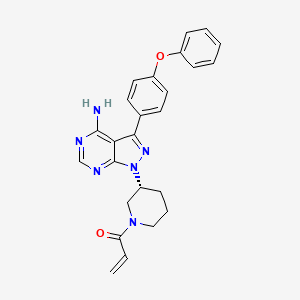
Overview
Ibrutinib is a first-in-class, orally administered small-molecule inhibitor of Bruton's tyrosine kinase (BTK), the signaling enzyme that relays B-cell receptor (BCR) engagement to downstream survival pathways. It forms an irreversible covalent bond with cysteine-481 in the ATP-binding site — with hydrogen bonding at Glu475 and Met477 — permanently silencing the kinase in each molecule it meets, so activity outlasts the drug's short plasma half-life and permits once-daily dosing. Blocking BTK cuts the survival and proliferation signals malignant B cells depend on, including flux through the PI3K/Akt signaling pathway, and also disrupts the adhesion and chemokine responses that keep those cells in protective tissue niches; the transient lymphocytosis seen on starting treatment is malignant cells being displaced into the blood rather than disease progression. Approved in 2013, it established BTK inhibition as a pillar of hematologic oncology.
Its indications span B-cell neoplasms including chronic lymphocytic leukemia (CLL), mantle cell lymphoma (MCL), Waldenström macroglobulinemia (WM) and marginal zone lymphoma (MZL). The covalent chemistry that makes it potent is also the source of its characteristic toxicity: cysteine-481 is not unique to BTK, and off-target inhibition of related kinases including EGFR, ITK and TEC family members produces the rash, diarrhea, bleeding and atrial fibrillation that limit long-term use. Next-generation covalent inhibitors such as acalabrutinib and zanubrutinib were designed for greater selectivity and carry less of that burden, which is the principal reason they have displaced ibrutinib in several settings.
Resistance most often arises by mutation of cysteine-481 itself, removing the anchor the covalent bond requires, or by activating mutations in PLCG2 downstream of the kinase — a failure mode that prompted non-covalent BTK inhibitors binding elsewhere, and BTK-directed degraders that remove the protein rather than inhibit it. Combination strategies, mechanisms of resistance and novel BTK-targeting compounds remain active areas of investigation.
New Publications Today (1)
- PMID 42598870 — Long-Term Clinical Outcomes, Adherence, Persistence, and Adverse Event Management in Patients With Chronic Lymphocytic Leukemia Treated With Ibrutinib.
Recent Publications Summary
Recent studies have demonstrated sustained clinical benefit of ibrutinib in chronic lymphocytic leukemia (CLL) across real-world and controlled trial settings. Long-term data from multicenter retrospective analysis of CLL patients treated between 2016 and 2024 documented progression-free and overall survival outcomes with assessment of treatment adherence and persistence 42598870Aug. Registry-based analysis from the German CLL Study Group showed that ibrutinib as first-line therapy achieved superior 3-year overall survival (87.9%) compared to later-line administration (73.8%) 41978941Apr. Single-cell transcriptomic profiling of CLL patients revealed distinct tumor and immunosuppressive T-cell phenotypes during ibrutinib treatment, providing insight into the cellular basis of response and resistance 42018044Apr.
Combination strategies incorporating ibrutinib have yielded improved outcomes across multiple lymphoid malignancies. In the phase 3 CLL13/GAIA trial, the combination of venetoclax-obinutuzumab-ibrutinib (GIV) achieved superior 5-year progression-free survival (81.3%) compared to venetoclax-rituximab (57.4%) and chemoimmunotherapy (50.7%), with GIV also demonstrating longer progression-free survival than venetoclax-obinutuzumab alone 41911073Mar. A phase II study of ibrutinib combined with venetoclax in relapsed/refractory CLL achieved high complete remission rates (67%) including cases with undetectable measurable residual disease at bone marrow assessment, with 7-year progression-free survival of 63.3% 41678768Feb. In mantle cell lymphoma, the TRIANGLE trial demonstrated that addition of ibrutinib to first-line immunochemotherapy improved failure-free survival in patients aged 18-65 years 42134356May. Beyond hematologic malignancies, a phase I/II study evaluated ibrutinib combined with trastuzumab in HER2-positive metastatic breast cancer, with 26 patients achieving a clinical benefit rate of 19.2%, though cardiac adverse events including decreased left ventricular ejection fraction occurred in 15% of patients 42504645Jul.
Mechanistic studies have illuminated pathways of resistance to ibrutinib and strategies to overcome them. Interleukin-16 emerged as a central mediator of non-genetic ibrutinib resistance in marginal zone lymphoma and other B-cell malignancies; IL-16 was transcriptionally upregulated in resistant cells and sufficient to induce cross-resistance across multiple lymphoid entities including CLL and diffuse large B-cell lymphoma 42213644May. In DLBCL, three-dimensional bone-derived culture models revealed that extracellular matrix engagement promoted reduced drug-induced apoptosis in certain cell lines and upregulated pro-migratory chemokines, indicating microenvironment-mediated resistance mechanisms 42455448Jul. Clonal evolution patterns in Waldenström macroglobulinemia patients treated with ibrutinib monotherapy—characterized by differential tumor subclone dynamics and T-cell responses—predicted variable treatment outcomes, with development of a baseline prediction score identifying likely responders 41671559Feb. The B-cell receptor phenotype classification of large B-cell lymphoma has been proposed to predict sensitivity to ibrutinib 42373252Jun.
Adverse event profiles and comparative safety data continue to inform clinical decision-making. A large propensity-matched real-world analysis comparing cardiovascular outcomes between zanubrutinib and ibrutinib in over 3,400 matched pairs with B-cell malignancies identified ibrutinib-associated cardiovascular toxicities including atrial fibrillation/flutter and bleeding 42086088May. Long-term monitoring of CLL patients underscored management of adverse events as an important component of treatment persistence 42598870Aug. To improve therapeutic delivery and potentially reduce systemic toxicity, novel pH-sensitive liposomal formulations of ibrutinib for intranasal nose-to-brain delivery were developed to enhance bioavailability and brain penetration in glioblastoma 42184887May. Cost-effectiveness analysis from South Africa's healthcare perspective evaluated ibrutinib alongside other Bruton tyrosine kinase inhibitors including acalabrutinib and zanubrutinib for CLL treatment 41739322Feb.
What Changes, What Holds
1. First-line administration produces superior survival to later-line use
NEW DIRECTION Whether ibrutinib is administered as initial or later therapy fundamentally affects long-term outcomes 41978941Apr, establishing that sequencing within the disease course is as important as the indication itself—a clinical variable the Overview does not address. Real-world adherence patterns 42598870Aug further show that sustained treatment tolerance determines whether patients achieve these long-term benefits, positioning ibrutinib not as a one-time intervention but as one requiring continuous engagement throughout the disease course.
2. Ibrutinib extends beyond B-cell malignancies to HER2-positive metastatic breast cancer
NEW DIRECTION Ibrutinib demonstrates activity in HER2-positive breast cancer combined with trastuzumab 42504645Jul, extending the drug to solid tumors entirely absent from the Overview's hematologic scope. Benefit was modest (19.2%), yet cardiac toxicity emerged in 15% of patients, indicating that off-target effects may intensify outside ibrutinib's established lymphoid context. Whether this limited solid-tumor activity justifies the cardiac risk remains unresolved.
3. Non-genetic resistance via interleukin-16 and microenvironment mechanisms drives ibrutinib failure beyond cysteine-481 mutation
NEW DIRECTION IL-16 upregulation confers cross-resistance in CLL and DLBCL 42213644May, while bone-derived microenvironment similarly enables treatment evasion 42455448Jul. These non-genetic mechanisms—absent from the Overview's account—now rival cysteine-481 and PLCG2 mutations as resistance determinants. Clonal evolution and T-cell dynamics further predict outcomes, suggesting resistance operates through kinase-intrinsic, transcriptional, tissue-level, and immune pathways the baseline does not integrate.
4. Intranasal liposomal ibrutinib formulation enables brain penetration for CNS applications beyond the established hematologic scope
NEW DIRECTION pH-sensitive liposomal formulations for intranasal nose-to-brain delivery 42184887May position ibrutinib for glioblastoma, a CNS application entirely absent from the Overview's hematologic focus. Established cardiovascular toxicities remain confirmed in long-term monitoring and comparative safety analyses, reinforcing rather than revising the known adverse-event profile. This formulation innovation thus marks the first step toward expanding ibrutinib's therapeutic scope beyond hematologic malignancies.
Overview update candidates: first-line administration efficacy and IL-16-mediated non-genetic resistance mechanisms.
ibrutinib
Background Contexts
In the literature, the biological baseline, pathological conditions, or disease models commonly surrounding ibrutinib are described as follows:
- chronic lymphocytic leukemia (Disease) — 8 papers: PMIDs 42598870, 42263669, 42018044, 41978941, etc.
- Bruton tyrosine kinase (BTK) (Protein) — 3 papers: PMIDs 42213644, 42086088, 42018044
- Bruton tyrosine kinase inhibitor (Therapy) — 2 papers: PMIDs 42581349, 42263669
- diffuse large B-cell lymphoma (Disease) — 2 papers: PMIDs 42528053, 42455448
- mantle cell lymphoma (Disease) — 2 papers: PMIDs 42581349, 42134356
- PLCG2 (Protein) — 2 papers: PMIDs 42263669, 42213644
- acquired resistance (Biological Process) — 1 paper: PMIDs 42263669
- activated B cells (Cellular Component) — 1 paper: PMIDs 42373252
- ado-trastuzumab emtansine (Therapy) — 1 paper: PMIDs 42504645
- Age (Other) — 1 paper: PMIDs 41964444
- B-cell non-Hodgkin lymphoma (Disease) — 1 paper: PMIDs 42213644
- bendamustine (Therapy) — 1 paper: PMIDs 42103972
Methodologies & Technologies Used
Researchers utilize the following experimental methods, imaging platforms, computational models, or biological reagents to study ibrutinib:
- bendamustine (Therapy) — 2 papers: PMIDs 42581349, 42046272
- chronic lymphocytic leukemia (Disease) — 2 papers: PMIDs 42213644, 42086088
- flow cytometry (Technology) — 2 papers: PMIDs 42528053, 42504645
- marginal zone B-cell lymphoma (Disease) — 2 papers: PMIDs 42213644, 42086088
- rituximab (Therapy) — 2 papers: PMIDs 42581349, 42046272
- 2D cell culture (Other) — 1 paper: PMIDs 42184887
- 3D cell culture (Other) — 1 paper: PMIDs 42184887
- 3D ECM model (Technology) — 1 paper: PMIDs 42455448
- acalabrutinib (Therapy) — 1 paper: PMIDs 41964444
- adherence (Clinical Metric) — 1 paper: PMIDs 42598870
- adverse event (Clinical Metric) — 1 paper: PMIDs 42598870
- Alternative Activated M2 Macrophages (Cellular Component) — 1 paper: PMIDs 42528053
Molecular Interventions & Targets
The primary molecular pathways, regulatory genes, enzymes, or therapeutic agents actively targeted and manipulated in relation to ibrutinib include:
- Bruton tyrosine kinase inhibitor (Therapy) — 4 papers: PMIDs 42528053, 41978941, 41974594, 41964444
- venetoclax (Therapy) — 4 papers: PMIDs 41978941, 41974594, 41911073, 41678768
- acalabrutinib (Therapy) — 3 papers: PMIDs 42103972, 41978941, 41739322
- zanubrutinib (Therapy) — 3 papers: PMIDs 42086088, 42046272, 41739322
- Bruton tyrosine kinase (BTK) (Protein) — 2 papers: PMIDs 42263669, 40886252
- Bruton's tyrosine kinase (Protein) — 2 papers: PMIDs 42184887, 42046272
- chronic lymphocytic leukemia (Disease) — 2 papers: PMIDs 42103972, 41739322
- Autologous stem cell transplantation (Therapy) — 1 paper: PMIDs 42134356
- B-cell (Cellular Component) — 1 paper: PMIDs 41687284
- B-cell receptor (Protein) — 1 paper: PMIDs 42373252
- Bruton's tyrosine kinase inhibitor (Therapy) — 1 paper: PMIDs 41739322
- CAR-T cells (Therapy) — 1 paper: PMIDs 42528053
Observed Outcomes & Phenotypes
The phenotypic changes, physiological endpoints, or clinical metrics observed and measured in connection with ibrutinib include:
- atrial fibrillation (Disease) — 2 papers: PMIDs 42086088, 41964444
- chronic lymphocytic leukemia (Disease) — 2 papers: PMIDs 42549568, 42263669
- cytotoxicity (Clinical Metric) — 2 papers: PMIDs 42528053, 42184887
- disease progression (Biological Process) — 2 papers: PMIDs 42581349, 42263669
- failure-free survival (Clinical Metric) — 2 papers: PMIDs 42581349, 42134356
- hazard ratio (Clinical Metric) — 2 papers: PMIDs 42086088, 41978941
- quality of life (Clinical Metric) — 2 papers: PMIDs 42581349, 41911073
- thrombocytopenia (Clinical Metric) — 2 papers: PMIDs 42504645, 41678768
- 10-years OS (Clinical Metric) — 1 paper: PMIDs 41911073
- 5-year overall survival (OS) (Clinical Metric) — 1 paper: PMIDs 42134356
- 7-year progression-free survival rate (Clinical Metric) — 1 paper: PMIDs 41678768
- A1/Bfl1 (Gene) — 1 paper: PMIDs 42213644
General Takeaways & Clinical Potentials
The high-level concepts, clinical translations, and overarching conclusions proposed in the research surrounding ibrutinib are summarized below:
- Bruton tyrosine kinase inhibitor (Therapy) — 2 papers: PMIDs 42528053, 42263669
- standard therapy (Therapy) — 2 papers: PMIDs 41978941, 41974594
- 24-cycle ibrutinib + venetoclax combination (Therapy) — 1 paper: PMIDs 41678768
- adherence (Clinical Metric) — 1 paper: PMIDs 42598870
- advanced disease (Other) — 1 paper: PMIDs 41978941
- adverse-event management (Other) — 1 paper: PMIDs 42598870
- Alternative Activated M2 Macrophages (Cellular Component) — 1 paper: PMIDs 42528053
- B cell immunoregulation (Biological Process) — 1 paper: PMIDs 41687284
- Bruton tyrosine kinase (BTK) (Protein) — 1 paper: PMIDs 42263669
- cancer drug discovery (Other) — 1 paper: PMIDs 40886252
- CAR-T cells (Therapy) — 1 paper: PMIDs 42528053
- cardiovascular assessments (Other) — 1 paper: PMIDs 41964444