dexmedetomidine
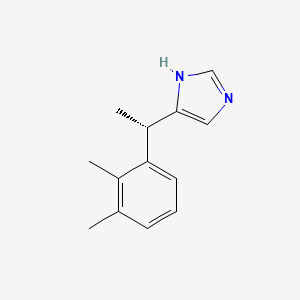
Overview
Dexmedetomidine is a highly selective and potent α2-adrenergic receptor agonist widely used as a sedative, analgesic, and anxiolytic agent in both surgical and nonsurgical clinical settings. It exerts its primary effects by binding to α2-adrenergic receptors in the central and peripheral nervous system, producing dose-dependent sedation, analgesia, and sympatholysis without causing significant respiratory depression—a property that distinguishes it from many classical sedatives. Originally approved for intravenous use in intensive care and procedural sedation, dexmedetomidine has more recently been formulated in novel delivery formats including sublingual, nasal spray, and topical ophthalmic preparations, reflecting a broader expansion of its therapeutic applications. Its pharmacological profile also encompasses anti-inflammatory and neuroprotective properties, making it a subject of increasing interest beyond the perioperative setting.
Beyond sedation, dexmedetomidine has attracted significant attention for its neuroprotective effects in acute and chronic neurological conditions. Its ability to modulate neuroinflammation, support neuronal survival signaling, and interact with metabolic regulatory pathways such as AMPK/mTOR and Sirtuin 1 (SIRT1) (SIRT1) has positioned it as a candidate therapeutic agent in models of ischemic brain injury, neonatal hypoxic-ischemic encephalopathy, and neurodegenerative diseases including Alzheimer's disease (AD). These emerging mechanistic insights are driving a wave of preclinical and clinical research aimed at characterizing the full scope of dexmedetomidine's biological activity.
Recent Publications Summary
Recent publications on dexmedetomidine span perioperative, neurologic, ophthalmic, and oncology-related applications, with several studies focused on optimizing delivery or clarifying mechanisms of action. In geriatric orthopaedic surgery, a randomized trial protocol is evaluating whether the timing of dexmedetomidine administration influences postoperative delirium after lower-limb fracture surgery, reflecting ongoing uncertainty about the best perioperative schedule despite prior evidence that dexmedetomidine may reduce delirium risk 42366003Jun. A separate multicentre randomized trial protocol is testing evening intranasal dexmedetomidine for prevention of postoperative sleep disturbance after laparoscopic cholecystectomy, based on the premise that improved sleep may reduce delirium, cognitive decline, and delayed recovery 42086269May. In esophageal endoscopic submucosal dissection, dexmedetomidine-based sedation was examined for adverse circulatory and respiratory events, underscoring safety concerns in older and comorbid patients 42026961Apr.
Several recent studies explored dexmedetomidine in neuroprotection and neurodegeneration. In neonatal hypoxic-ischemic encephalopathy, dexmedetomidine mitigated brain injury in rats, reduced inflammation and microglial M1 polarization in BV2 cells, and acted through upregulation of Rbm47; Rbm47 overexpression reproduced protective effects, whereas knockdown weakened dexmedetomidine’s benefit 42065818May. In ischemic brain injury, another study investigated cerebral protection via activation of the BDNF/TrkB pathway 42015734Apr. In Alzheimer’s disease models, dexmedetomidine was reported to reduce Aβ accumulation, suppress amyloidogenic gene expression, attenuate neuroinflammation, preserve neuronal marker integrity, and increase anti-inflammatory signaling in adult zebrafish 42082800May. Preliminary rat data also suggested protection in Alzheimer’s disease through activation of the AMPK/SIRT1 pathway, although the abstract emphasizes that efficacy in metabolically driven AD models remains under investigation 42268445Jun.
Outside neurology, dexmedetomidine was studied as a topical ophthalmic agent to prevent intraocular pressure elevation after Nd:YAG laser capsulotomy. In a prospective, double-masked randomized trial, dexmedetomidine 0.008% was compared with brimonidine 0.2% given one hour before the procedure, with serial IOP measurements through 24 hours post-laser 42192576May. In oncology, dexmedetomidine was reported to enhance cisplatin sensitivity in esophageal carcinoma cells by promoting pyroptosis through the SREBF1/miR-185-5p/Caspase-1 axis, increasing cleaved Caspase-1, GSDMD-N, IL-1β, and IL-18, and reducing cell viability and cisplatin IC50 in resistant cells 41966778Apr. A related publication also investigated dexmedetomidine as a potential adjunct in esophageal carcinoma, while another study examined adverse circulatory and respiratory events during dexmedetomidine-based sedation for esophageal endoscopic submucosal dissection 42026961Apr41966778Apr.
Additional publications addressed formulation and safety. A case report described severe hypotension after sublingual dexmedetomidine in an elderly patient, highlighting the need for caution outside clinical trials 41351540Dec. Finally, a drug-delivery study described a lattice-enhanced caramelized sucrose microneedle system designed for painless dexmedetomidine administration, with preliminary simulation data suggesting rapid drug release and improved practicality for sedative delivery 41240712Nov.
What Changes, What Holds
1. Timing and sleep remain unsettled rather than settled into a single best perioperative schedule
METHOD These protocols do not overturn dexmedetomidine’s established perioperative sedative role, but they do show that the field is still testing how and when to use it to reduce delirium and sleep disruption. The practical implication is that benefit may depend on timing, route, and patient risk profile, so the current account should stay cautious rather than implying an optimized standard regimen 42366003Jun42086269May.
2. Neuroprotection now looks mechanistically broader, but still preclinical
REINFORCES The new work strengthens the baseline view that dexmedetomidine can act beyond sedation in brain injury and neurodegeneration, while adding specific candidate pathways and cell-state effects. It does not displace the established neuroprotective framing; instead, it makes that framing more concrete by linking benefit to inflammatory control and survival signaling in models of neonatal injury, ischemia, and Alzheimer’s disease 42065818May42015734Apr42082800May42268445Jun.
3. Ophthalmic and oncology uses expand the drug’s scope without changing its core profile
NEW DIRECTION These studies point to roles not covered by the baseline: topical prevention of post-laser pressure rise and possible chemosensitization in esophageal carcinoma. That broadens dexmedetomidine’s therapeutic map, but it does not contradict the established sedative, analgesic, and anti-inflammatory account. The oncology signal is especially early and mechanistic, so it should be treated as hypothesis-generating rather than practice-changing 42192576May41966778Apr.
4. New delivery formats can also produce serious hemodynamic risk
NEW DIRECTION The case report adds a safety concern for sublingual use that the baseline does not address: dexmedetomidine can cause severe hypotension outside the usual monitored settings. That does not negate its known clinical utility, but it does mean newer formulations should not be assumed to inherit the same safety margin as standard intravenous use. The microneedle delivery concept remains preliminary and mainly shows feasibility rather than established clinical advantage 41351540Dec41240712Nov.
Overview update candidates: mechanistic refinement of neuroprotection; ophthalmic use to blunt post-laser intraocular pressure rise; potential chemosensitization in esophageal carcinoma; severe hypotension with sublingual administration.
dexmedetomidine
Background Contexts
In the literature, the biological baseline, pathological conditions, or disease models commonly surrounding dexmedetomidine are described as follows:
- Alzheimer's disease (Disease) — 2 papers: PMIDs 42268445, 42082800
- bipolar mania (Disease) — 1 paper: PMIDs 41351540
- Cerebral ischemia-reperfusion injury (Disease) — 1 paper: PMIDs 42015734
- Circulatory and Respiratory Systems (Other) — 1 paper: PMIDs 42026961
- Elderly Patients (Other) — 1 paper: PMIDs 42026961
- esophageal squamous cell carcinoma (Disease) — 1 paper: PMIDs 42026961
- Hypopharyngeal and esophageal squamous cell carcinoma (Disease) — 1 paper: PMIDs 41966778
- laparoscopic cholecystectomy (Other) — 1 paper: PMIDs 42086269
- neonatal hypoxic-ischemic encephalopathy (Disease) — 1 paper: PMIDs 42065818
- optimized sedative delivery system (Other) — 1 paper: PMIDs 41240712
- pediatric patients aged 6 months to 5 years (Organism) — 1 paper: PMIDs 41240712
- Posterior Capsule Opacification (Disease) — 1 paper: PMIDs 42192576
Methodologies & Technologies Used
Researchers utilize the following experimental methods, imaging platforms, computational models, or biological reagents to study dexmedetomidine:
- 1-acyl-sn-glycero-3-phosphoserine (Other) — 1 paper: PMIDs 42065818
- Adenovirus (Disease) — 1 paper: PMIDs 42065818
- adult zebrafish (Organism) — 1 paper: PMIDs 42082800
- AIF1 (Protein) — 1 paper: PMIDs 42065818
- Beta amyloid (Protein) — 1 paper: PMIDs 42082800
- BV2 Murine Microglial Cells (Cell Line) — 1 paper: PMIDs 42065818
- caramelization process (Biological Process) — 1 paper: PMIDs 41240712
- caramelized amorphous sucrose-based lunging microneedle array (CALM) (Technology) — 1 paper: PMIDs 41240712
- clinical simulations (Other) — 1 paper: PMIDs 41240712
- Differential scanning fluorimetry (Therapy) — 1 paper: PMIDs 41966778
- endoscopic submucosal dissection (Technology) — 1 paper: PMIDs 42026961
- hypoxia-ischemia (Biological Process) — 1 paper: PMIDs 42065818
Molecular Interventions & Targets
The primary molecular pathways, regulatory genes, enzymes, or therapeutic agents actively targeted and manipulated in relation to dexmedetomidine include:
- AMPK/mTOR (Pathway) — 1 paper: PMIDs 42268445
- Beta amyloid (Protein) — 1 paper: PMIDs 42082800
- Brain derived neurotrophic factor (Protein) — 1 paper: PMIDs 42015734
- brimonidine (Therapy) — 1 paper: PMIDs 42192576
- CASP1 (Protein) — 1 paper: PMIDs 41966778
- cisplatin/fluorouracil (Therapy) — 1 paper: PMIDs 41966778
- miR-185-5p (Gene) — 1 paper: PMIDs 41966778
- neurotrophic receptor tyrosine kinase 2 (Protein) — 1 paper: PMIDs 42015734
- RBM47 (Gene) — 1 paper: PMIDs 42065818
- sirtuin 1 (Protein) — 1 paper: PMIDs 42268445
- Srebf1 (Gene) — 1 paper: PMIDs 41966778
- β2 adrenergic receptor (Protein) — 1 paper: PMIDs 41240712
Observed Outcomes & Phenotypes
The phenotypic changes, physiological endpoints, or clinical metrics observed and measured in connection with dexmedetomidine include:
- amyloidogenic pathway-related genes (Gene) — 1 paper: PMIDs 42082800
- anxiety- and aggression-like behaviors (Biological Process) — 1 paper: PMIDs 42082800
- brain injury (Other) — 1 paper: PMIDs 42065818
- cerebral infarction (Clinical Metric) — 1 paper: PMIDs 42065818
- chemosensitivity (Clinical Metric) — 1 paper: PMIDs 41966778
- cleaved-caspase-1 (Protein) — 1 paper: PMIDs 41966778
- Complications/AEs (Other) — 1 paper: PMIDs 42026961
- Convenient Administration (Other) — 1 paper: PMIDs 42086269
- Death executioner caspase related to Apopain/Yama Dmel_CG14902 (Protein) — 1 paper: PMIDs 42082800
- GSDMD-N (Protein) — 1 paper: PMIDs 41966778
- High Bioavailability (Other) — 1 paper: PMIDs 42086269
- HuC/D (Protein) — 1 paper: PMIDs 42082800
General Takeaways & Clinical Potentials
The high-level concepts, clinical translations, and overarching conclusions proposed in the research surrounding dexmedetomidine are summarized below:
- clinically available agent (Other) — 1 paper: PMIDs 42082800
- Efficacy of dexmedetomidine (Other) — 1 paper: PMIDs 42192576
- further studies (Other) — 1 paper: PMIDs 42192576
- Limited Data (Other) — 1 paper: PMIDs 42026961
- multi-level effects of DEX (Other) — 1 paper: PMIDs 42082800
- patient-friendly option (Other) — 1 paper: PMIDs 41240712
- preclinical studies in mammalian models (Other) — 1 paper: PMIDs 42082800
- protective effects of Dex (Therapy) — 1 paper: PMIDs 42065818
- SREBF1/miR-185-5p/Caspase-1 axis (Pathway) — 1 paper: PMIDs 41966778
- vulnerable population (Other) — 1 paper: PMIDs 41240712