dasatinib
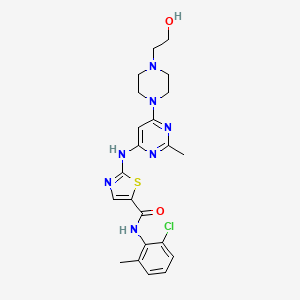
Overview
Dasatinib is a second-generation, orally bioavailable tyrosine kinase inhibitor (TKI) developed primarily for the treatment of chronic myeloid leukemia (CML) and Philadelphia chromosome-positive acute lymphoblastic leukemia (Ph+ ALL). It exerts its anticancer effects by potently inhibiting BCR-ABL1, the constitutively active fusion kinase that drives CML pathogenesis, as well as a broad spectrum of additional kinases including SRC-family kinases, c-KIT, PDGFR, and ephrin receptors. This multitarget profile distinguishes dasatinib from first-generation TKIs such as imatinib and underpins both its enhanced potency against BCR-ABL1 mutations and its broader applicability across multiple tumor types. Dasatinib binds BCR-ABL1 in both its active and inactive conformations, giving it activity against many imatinib-resistant mutants. Its inhibition of SRC-family kinases is particularly relevant beyond CML, as SRC-mediated compensatory signaling is a recognized resistance mechanism in non-small cell lung cancer and other solid tumors.
Despite its clinical efficacy, dasatinib carries a well-characterized toxicity profile that includes pleural effusions, pulmonary arterial hypertension, and cardiopulmonary complications. Dose optimization has therefore become a central research question in CML management, aiming to preserve therapeutic depth of response while mitigating adverse effects and reducing treatment cost. Emerging evidence also positions dasatinib as a candidate agent in several solid tumor contexts, including triple-negative breast cancer (TNBC) and pediatric diffuse intrinsic pontine glioma (DIPG), reflecting the broad oncological relevance of its kinase inhibition profile.
Recent Publications Summary
Recent publications have examined dasatinib across both oncology and non-oncology contexts, with several studies focusing on its effects as a tyrosine-kinase inhibitor and senolytic agent. In chronic myeloid leukemia, a German real-world claims analysis found that proton pump inhibitor co-medication around dasatinib initiation was associated with earlier treatment switching, consistent with the pH-dependent absorption and reduced exposure of dasatinib 42530652Jul. Another retrospective cohort study of chronic- and accelerated-phase chronic myeloid leukemia reported that first-line dasatinib was used in 30% of patients and provided longitudinal outcome data, including a five-year overall survival of 78% in the dasatinib group 42455913Jul. A prospective cohort study comparing response-adapted dasatinib de-escalation after an initial standard dose versus upfront low-dose dasatinib found faster early molecular responses and fewer discontinuations in the de-escalation strategy, while longer-term molecular response rates were more comparable 41932299Apr. In addition, echocardiographic assessment of patients with chronic myeloid leukemia on dasatinib was reported in the context of its known cardiopulmonary toxicities 42206579May.
Mechanistic and translational studies further characterized dasatinib-related effects on immune cells and the tumor microenvironment. One report showed that dasatinib reversibly disrupted T cell motility and activation in lymph nodes, with in vivo inhibition of T and B cell motility linked to vasoconstriction, reduced blood flow, and increased lymph node hypoxia; ROCK inhibition reversed the hypoxia and rescued CD8+ T cell motility 42555708Aug. Another transporter-focused study found that dasatinib, like imatinib, is a substrate of both P-glycoprotein and BCRP, and that it functions as a weak P-gp inhibitor but is less effective against BCRP than several other chronic myeloid leukemia TKIs 42118353May. In diffuse intrinsic pontine glioma, dasatinib was one of three targeted agents tested with radiotherapy in the randomized phase 2 BIOMEDE trial, which did not show an overall survival benefit over the control cohort 42032072Apr.
Outside leukemia, dasatinib has also been studied in senescence-targeting strategies. In mouse and human sickle cell disease samples, senescence-targeting therapy with dasatinib plus quercetin reversed impaired hematopoietic stem and progenitor cell function 42485438Jul. In a preclinical anterior cruciate ligament injury model, the dasatinib and quercetin combination reduced senescent cell burden and mitigated muscle atrophy and cartilage degradation 42348390Jun. In triple-negative breast cancer, high-throughput screening identified dasatinib as a candidate with selective activity against a true basal subtype, and treatment suppressed tumor growth in patient-derived xenograft models 41671401Feb.
What Changes, What Holds
1. proton-pump inhibitor co-medication and dose de-escalation affect how dasatinib is used, without changing its core role in CML
METHOD Dasatinib’s pH-dependent absorption becomes clinically relevant when proton pump inhibitors are co-prescribed, because reduced exposure can push patients toward earlier switching 42530652Jul. Separately, response-adapted de-escalation supports a more individualized dosing strategy: it may preserve longer-term molecular control while reducing discontinuation burden, but it does not replace standard first-line use 41932299Apr. The outcome signal in real-world cohorts also reinforces that dasatinib remains an effective frontline option in CML 42455913Jul.
2. Dasatinib has an underappreciated immunologic and pharmacokinetic footprint, while its CNS-tumor benefit remains unproven
NEW DIRECTION Dasatinib is now shown to alter lymph-node T-cell and B-cell motility through vascular and hypoxic effects, adding an immune-microenvironment role that the Overview did not cover 42555708Aug. Transporter data further clarify that drug handling is constrained by P-gp and BCRP substrate behavior, which helps explain variable exposure and resistance to intracorporeal accumulation 42118353May. By contrast, the randomized DIPG result argues against assuming benefit from this mechanism in that setting 42032072Apr.
3. Dasatinib’s senolytic and solid-tumor activity broadens its experimental scope, but these uses remain preclinical or unconfirmed clinically
NEW DIRECTION Dasatinib now has support as part of senescence-targeting strategies in non-oncology disease models, extending its relevance beyond kinase blockade in leukemia 42485438Jul42348390Jun. In TNBC, selective activity in a basal subtype and xenograft suppression suggest a more refined solid-tumor niche than the broad exploratory role already noted in the Overview 41671401Feb. None of this displaces the baseline account; it mainly adds experimental directions that still need clinical validation.
Overview update candidates: pH-dependent interactions with proton pump inhibitors may matter clinically; response-adapted dose de-escalation may preserve efficacy with fewer discontinuations; dasatinib may have immune-microenvironment effects; senolytic applications and selective TNBC activity are promising preclinical directions.
dasatinib
Background Contexts
In the literature, the biological baseline, pathological conditions, or disease models commonly surrounding dasatinib are described as follows:
- chronic myeloid leukemia (Disease) — 6 papers: PMIDs 42530652, 42455913, 42348627, 42206579, etc.
- tyrosine-kinase inhibitor (Therapy) — 2 papers: PMIDs 41874451, 41641639
- 2-Chloro-4-nitroaniline (Chemical) — 1 paper: PMIDs 42527092
- 3,5-Dichlorosalicylaldehyde (Chemical) — 1 paper: PMIDs 42527092
- ABL1 BCR::ABL (Gene) — 1 paper: PMIDs 41641639
- advanced melanoma (Disease) — 1 paper: PMIDs 42091786
- aminolevulinic acid (Chemical) — 1 paper: PMIDs 42527092
- biomarker (Other) — 1 paper: PMIDs 41895167
- BIOMEDE (Technology) — 1 paper: PMIDs 42032072
- bone marrow (Organism) — 1 paper: PMIDs 42485438
- breast cancer (Disease) — 1 paper: PMIDs 41895167
- Cancer (Disease) — 1 paper: PMIDs 42527092
Methodologies & Technologies Used
Researchers utilize the following experimental methods, imaging platforms, computational models, or biological reagents to study dasatinib:
- human (Organism) — 2 papers: PMIDs 42555708, 42485438
- machine learning (Technology) — 2 papers: PMIDs 42531731, 41895167
- molecular docking (Technology) — 2 papers: PMIDs 42531731, 41895167
- 100 mg standard dose (Therapy) — 1 paper: PMIDs 41932299
- 143 newly diagnosed chronic-phase CML patients (Organism) — 1 paper: PMIDs 41932299
- 607 drug combinations (Other) — 1 paper: PMIDs 42118752
- A549 lung epithelial cells (Cell Line) — 1 paper: PMIDs 42118752
- ADMET profiling (Technology) — 1 paper: PMIDs 41895167
- afatinib (Therapy) — 1 paper: PMIDs 41874451
- amygdala-specific astrocytic Hk2 knockdown mice (Organism) — 1 paper: PMIDs 41935525
- anterior cruciate ligament (Other) — 1 paper: PMIDs 42348390
- astrocyte-neuron serine shuttle (Pathway) — 1 paper: PMIDs 41935525
Molecular Interventions & Targets
The primary molecular pathways, regulatory genes, enzymes, or therapeutic agents actively targeted and manipulated in relation to dasatinib include:
- ATP binding cassette subfamily G member 2 (Junior blood group) (Protein) — 2 papers: PMIDs 42527092, 42118353
- bosutinib (Therapy) — 2 papers: PMIDs 42455913, 42118353
- nilotinib (Therapy) — 2 papers: PMIDs 42455913, 42118353
- quercetin (Chemical) — 2 papers: PMIDs 42485438, 42348390
- ABL1 BCR::ABL (Gene) — 1 paper: PMIDs 42455913
- asciminib (Therapy) — 1 paper: PMIDs 42118353
- asparaginase (Therapy) — 1 paper: PMIDs 41995729
- AZD4320 (Chemical) — 1 paper: PMIDs 41995729
- basal identity genes (Gene) — 1 paper: PMIDs 41671401
- basal mammary epithelial compartment (Biological Process) — 1 paper: PMIDs 41671401
- BCL-extra-large (Protein) — 1 paper: PMIDs 41995729
- BCL2 apoptosis regulator (Protein) — 1 paper: PMIDs 41995729
Observed Outcomes & Phenotypes
The phenotypic changes, physiological endpoints, or clinical metrics observed and measured in connection with dasatinib include:
- hazard ratio (Clinical Metric) — 3 papers: PMIDs 42530652, 42455913, 42032072
- apoptotic process (Biological Process) — 2 papers: PMIDs 42531731, 41995729
- T-lymphocytes (Cellular Component) — 2 papers: PMIDs 42555708, 41641639
- 4,000 × 10^9/L (Clinical Metric) — 1 paper: PMIDs 42348627
- 6 Years (Other) — 1 paper: PMIDs 42032072
- ABL1 BCR::ABL (Gene) — 1 paper: PMIDs 41932299
- Accuracy (Clinical Metric) — 1 paper: PMIDs 41895167
- Aggressive biology (Biological Process) — 1 paper: PMIDs 42531731
- AHPN (Chemical) — 1 paper: PMIDs 41895167
- ALA-PDT Sensitization (Biological Process) — 1 paper: PMIDs 42527092
- amygdaloid astrocytic senescence (Biological Process) — 1 paper: PMIDs 41935525
- Anti-inflammatory macrophage (Cellular Component) — 1 paper: PMIDs 42348390
General Takeaways & Clinical Potentials
The high-level concepts, clinical translations, and overarching conclusions proposed in the research surrounding dasatinib are summarized below:
- Adaptive Immune System (Biological Process) — 1 paper: PMIDs 42555708
- antimicrobial resistance (Other) — 1 paper: PMIDs 42118353
- Autologous Hematopoietic Stem and Progenitor Cell (Cellular Component) — 1 paper: PMIDs 42485438
- basal markers (Biological Process) — 1 paper: PMIDs 41671401
- breast cancer (Disease) — 1 paper: PMIDs 41895167
- BUB1 mitotic checkpoint serine/threonine kinase B (Gene) — 1 paper: PMIDs 41895167
- carcinogenesis (Biological Process) — 1 paper: PMIDs 41874451
- CD8-positive T cell activation pathway (Pathway) — 1 paper: PMIDs 42555708
- cellular senescence (Biological Process) — 1 paper: PMIDs 42348390
- chronic myeloid leukemia (Disease) — 1 paper: PMIDs 42530652
- ClinicalTrials.gov: NCT02233049 (Clinical Metric) — 1 paper: PMIDs 42032072
- Colorectal cancer stratification (Disease) — 1 paper: PMIDs 42531731